Facts
The petitioner-workman was issued a charge-sheet on October 12, 2012, for alleged misconduct under Certified Standing Orders
Source reference: para 3Following a domestic enquiry, he was found guilty and dismissed on October 17, 2014
Source reference: para 4-6At the time of dismissal, industrial references involving the company and the Union were pending settlement/withdrawal
Source reference: para 5The workman challenged the dismissal under Section 33A of the Industrial Disputes Act (IDA), 1947, alleging that the company failed to obtain mandatory approval under Section 33(2)(b).
Source reference: no citationWhile the Tribunal found the enquiry fair and proper [para 9], it held the termination void for lack of statutory approval but denied reinstatement, awarding ₹7,00,000 as compensation instead
Source reference: para 10Both the workman (seeking reinstatement) and the company (challenging the finding of illegal termination) filed writ petitions
Source reference: para 2Issues
1. Whether the dismissal of the workman during the period between the passing of an award and its enforceability under Section 17A constitutes a breach of Section 33(2)(b) of the IDA
Source reference: para 2, 132. Whether the lack of approval under Section 33(2)(b) necessitates automatic reinstatement or if monetary compensation in lieu of reinstatement is permissible
Source reference: para 11, 19Law Applied
The Court applied Section 33(2)(b) of the IDA, which mandates that an employer must pay one month’s wages and apply for approval when dismissing a workman during the pendency of a dispute
Source reference: para 22, 24It relied on Section 20(3) of the IDA, which deems proceedings as pending until the award becomes enforceable under Section 17A (30 days post-publication)
Source reference: para 20, 27The primary precedent was the Constitution Bench decision in Jaipur Zila Sahakari Bhoomi Vikas Bank Ltd. v. Ram Gopal Sharma, which established that a dismissal without Section 33(2)(b) approval is void ab initio and the relationship of employer-employee is deemed never to have ended
Source reference: para 19, 31It further applied Grindlays Bank Ltd. v. CGIT regarding the statutory duration of "pendency"
Source reference: para 20, 27Reasoning
The Court rejected the company’s argument that "pendency" ceases the moment a settlement is reached or a reference is withdrawn. It reasoned that Section 20(3) creates a legal fiction where proceedings continue until the award becomes enforceable, which occurs 30 days after publication; since the dismissal occurred during this statutory window, Section 33(2)(b) was triggered
Source reference: para 27-30Applying the Jaipur Zila doctrine, the Court noted that the dismissal was "inchoate" and "non est" in the eye of law because the mandatory approval was never sought
Source reference: para 32Consequently, the Tribunal’s decision to deny reinstatement was found erroneous because, legally, the workman never left service
Source reference: para 33-34The Court observed that technological changes or passage of time are insufficient grounds to override the statutory protection of continuity of service
Source reference: para 34Holding
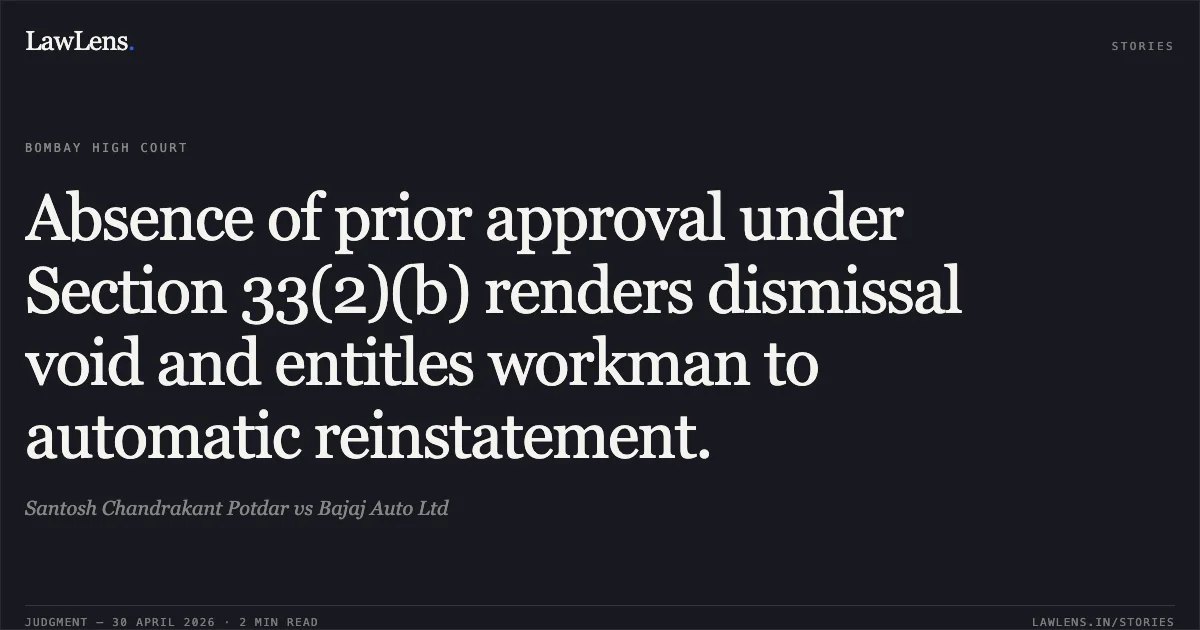
It held that the termination was void for non-compliance with Section 33(2)(b)
The Court quashed the order of compensation and directed the respondent-company to reinstate the workman with continuity of service [para 40(vi-vii)]. Regarding back wages, the Court ordered: (a) full back wages from termination until the start of his grocery business in 2016; (b) 50% back wages during the business period (2016-Covid closure); and (c) full back wages from the closure of business until actual reinstatement
Source reference: para 39, 40(viii)Acts & Sections Cited
5 provisions across 1 statute referred to in this judgment. Linked provisions open on LawLens.
Industrial Disputes Act, 19475
Original Court PDF
Santosh Chandrakant PotdarvsBajaj Auto Ltd
Click to open original judgment
Original judgment, available to read, download and summarize on LawLens.in