Facts
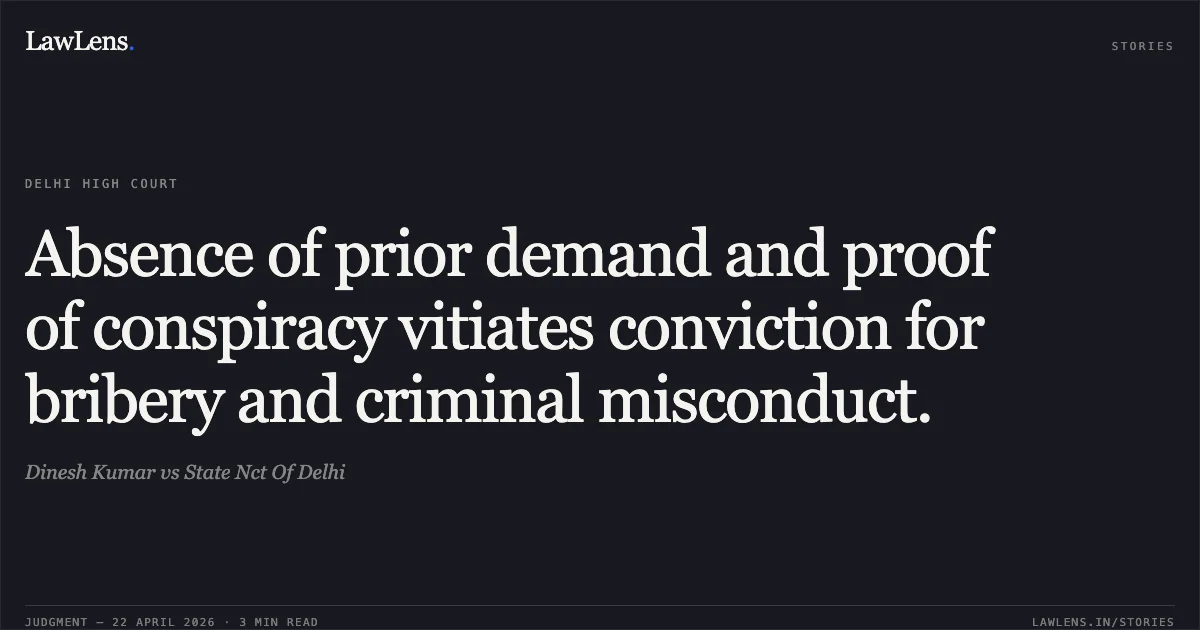
The Appellants, Dinesh Kumar (A2) and Laxmi Chand (A3), along with the deceased A1, were officials of the Railway Protection Force (RPF).
Source reference: p. 2It was alleged that in May 1995, A1 and A2 demanded ₹10,000/- from PW5 to refrain from implicating his brother-in-law (PW3) in a theft case.
Source reference: p. 2, 10A trap was laid by the Anti-Corruption Branch (ACB) on 13.05.1995, where A3 allegedly accepted ₹5,000/- on behalf of A1 and A2 at Tuglakabad Railway Station.
Source reference: p. 14-15The Trial Court convicted them under Sections 7 and 13(1)(d) of the Prevention of Corruption Act (PC Act) and Section 120-B of the IPC.
Source reference: p. 6The Appellants challenged the conviction on grounds of lack of demand and procedural inconsistencies.
Source reference: p. 7-8Issues
1. Whether the prosecution established the "demand" of illegal gratification as a sine qua non for an offence under the PC Act against A2 and A3
Source reference: p. 39-402. Whether A3 can be held liable for acceptance of bribe money in the absence of a charge of abetment or proof of conspiracy
Source reference: p. 44-453. Whether the charge of criminal conspiracy under Section 120-B IPC was substantiated by the evidence on record
Source reference: p. 45-47Law Applied
Sections 7 and 13(1)(d) of the PC Act, emphasizing that "demand and acceptance" of illegal gratification are essential prerequisites for conviction
Source reference: p. 40Neeraj Dutta v. State (NCT of Delhi) (2023), stating that demand must be proved by direct or circumstantial evidence
Source reference: p. 9, 40A. Karunanithi v. State (2025) and N. Sunkanna v. State of A.P. (2016) to establish that mere recovery of money without proof of demand is insufficient for conviction
Source reference: p. 41-44CBI v. K. Narayana Rao (2012) regarding the necessity of a "meeting of minds" for criminal conspiracy under Section 120-B IPC
Source reference: p. 45-46Mahendra Singh Chotelal Bhargad v. State of Maharashtra (1998) regarding the necessity of an abetment charge when a person accepts money on behalf of another
Source reference: p. 44Reasoning
The Court found the prosecution's case fundamentally flawed due to material contradictions. First, while PW5 alleged a demand by A1 on 12.05.1995, the daily diary (Ext. DW2/A) proved A1 was not in his office at the alleged time.
Source reference: p. 33-34Regarding A2, the court noted that PW3 (the intended victim) denied that A1 or A2 threatened false implication, as PW3 was already a known accused in a legitimate theft case.
Source reference: p. 35Concerning A3, the court observed that there was no evidence of A3 ever making a demand; he was merely a recipient acting on instructions.
Source reference: p. 39-40Applying A. Karunanithi, the court held that receiving money on behalf of others might constitute abetment, but since no charge of abetment was framed, A3 could not be convicted solely on acceptance.
Source reference: p. 44-45The court ruled that the "chain of actions" lacked evidence of a prior agreement or meeting of minds, failing the threshold for Section 120-B IPC.
Source reference: p. 47Holding
The High Court allowed the appeals and set aside the conviction and sentence.
The Court held that since "demand" is the sine qua non for offences under the PC Act and was not proved against A2 or A3, mere recovery of treated notes was insufficient.
Source reference: p. 43-44It further held that A3 could not be convicted as an accomplice without a specific charge of abetment.
Source reference: p. 45The Appellants were acquitted under Section 248(1) Cr.P.C.
Source reference: p. 48Acts & Sections Cited
9 provisions across 3 statutes referred to in this judgment. Each provision opens on LawLens.
Prevention of Corruption Act, 19884
Code of Criminal Procedure, 19734
Railway Property (Unlawful Possession) Act, 19661
Original Court PDF
Dinesh KumarvsState Nct Of Delhi
Click to open original judgment
Original judgment, available to read, download and summarize on LawLens.in