Facts
The State appealed an acquittal order dated 07.06.2012 regarding a suicide that occurred on 21.01.2006.
Source reference: p. 1-3The complainant, Madhavlal Jani, alleged that his son, Kamlesh, committed suicide by hanging due to mental depression caused by his wife’s (Respondent No. 2) alleged illicit relationship with a neighbor (Respondent No. 3), supported by his in-laws (Respondents No. 1 & 4).
Source reference: p. 1-3A suicide note was reportedly found in the deceased’s pocket naming the four accused.
Source reference: p. 2During the trial (Sessions Case No. 19 of 2010), several key witnesses, including the father and siblings of the deceased, did not support the prosecution’s case.
Source reference: p. 7-8Issues
1. Whether the trial court was justified in passing the judgment of acquittal based on the available evidence.
Source reference: p. 7 / para. 112. Whether the acts or omissions of the accused amounted to instigation or abetment of suicide under Section 306 of the IPC.
Source reference: p. 8 / para. 123. Whether there was manifest illegality or perversity in the trial court’s appreciation of evidence.
Source reference: p. 7 / para. 11Law Applied
Section 306 (Abetment of suicide) read with Section 114 (Abettor present when offence committed) and Section 107 (Definition of abetment) of the Indian Penal Code.
Source reference: p. 1, 8Section 378 of the CrPC regarding appeals against acquittal.
Source reference: p. 1The "double presumption of innocence" principle.
Source reference: p. 10Standards for appellate interference in acquittals as established in Chandrappa v. State of Karnataka (2007), Rajesh Prasad v. State of Bihar (2022), and Ramesh v. State of Karnataka (2024), which dictate that if two reasonable views are possible, the appellate court should not disturb the trial court's finding unless it is perverse.
Source reference: p. 10-12Reasoning
The High Court observed that while the death was homicidal (suicidal nature confirmed by medical evidence), the prosecution failed to establish a nexus between the accused's actions and the suicide.
Source reference: p. 8The court noted that no evidence was produced to prove the alleged extra-marital affair or that the accused "instigated" the deceased to a point where no alternative remained but suicide.
Source reference: p. 8-9The prosecution failed to produce a handwriting expert to verify the authenticity of the suicide note.
Source reference: p. 8Given that the immediate relatives of the deceased (PW-1, PW-4, PW-5, PW-11, PW-12) turned hostile or failed to provide positive evidence of abetment, the court found the trial court's conclusion of "benefit of doubt" to be a reasonable view.
Source reference: p. 8-9Holding
The prosecution miserably failed to prove the charges beyond reasonable doubt and no manifest error of law or perversity was found in the trial court's reasoning.
The High Court dismissed the State’s appeal, confirmed the judgment of acquittal, and ordered the bail bonds of the respondents cancelled.
Source reference: p. 13Acts & Sections Cited
6 provisions across 2 statutes referred to in this judgment. Each provision opens on LawLens.
Code of Criminal Procedure, 19733
Indian Penal Code, 18603
Original Court PDF
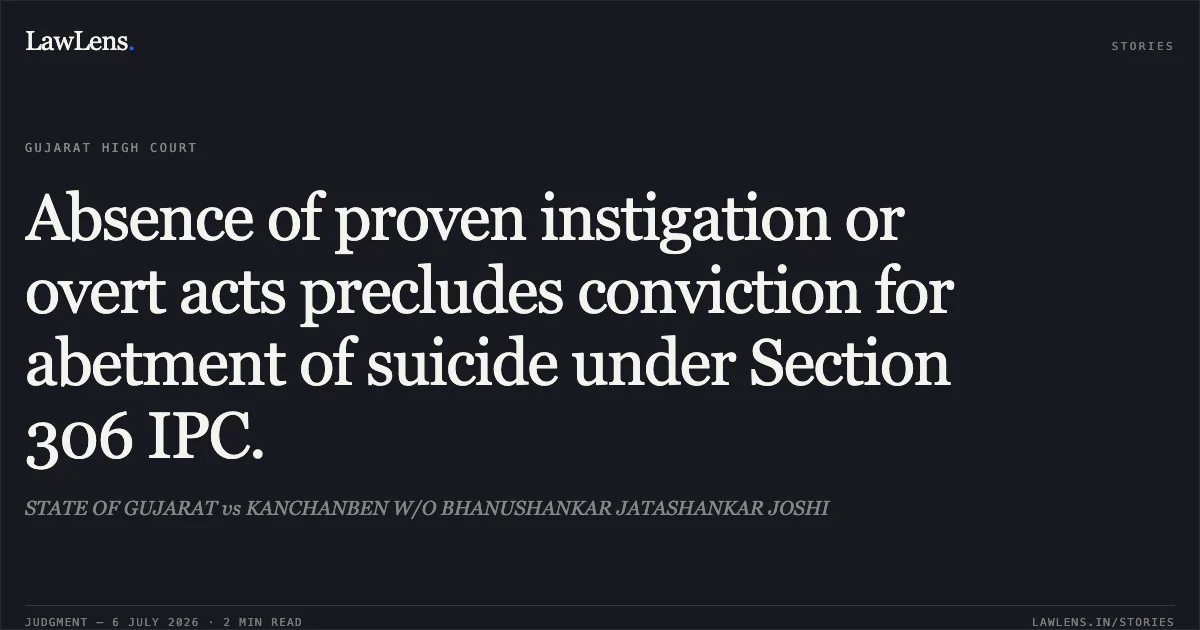
STATE OF GUJARATvsKANCHANBEN W/O BHANUSHANKAR JATASHANKAR JOSHI
Click to open original judgment
Original judgment, available to read, download and summarize on LawLens.in