Facts
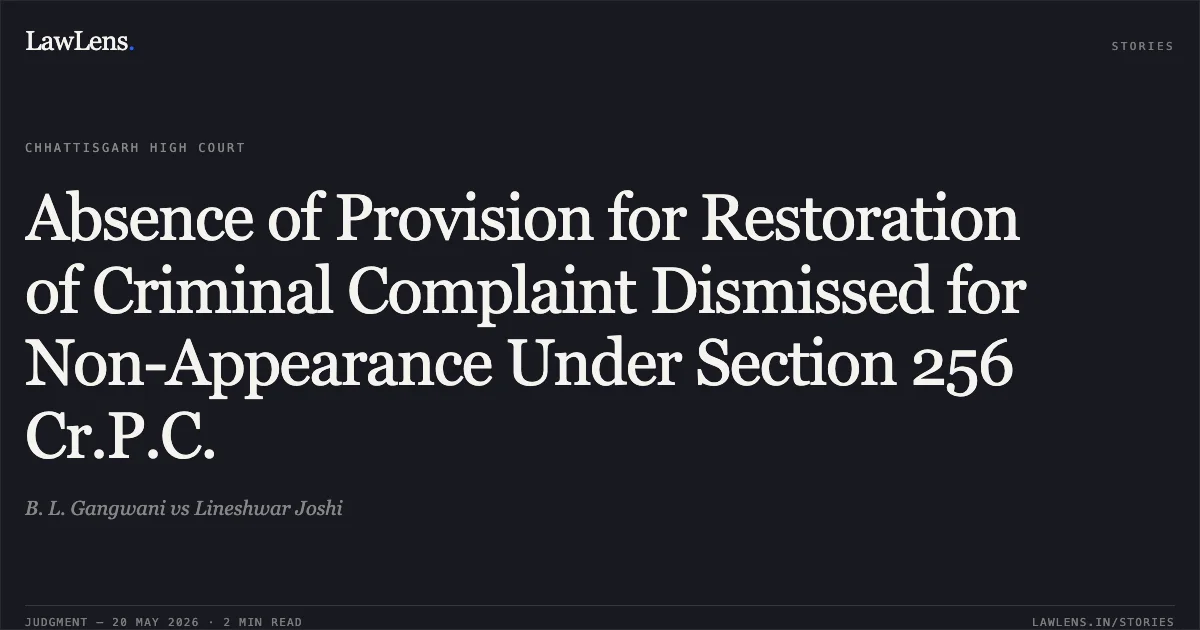
The appellant filed a complaint against Respondent No. 1 under Section 138 of the Negotiable Instruments Act on September 16, 2011
Source reference: p. 2Following notice of the offence on April 16, 2013, the case was scheduled for evidence on April 27, 2013
Source reference: p. 2On that date, the Judicial Magistrate First Class (JMFC), Raipur, dismissed the complaint for want of prosecution due to the complainant's absence
Source reference: p. 2The appellant moved for restoration of the complaint on June 5, 2013, which the trial court rejected on the grounds that no legal provision exists for restoring a dismissed criminal complaint
Source reference: p. 2A subsequent criminal revision (CRR No. 308/2013) was dismissed by the Special/Additional Sessions Judge, Raipur, on June 16, 2014
Source reference: p. 2Issues
1. Whether the trial court was justified in dismissing the complaint under Section 256 of the Cr.P.C. due to the non-appearance of the complainant
Source reference: p. 3, para. 6-72. Whether the court possesses the jurisdiction to restore a criminal complaint once it has been dismissed in default
Source reference: p. 4, para. 73. Whether the passage of a significant period (over a decade) impacts the court’s willingness to interfere with an order of acquittal
Source reference: p. 5, para. 9Law Applied
Section 256 of the Code of Criminal Procedure (Cr.P.C.), which empowers a Magistrate to dismiss a complaint and acquit the accused if the complainant fails to appear on the appointed day
Source reference: p. 3-4The established legal principle that once a criminal complaint is dismissed under Section 256 Cr.P.C., the trial court becomes functus officio regarding that matter, as the Cr.P.C. does not provide a mechanism for the restoration of such complaints
Source reference: p. 4Principle of judicial restraint in acquittal appeals, where interference is only warranted in cases of clear perversity or gross miscarriage of justice
Source reference: p. 4-5Reasoning
The Court observed that on the date fixed for evidence (April 27, 2013), neither the appellant nor his counsel appeared, nor was any application for adjournment or exemption filed
Source reference: p. 3-4The appellant’s subsequent justifications regarding illness were not brought to the trial court's attention at the relevant time, and the Court emphasized that the burden of informing the court of an inability to appear lies solely with the complainant
Source reference: p. 4The Court affirmed the Revisional Court's finding that there is no statutory provision for the restoration of a complaint dismissed under Section 256 Cr.P.C.
Source reference: p. 4The Court noted that the incident occurred in 2014; given the decade-long pendency and the "stale" nature of the case, it found no evidence of perversity or miscarriage of justice that would justify overturning the acquittal at this late stage
Source reference: p. 5Holding
The Court answered the issues in the affirmative for the respondents, holding that the dismissal was legally sound and that no provision for restoration exists
The High Court found no infirmity, illegality, or perversity in the impugned orders passed by the trial and revisional courts. Consequently, the acquittal appeal was dismissed as being devoid of merit
Source reference: p. 4-5Acts & Sections Cited
2 provisions across 2 statutes referred to in this judgment. Each provision opens on LawLens.
Negotiable Instruments Act, 18811
Code of Criminal Procedure, 19731
Original Court PDF
B. L. GangwanivsLineshwar Joshi
Click to open original judgment
Original judgment, available to read, download and summarize on LawLens.in