Facts
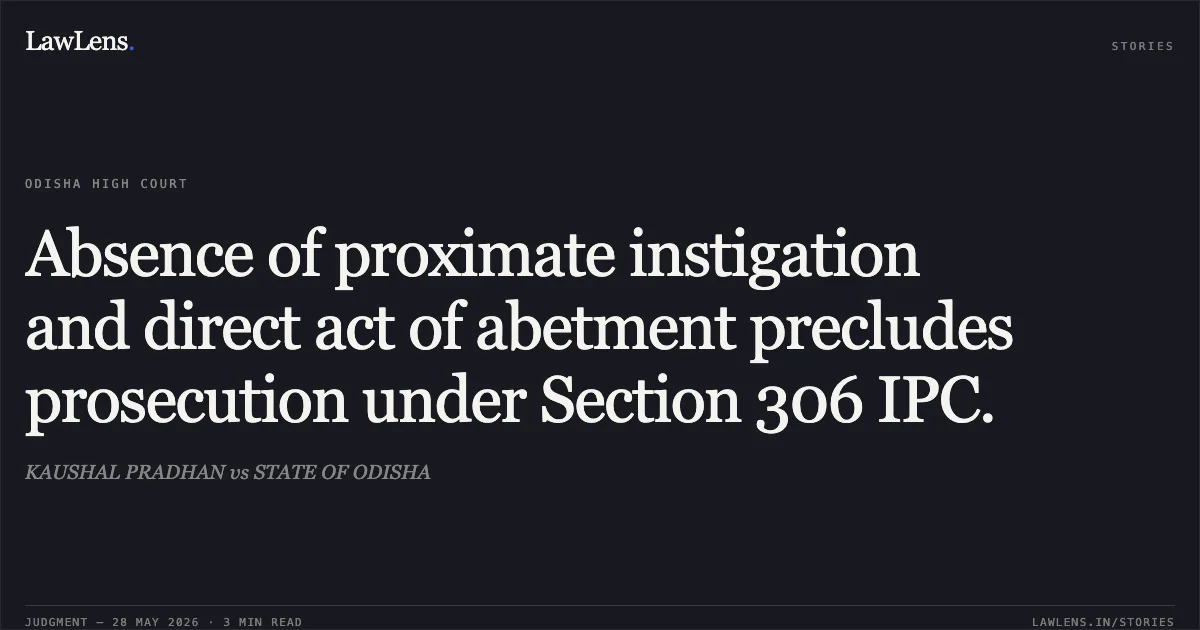
The Petitioner filed an application under Section 482 Cr.P.C. (or Section 528 BNSS) seeking to quash FIR No. 382 of 2021 and the resulting S.T. Case No. 129 of 2025.
Source reference: p. 1The case involves the suicide of a 19-year-old student, Tusharkanta Sahoo, whose body was found on August 5, 2021.
Source reference: p. 2The prosecution alleges that after a consensual physical relationship between the deceased and a girl (Bulbul) was discovered by her ex-boyfriend (Sonu), Bulbul blackmailed and defamed the deceased.
Source reference: p. 2-3On August 3, 2021, a meeting was held at an Indoor Stadium where the Petitioner (Bulbul's brother) and others allegedly questioned, threatened, and physically assaulted the deceased (by slapping), pressuring him to apologize to Sonu.
Source reference: p. 3-5The deceased committed suicide by jumping into the river shortly thereafter.
Source reference: p. 5A charge-sheet was submitted against the Petitioner under Section 306/34 of the IPC on November 24, 2021.
Source reference: p. 5Issues
1. Whether the allegations in the FIR and charge-sheet, even if accepted as true, disclose the essential ingredients of "abetment of suicide" under Section 306 IPC against the Petitioner.
Source reference: p. 7, 122. Whether the High Court, in the exercise of its inherent jurisdiction under Section 482 Cr.P.C., should quash the criminal proceedings at the preliminary stage of trial.
Source reference: p. 11-12Law Applied
The court primarily applied Section 306 (Abetment of Suicide) and Section 107 (Definition of Abetment) of the IPC.
Source reference: p. 7, 10In M. Arjunan v. State, it was held that the essential ingredients of Section 306 are (i) abetment and (ii) the intention to aid or instigate the suicide.
Source reference: p. 7In Prabhat Kumar Mishra v. State of U.P., the court emphasized the requirement of clear mens rea.
Source reference: p. 7Chitresh Kumar Chopra v. State establishes that "instigation" can be inferred if the accused’s continuous conduct leaves the deceased with no option but suicide.
Source reference: p. 10The High Court's jurisdiction under Section 482 Cr.P.C. is inherent but should be exercised sparingly, only where the process is an abuse of court or no offence is disclosed.
Source reference: p. 11Reasoning
The Petitioner argued that his role was limited to protecting his sister's dignity and that a generic warning or words uttered in anger do not constitute instigation.
Source reference: p. 6, 8The Court observed that the prosecution’s materials—including witness statements and the Petitioner’s own statement—allege active confrontation, physical assault (slapping), and persistent pressure on the deceased to confess to a fabricated story.
Source reference: p. 9-10The Court reasoned that evaluating whether such conduct constitutes a direct proximate cause or "instigation" under Section 306 IPC is a factual inquiry.
Source reference: p. 11The Court found that the sequence of events, spanning from the humiliation at the stadium to the suicide at 6:23 P.M. on the same day, created a chain of causality that cannot be summarily dismissed.
Source reference: p. 10, 12The Court concluded that it cannot embark on a "meticulous enquiry" into the reliability of evidence at this stage, as the determination of mens rea and culpability requires a full-fledged trial.
Source reference: p. 11-13Holding
The High Court cannot conclusively determine the truth of the allegations at the preliminary stage, as the connection between the alleged harassment and the death is a matter for adjudication during trial.
The CRLMC petition was dismissed and any interim orders were vacated.
Source reference: p. 13-14Acts & Sections Cited
6 provisions across 3 statutes referred to in this judgment. Each provision opens on LawLens.
Indian Penal Code, 18603
Code of Criminal Procedure, 19732
Bharatiya Nagarik Suraksha Sanhita, 20231
Original Court PDF
KAUSHAL PRADHANvsSTATE OF ODISHA
Click to open original judgment
Original judgment, available to read, download and summarize on LawLens.in