Facts
The State appealed an acquittal dated 26.09.2009 regarding offences under Sections 498(A), 306, and 114 of the IPC
Source reference: p. 1The deceased, Surtiben, married Accused No. 1 approximately eight months prior to the incident
Source reference: p. 4It was alleged that the accused subjected her to mental and physical torture, leading her to commit suicide by jumping into a well between 21.10.2008 and 23.10.2008
Source reference: p. 2The prosecution examined 13 witnesses; however, several panch witnesses turned hostile
Source reference: p. 6The Trial Court acquitted the respondents, finding the prosecution failed to prove the charges beyond reasonable doubt
Source reference: p. 3Issues
1. Whether the prosecution established the essential ingredients of "instigation" or "abetment" under Section 306 IPC to connect the accused's conduct with the deceased's suicide
Source reference: p. 10 / para. 9.12. Whether the High Court should interfere with an order of acquittal when the Trial Court’s view is a "possible view" based on the evidence
Source reference: p. 19 / para. 17Law Applied
The court applied Section 306 (Abetment of suicide) and Section 107 (Definition of abetment) of the IPC
Source reference: p. 11It leaned on *Mahendra K.C. v. State of Karnataka (2022)*, defining instigation as provoking or encouraging a specific act
Source reference: p. 14and *Amalendu Pal v. State of West Bengal (2010)*, establishing that mere harassment without a positive act proximate to the time of suicide is insufficient for conviction
Source reference: p. 15Regarding the scope of acquittal appeals, the court followed *Chandrappa v. State of Karnataka (2007)*, which holds that if two reasonable views exist, the appellate court should not disturb an acquittal
Source reference: p. 19-21Reasoning
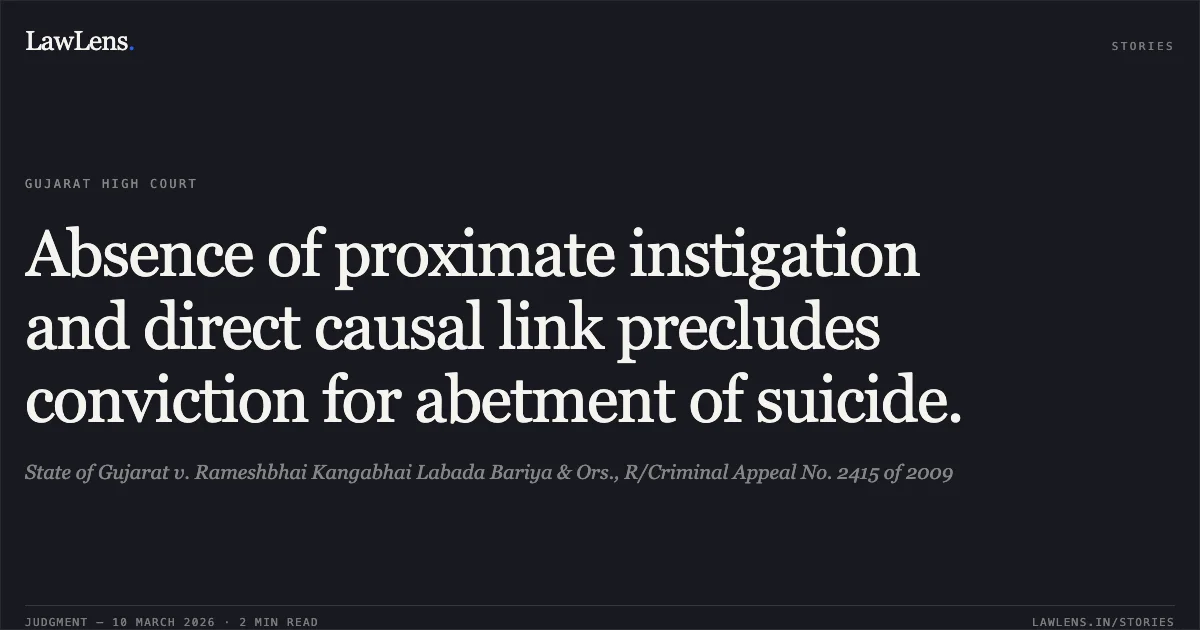
The court found that the prosecution failed to provide evidence of a "proximate act" of instigation immediately preceding the suicide
Source reference: p. 13 / para. 9.7While the complainant alleged physical harassment, his oral deposition lacked specific details, and medical evidence showed no injury marks on the body
Source reference: p. 7-9Furthermore, testimony suggested the deceased suffered from Tuberculosis, indicating potential distress unrelated to the accused
Source reference: p. 9 / para. 8.9The court reasoned that "abetment" requires a clear *mens rea* and a direct causal link; routine domestic disagreements do not suffice
Source reference: p. 12Since the Investigating Officer failed to examine independent neighbors or verify medical records, the "twin test" of provocation and facilitation remained unsatisfied
Source reference: p. 10-11Holding
The High Court dismissed the appeal and upheld the acquittal.
It held that the prosecution failed to prove that the accused stimulated the deceased to commit suicide through any positive act or intentional omission
Source reference: p. 11 / para. 9.3The court concluded that the Trial Court’s findings were neither perverse nor based on a misreading of evidence, and since the view taken was "possible," there was no ground for interference
Source reference: p. 22 / para. 20-21Acts & Sections Cited
5 provisions across 2 statutes referred to in this judgment. Each provision opens on LawLens.
Indian Penal Code, 18603
Code of Criminal Procedure, 19732
Original Court PDF
State of Gujarat v. Rameshbhai Kangabhai Labada Bariya & Ors., R/Criminal Appeal No. 2415 of 2009
Click to open original judgment
Original judgment, available to read, download and summarize on LawLens.in


