Facts
The deceased, Jasuben, committed suicide by self-immolation on 08.12.2009 and succumbed to injuries on 12.12.2009
Source reference: p. 7The prosecution alleged that the respondent-accused had blackmailed and threatened the deceased for money using certain photographs, thereby abetting her suicide
Source reference: p. 1-2An FIR was registered under Sections 506(2) and 306 of the IPC
Source reference: p. 2The Trial Court acquitted the accused on 25.11.2011, noting that the deceased’s father and husband turned hostile and that there were material contradictions in the dying declaration
Source reference: p. 8, 11Issues
1. Whether the prosecution proved beyond reasonable doubt that the accused’s actions constituted "instigation" or "abetment" under Section 306 IPC
Source reference: p. 6, 102. Whether the Trial Court committed any manifest error or perversity in discarding the dying declaration and documentary evidence (photographs)
Source reference: p. 11-123. Whether there was a direct and proximate nexus between the alleged harassment and the death of the deceased
Source reference: p. 12Law Applied
Section 306 of the Indian Penal Code (IPC) regarding abetment of suicide
Source reference: p. 13Section 506(2) regarding criminal intimidation
Source reference: no citationAbetment involves a mental process of instigating or intentionally aiding the commission of suicide, requiring a clear mens rea.
Source reference: p. 10Section 65B of the Indian Evidence Act, which mandates a certificate for the admissibility of electronic records (specifically regarding the alleged photographs)
Source reference: p. 9The standard for appellate interference in acquittals as defined in Chandrappa v. State of Karnataka and Ramesh v. State of Karnataka
Source reference: p. 16-17Reasoning
The court found the alleged incriminating photographs inadmissible as the prosecution failed to provide a Section 65B certificate or prove their origin from the accused's studio
Source reference: p. 9Crucially, the court noted a "serious contradiction" regarding the dying declaration: the Executive Magistrate claimed he took a thumb impression from the hand, whereas the Investigating Officer testified it was taken from the toe as the hands were burnt
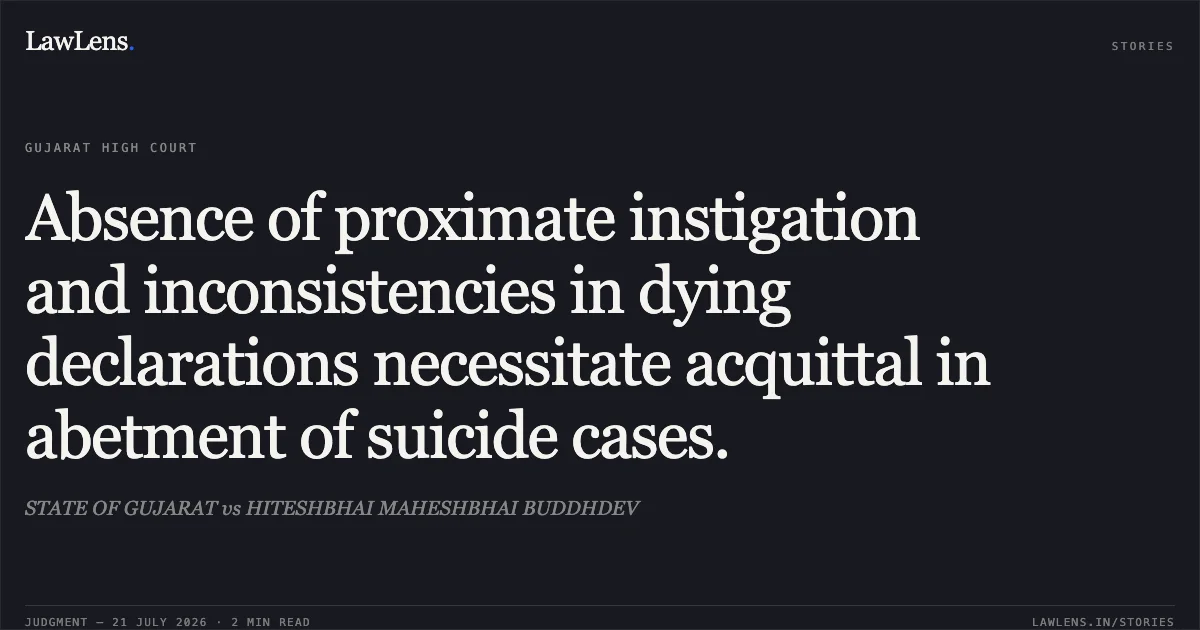
Source reference: p. 11-12Applying the Gangula Mohan Reddy precedent, the court held that since no proximate act of instigation was proved, the ingredients of Section 306 were not met
Source reference: p. 10, 12Holding
The High Court dismissed the appeal and confirmed the Trial Court’s acquittal
The Court held that the prosecution miserably failed to prove the charges beyond a reasonable doubt and that the Trial Court’s findings were neither perverse nor illegal
Source reference: p. 11, 18The bail bond was ordered cancelled
Source reference: p. 18Acts & Sections Cited
5 provisions across 2 statutes referred to in this judgment. Each provision opens on LawLens.
Code of Criminal Procedure, 19733
Indian Penal Code, 18602
Original Court PDF
STATE OF GUJARATvsHITESHBHAI MAHESHBHAI BUDDHDEV
Click to open original judgment
Original judgment, available to read, download and summarize on LawLens.in