Facts
The deceased, Nirupaben, married Accused No. 2 nine years prior to the incident and had two children
Source reference: p. 8The prosecution alleged that she was subjected to continuous physical and mental harassment and dowry demands by her husband and in-laws (Accused Nos. 1, 3, 4, 5, and 6)
Source reference: p. 8On April 22, 2010, the deceased consumed endosulfan poison and succumbed during treatment
Source reference: p. 9, 12The complainant (brother of the deceased) initially filed a complaint under Sections 498(A), 306 IPC, and Sections 3 and 4 of the Dowry Prohibition Act
Source reference: p. 2-3However, during the trial, all material prosecution witnesses, including the complainant (PW-3), mother (PW-4), father (PW-5), and other relatives, turned hostile, denying any harassment and stating the accused took good care of the deceased
Source reference: p. 10-11The Trial Court acquitted the accused on April 23, 2012
Source reference: p. 2The State appealed this acquittal.
Source reference: no citationIssues
1. Whether the conduct of the accused persons amounted to "instigation" or "abetment" under Section 306 read with Section 107 of the IPC
Source reference: p. 1-2, 132. Whether the prosecution established a proximate causal link and mens rea between the alleged harassment and the act of suicide
Source reference: p. 15, 22Law Applied
The Court applied Section 306 (Abetment of suicide) and Section 107 (Definition of abetment) of the IPC
Source reference: p. 2, 13It relied on Gangula Mohan Reddy v. State of Andhra Pradesh, establishing that abetment requires a mental process of instigation or intentional aid
Source reference: p. 14The court further applied the "twin test" from Abhinav Mohan Delkar v. State of Maharashtra, which mandates proving a "proximate prior act" and a "conscious deliberate intention" (mens rea) to drive the victim to suicide
Source reference: p. 15-17Principles from Amalendu Pal v. State of West Bengal were used to clarify that mere harassment without a positive act proximate to the time of occurrence is insufficient for conviction
Source reference: p. 25Reasoning
The Court observed that for a conviction under Section 306 IPC, there must be evidence of "goading" or "provocation" that leaves the deceased with no other option but suicide
Source reference: p. 14, 24In this case, the prosecution's foundation collapsed as every family member of the deceased (PW-3 to PW-8) testified that the deceased was treated well and faced no harassment
Source reference: p. 10-12The Court found no evidence of a "proximate act" or "live link" preceding the suicide that could be legally construed as instigation
Source reference: p. 22-23Applying the standard for acquittal appeals, the Court noted that unless the Trial Court's view is "perverse" or "impossible," the appellate court should not interfere merely because a different view is possible
Source reference: p. 29, 31Since the material witnesses turned hostile, the prosecution failed to prove mens rea or the actus reus of abetment
Source reference: p. 18-19Holding
The High Court dismissed the State's appeal and upheld the judgment of acquittal
The Court held that "sympathy, however compelling, cannot substitute the standard of proof mandated in law"
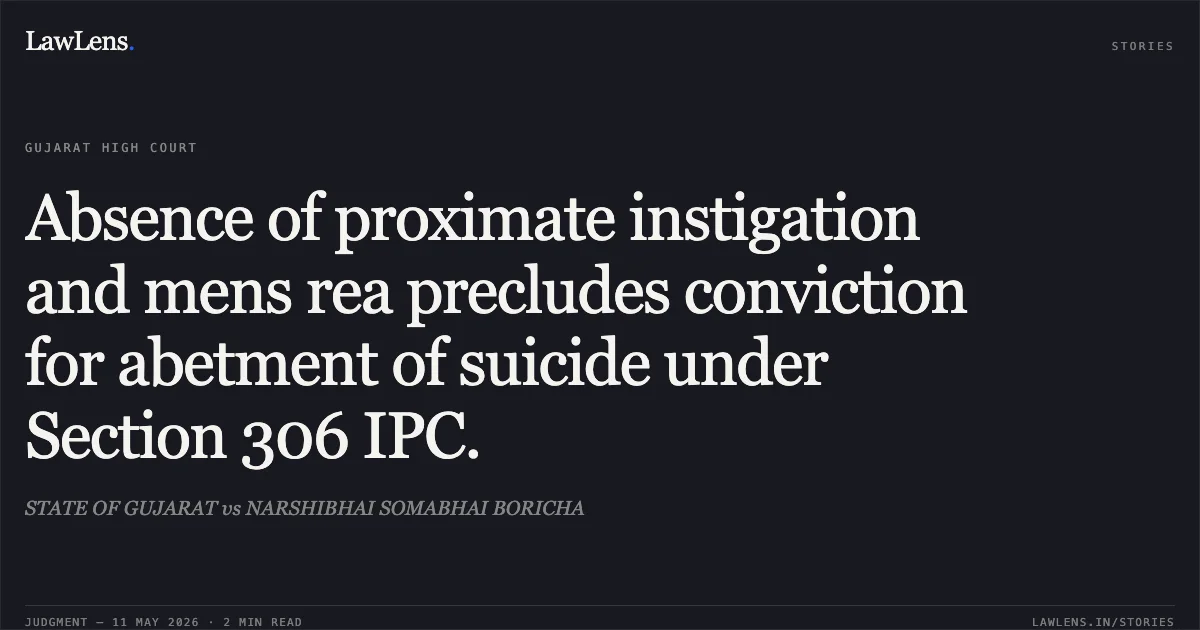
Source reference: p. 2It concluded that the prosecution fails if it cannot prove a direct and immediate act closely connected to the suicide showing the death was the result of instigation
Source reference: p. 20, 26The respondents were cleared of all charges under Sections 498(A) and 306 IPC
Source reference: p. 33Acts & Sections Cited
7 provisions across 3 statutes referred to in this judgment. Each provision opens on LawLens.
Indian Penal Code, 18603
Code of Criminal Procedure, 19732
Original Court PDF
STATE OF GUJARATvsNARSHIBHAI SOMABHAI BORICHA
Click to open original judgment
Original judgment, available to read, download and summarize on LawLens.in


