Facts
The applicant, a Physics teacher, was accused by Smt. Geeta Bainsla of harassing her minor daughter, Km. Jyoti, through indecent gestures, demands for private tuition, and threats
Source reference: para 2-3It was alleged that on 25.03.2011 and 02.04.2011, the applicant molested and threatened the victim in school
Source reference: para 5-6The victim allegedly committed suicide by poisoning on 29.07.2011
Source reference: para 8No FIR was registered immediately; the body was cremated without an inquest or post-mortem
Source reference: para 9, 32Following an application under Section 156(3) Cr.P.C. filed in November 2011, an FIR was registered
Source reference: para 9After two police final reports were submitted, the Magistrate treated the protest petition as a complaint and summoned the applicant under Sections 306, 354, and 506 IPC on 21.10.2014
Source reference: para 10-11, 17The applicant challenged the summoning order and the revisional court’s dismissal
Source reference: para 1Issues
1. Whether there existed a proximate nexus and live link between the alleged harassment by the applicant and the victim's act of suicide to satisfy the ingredients of Section 306 IPC
Source reference: para 25-272. Whether the criminal proceedings against the applicant constituted an abuse of the process of law given the delay in filing the FIR and lack of medical evidence
Source reference: para 31-33Law Applied
The court primarily applied Section 306 of the IPC regarding abetment of suicide and Section 107 regarding instigation
Source reference: para 25The court relied on Neeharika Infrastructure Pvt. Ltd. v. State of Maharashtra (2021) regarding the high court's power to quash proceedings only in "rarest of rare cases"
Source reference: para 22Principles from Prakash v. State of Maharashtra (2024) and Abhinav Mohan Delkar v. State of Maharashtra (2025), which established that abetment requires a "proximate and live link" and clear mens rea to goad the victim into suicide
Source reference: para 25-26, 28The court also noted the necessity of a "direct and immediate act of incitement"
Source reference: para 26Reasoning
The court found that the last alleged act of harassment occurred on 02.04.2011, while the suicide took place on 29.07.2011. This nearly four-month time gap indicated a lack of proximity or "live link" required to constitute abetment under Section 306 IPC
Source reference: para 29-30The court observed that the victim remained with her family during this interval without further contact with the applicant, negating any immediate instigation
Source reference: para 30The court highlighted significant procedural lapses: the family failed to seek medical treatment for the alleged poisoning, surreptitiously cremated the body without a post-mortem, and delayed filing the Section 156(3) application by nearly four months after the death
Source reference: para 31-33The absence of independent school witnesses or the Principal’s testimony rendered the claims of molestation under Section 354 IPC unsubstantiated
Source reference: para 34Holding
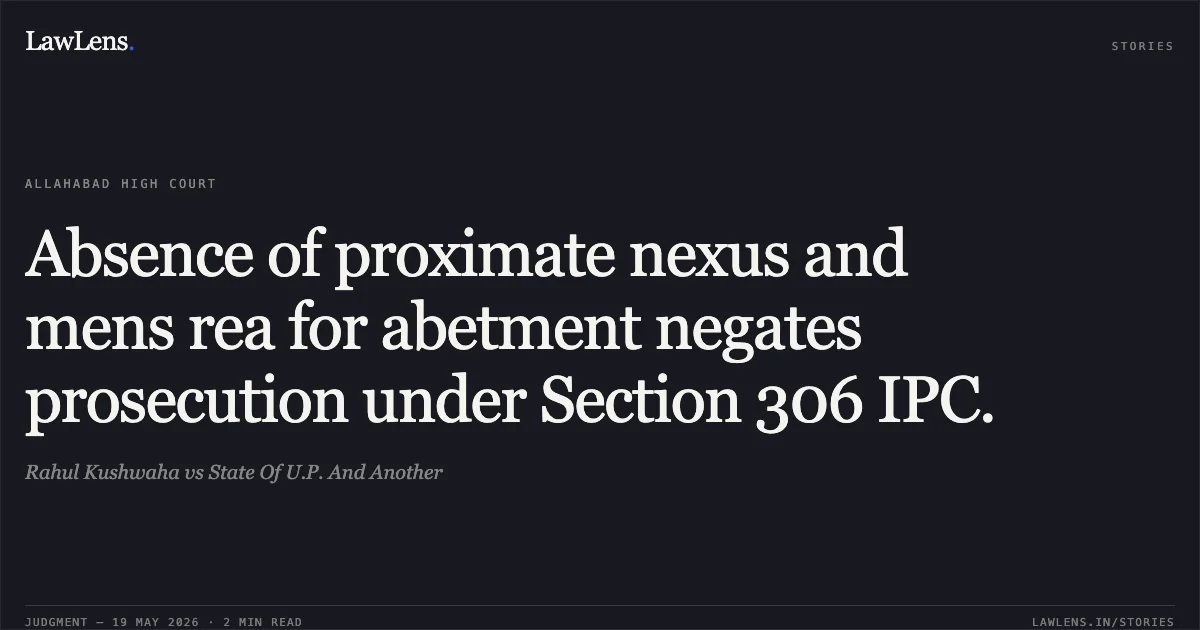
The court held that no prima facie case under Sections 306, 354, or 506 IPC was made out as there was no evidence of mens rea or proximate instigation
The application was allowed, and the entire proceedings of Complaint Case No. 49 of 2012, including the summoning order dated 21.10.2014 and the revisional order dated 13.03.2015, were quashed
Source reference: para 36Acts & Sections Cited
10 provisions across 2 statutes referred to in this judgment. Each provision opens on LawLens.
Code of Criminal Procedure, 19736
Indian Penal Code, 18604
Original Court PDF
Rahul KushwahavsState Of U.P. And Another
Click to open original judgment
Original judgment, available to read, download and summarize on LawLens.in