Facts
The Naval Dockyard, Mumbai, awarded a contract to NBCC for technical building construction, which was subsequently sub-contracted to Richa Construction Company (RCC) on 09.09.1999
Source reference: p. 2Although completion was scheduled for 08.07.2001, work was finished on 22.11.2002, leading to disputes over final payments, work contract tax (WCT) deductions, and extra work
Source reference: p. 2NBCC appointed a sole arbitrator who passed an award on 28.06.2018, partially allowing RCC’s claims while rejecting others
Source reference: p. 2-3Both parties challenged the award under Section 34 of the Arbitration and Conciliation Act, 1996, with RCC contesting rejected claims and NBCC contesting the quantification of damages and findings on limitation
Source reference: p. 3-5Issues
1. Whether the Arbitral Tribunal provided adequate reasoning for its findings, specifically regarding the 1.35% rebate and the balance payment, as mandated under Section 31(3) of the Act
Source reference: p. 5-72. Whether damages for underutilization of labor and overheads can be awarded under Section 73 of the Contract Act without evidence of actual loss
Source reference: p. 7-83. Whether the award remains valid if the arbitrator relies on personal knowledge rather than the evidence on record
Source reference: p. 8-9Law Applied
The court primarily applied Section 31(3) of the Arbitration and Conciliation Act, 1996, which mandates a reasoned award unless otherwise agreed by parties
Source reference: p. 6It relied on Dyna Technologies Pvt. Ltd. v. Crompton Greaves Ltd. [para. 34] and Som Datt Builders Ltd. v. State of Kerala [para. 25] to establish that reasons must be intelligible, adequate, and more than a mere formality
Source reference: p. 6Section 73 of the Indian Contract Act, 1872, regarding compensation for loss or damage
Source reference: p. 7-8The court relied on the supreme court precedent Unibros v. All India Radio [para. 19], which necessitates credible evidence to substantiate claims of loss or profitability
Source reference: p. 7-8Reasoning
The arbitrator failed to provide reasoning for accepting NBCC's contention on the 1.35% rebate, merely stating the claim was "unjustified" without discussing evidence or allegations of document tampering
Source reference: p. 5-6This violated Section 31(3), as the award lacked the "intelligible" logic required by law
Source reference: p. 6-7Regarding Issue 2, the court observed that the arbitrator awarded damages for underutilization of labor and overheads (Claims 7 & 9) based on "personal knowledge and experience" and "sheer guesswork" rather than proof of actual loss
Source reference: p. 4, 8-9The court held this was a direct violation of Section 73 of the Contract Act and the Unibros doctrine, which mandates that a claimant must establish the delay was not their fault and provide credible evidence of loss
Source reference: p. 8Consequently, the arbitrator's departure from settled legal principles and statutory provisions rendered the award against public policy
Source reference: p. 9Holding
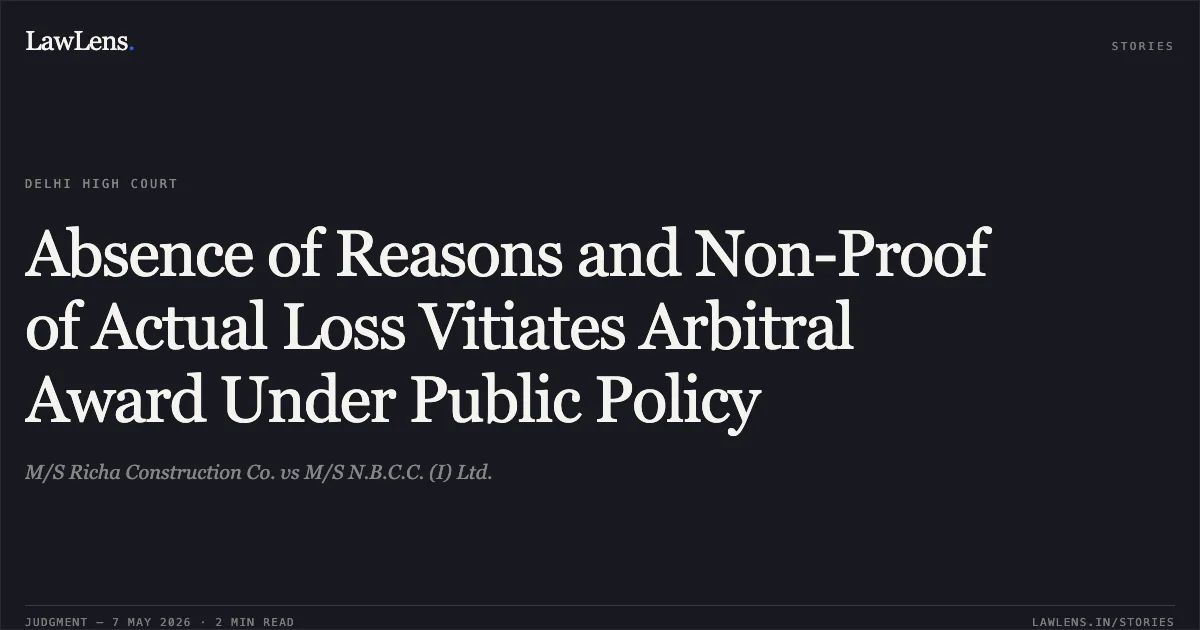
The Court answered the issues in the negative, holding that an award lacking adequate reasoning and evidence-based quantification of damages is unsustainable.
The High Court set aside the impugned award dated 28.06.2018 in its entirety, ruling that it was in the teeth of Sections 31(3) and 28(3) of the Arbitration Act and contrary to the Indian Contract Act. The petitions were allowed, and the parties were granted liberty to initiate fresh arbitration proceedings in accordance with law
Source reference: p. 9Acts & Sections Cited
4 provisions across 2 statutes referred to in this judgment. Each provision opens on LawLens.
Arbitration and Conciliation Act, 19963
Indian Contract Act, 18721
Original Court PDF
M/S Richa Construction Co.vsM/S N.B.C.C. (I) Ltd.
Click to open original judgment
Original judgment, available to read, download and summarize on LawLens.in