Facts
The parties entered into a contract on December 15, 2004, for the supply and commissioning of a Steam Turbine Generator (TG Set)
Source reference: para. 4The TG Set was delivered on December 28, 2006
Source reference: para. 28Following intermittent technical failures and repairs for which the buyer (Neo Metaliks) paid without protest, the buyer rejected the machine on July 27, 2009, alleging manufacturing defects
Source reference: para. 32, 134An Arbitral Tribunal was constituted; oral arguments concluded on January 18, 2020
Source reference: para. 6During the award preparation phase, the Presiding Arbitrator was hospitalized twice for "Lewy Body Disease" and other infections
Source reference: para. 11-12A majority award was delivered on July 22, 2020, two days after the Presiding Arbitrator’s discharge
Source reference: para. 10The majority award granted extinction of price and damages to the buyer, while the third arbitrator issued a separate dissenting award later, claiming he was not consulted during the majority’s deliberation
Source reference: para. 21Issues
1. Whether the majority award was vitiated by fraud or corruption due to the Presiding Arbitrator’s alleged mental incapacity
Source reference: para. 79/822. Whether the award is void under Section 31(2) for failing to state reasons for the omission of the dissenting arbitrator’s signature
Source reference: para. 79/1103. Whether the Tribunal’s interpretation of the "Guarantee Clause" (Clause 14.1) constituted a patent illegality
Source reference: para. 80/1324. Whether the grant of both extinction of price and damages for the same breach violated Section 59 of the Sale of Goods Act, 1930
Source reference: para. 163-164Law Applied
The Court applied Section 34(2)(b)(ii) and 34(2-A) of the Arbitration and Conciliation Act, 1996, regarding awards in conflict with public policy or vitiated by patent illegality
Source reference: para. 85-86, 142It relied on Section 31(1) and (2) of the 1996 Act, which mandatorily requires all arbitrators to sign the award or provide reasons for omission in the award itself
Source reference: para. 110-111The "Business Efficacy Test" and Section 28(3) of the 1996 Act were applied to ensure the Tribunal decided in accordance with the terms of the contract
Source reference: para. 144, 161Under the Sale of Goods Act, 1930, Section 16(4) was used to establish that express warranties override inconsistent implied warranties
Source reference: para. 31, 166Section 59 was applied regarding the buyer's remedies for breach of warranty
Source reference: para. 164Key precedents included Dakshin Haryana Bijli Vitran Nigam v. Navigant Technologies on the finality of signed awards
Source reference: para. 113Key precedents included Ssaynong Engg. & Construction v. NHAI on patent illegality
Source reference: para. 140Reasoning
The Court found that while the allegation of fraud was based on mere suspicion of mental incapacity and did not meet the high standard of proof
Source reference: para. 106-109Procedurally, the majority failed to record the reason for the missing signature of the third arbitrator within the award as required by Section 31(2); the third arbitrator’s subsequent dissent proved he was excluded from deliberations, violating party autonomy
Source reference: para. 128-129Substantively, the Tribunal’s interpretation of "successful commissioning" as 18 months of continuous trouble-free running was deemed "absurd" and a rewriting of Clause 14.1, which actually set a hard cutoff of 24 months from delivery—a date that had passed before the buyer rejected the goods
Source reference: para. 153-157The Court noted that the buyer waived its right to claim defects by paying for repairs without protest and failing to invoke the Performance Bank Guarantee
Source reference: para. 179-180Furthermore, the Tribunal committed a patent illegality by awarding both extinction of price and diesel/electricity damages for the same breach, violating the restrictive remedies under Section 59 of the Sale of Goods Act
Source reference: para. 166-167Holding
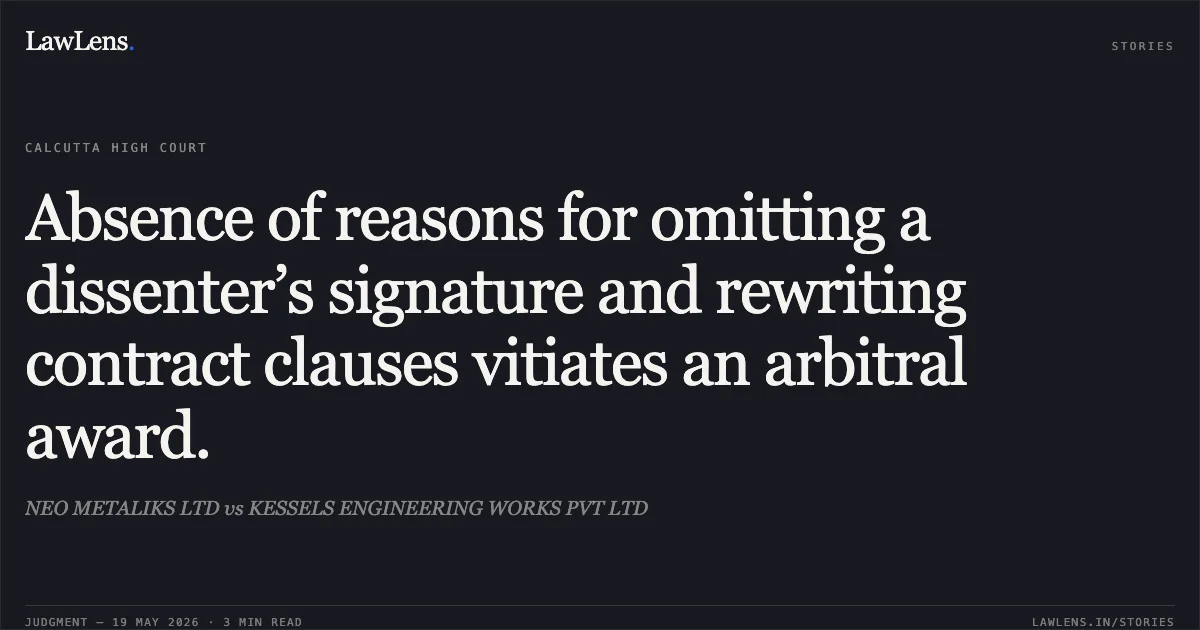
The Court allowed the Section 34 application and set aside the majority award dated July 22, 2020
It held that the interpretation of the Guarantee Clause was patently illegal and the award was procedurally void for violating Section 31(2)
Source reference: para. 158, 193The Court dismissed the buyer’s (Neo Metaliks) claims and upheld the seller’s (Kessels) counter-claim for the unpaid balance. The Court directed Neo Metaliks to pay Kessels ₹38 lakh with 10% interest from July 27, 2009, until the amended award date (Feb 22, 2021), and further post-award interest at 2% above the current rate until payment
Source reference: para. 195The enforcement application (EC/143/2021) was disposed of as infructuous
Source reference: para. 197Acts & Sections Cited
10 provisions across 4 statutes referred to in this judgment. Each provision opens on LawLens.
Arbitration and Conciliation Act, 19966
Sale of Goods Act, 19302
Indian Contract Act, 18721
Interest Act, 19781
Original Court PDF
NEO METALIKS LTDvsKESSELS ENGINEERING WORKS PVT LTD
Click to open original judgment
Original judgment, available to read, download and summarize on LawLens.in