01Facts
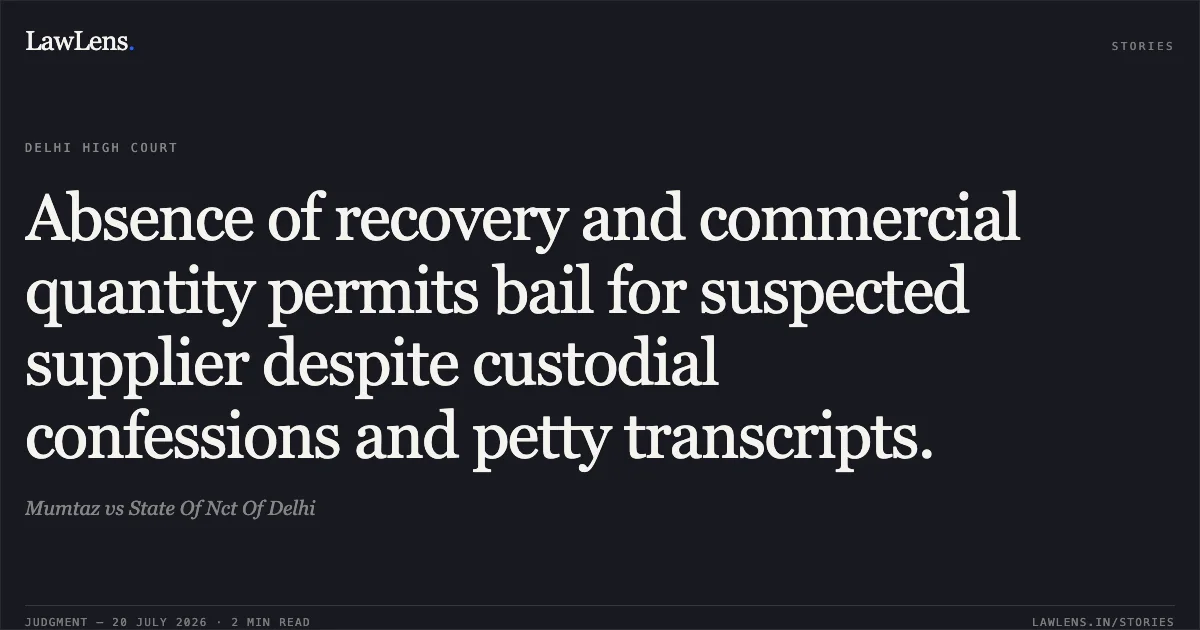
The petitioner sought regular bail regarding FIR No. 175/2026 registered at PS Sarojini Nagar for offences under Section 20(b)(ii)(B)/29 of the NDPS Act.
¶ 1On April 28, 2026, police apprehended a co-accused, Sanjay, with 1.228 kg of ganja.
¶ 4In a custodial statement, Sanjay named the petitioner as a supplier.
¶ 4Consequently, the petitioner was arrested; the police cited online credit transactions (ranging from Rs. 100 to Rs. 300) on her phone and two audio recordings as evidence of her involvement.
¶ 4, 6No physical recovery was made from the petitioner.
¶ 6The petitioner contended she was falsely implicated and highlighted her advanced stage of pregnancy.
¶ 502Issues
i.1. Whether the petitioner is entitled to regular bail considering the lack of recovery and the nature of the evidence presented.
¶ 7-11ii.2. Whether the "twin conditions" for bail under Section 37 of the NDPS Act are applicable to the present case.
¶ 703Law Applied
The court applied Section 37 of the NDPS Act, noting that its restrictive bail conditions apply only to commercial quantities of contraband.
¶ 7Interpretation of Section 20(b)(ii)(B) (intermediate quantity) and Section 29 (abetment/conspiracy) of the NDPS Act.
¶ 1The court relied on the principle that custodial statements of co-accused require corroboration and that circumstantial evidence like financial transactions must logically link to the alleged crime.
¶ 8-9Provisions in the judgment · 3 · Linked ones open on LawLens
Narcotic Drugs and Psychotropic Substances Act, 1985 Section 20Section 29Section 37
04Reasoning
The court observed that since 1.228 kg of ganja is not a "commercial quantity" (which is 20 kg), the strict "twin conditions" of Section 37 NDPS Act do not apply.
¶ 7The court found the prosecution's reliance on petty online transactions (Rs. 100 to Rs. 300) logically inconsistent with professional drug trafficking, questioning why a supplier would use traceable online systems for such small amounts rather than lump-sum cash.
¶ 8Regarding the audio recordings, the court noted that even if the voice belongs to the petitioner, the use of "filthy language" does not imply complicity in drug dealing, especially when the recordings lack explicit references to contraband.
¶ 9The court took judicial notice of the petitioner’s advanced stage of pregnancy as a humanitarian ground for release.
¶ 1005Holding
The court answered the issues in the affirmative and allowed the bail application.
¶ 12It held that there was no justification to deprive the petitioner of her liberty given the lack of recovery and the weak circumstantial evidence.
¶ 11The petitioner was directed to be released on a personal bond of Rs. 10,000/- with one surety, with a condition to join the investigation as directed.
¶ 12, 15Original Court PDF
MumtazvsState Of Nct Of Delhi
Click to open original judgment
Original judgment, available to read, download and summarize on LawLens.in