Facts
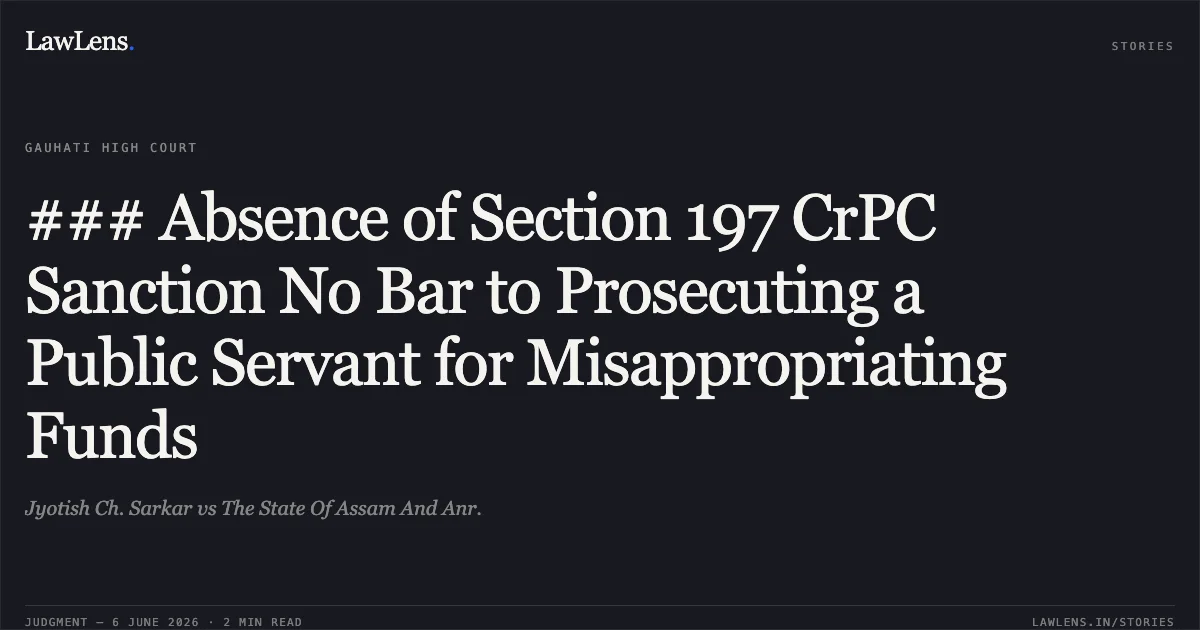
The petitioner, a Head Teacher at Pub-Baralimari L.P. School, was entrusted with government funds (Rs. 1,64,000/-) for the construction of an additional classroom and toilet under the Sarva Siksha Abhiyan (SSA) Scheme
Source reference: p. 3An enquiry revealed that the project was incomplete and deviated from sanctioned plans; prosecution witnesses testified the petitioner admitted to using the funds for his relatives' medical expenses
Source reference: p. 14-15The trial court convicted the petitioner under Section 409 IPC, which was affirmed by the appellate court
Source reference: p. 3-4The petitioner challenged these concurrent findings via a revision petition, primarily arguing that the prosecution was viciated for want of prior sanction under Section 197 Cr.P.C.
Source reference: p. 6Issues
1. Whether the prosecution and conviction are vitiated for want of sanction under Section 197 Cr.P.C.
Source reference: p. 6 / para. 132. Whether the prosecution established the ingredients of criminal breach of trust under Section 409 IPC beyond reasonable doubt
Source reference: p. 6 / para. 133. Whether the concurrent findings of the lower courts suffer from perversity or jurisdictional error warranting revisional interference
Source reference: p. 6 / para. 13Law Applied
Section 197 of the Cr.P.C., which requires prior government sanction only for public servants not removable from office except by or with the sanction of the Government.
Source reference: p. 7-8K. Ch. Prasad v. Smt. J. Vanalatha Devi to establish that mere status as a public servant is insufficient to trigger Section 197.
Source reference: p. 8Principles from Shadakshari v. State of Karnataka and Shambhoo Nath Misra v. State of Uttar Pradesh, which clarify that misappropriation of public funds or fabrication of records is not an act performed in the discharge of official duty.
Source reference: p. 10-11Section 409 of the IPC regarding criminal breach of trust by a public servant.
Source reference: p. 18Reasoning
The High Court first determined that as a provincialised school headmaster, the petitioner was subject to the Assam Services (Discipline and Appeal) Rules, 1964, and did not belong to the limited class of public servants removable only by the Government; thus, Section 197 Cr.P.C. was inapplicable.
Source reference: p. 8-9Even if applicable, the court reasoned that while the petitioner's office enabled the entrustment of funds, the dishonest diversion of those funds for private medical expenses bore no reasonable nexus to his official duties.
Source reference: p. 10-12On the merits, the court noted that the prosecution successfully proved entrustment, withdrawal, and non-utilization of funds through technical reports and witness testimony.
Source reference: p. 14-17The defence of "flood damage" was rejected as it was unsubstantiated by evidence and contradicted the petitioner’s own prior admission regarding medical expenditures.
Source reference: p. 16-17Holding
The court answered Issue 1 in the negative, holding that no sanction was required for acts of misappropriation by this class of public servant.
On Issues 2 and 3, it held that the ingredients of Section 409 IPC were fully satisfied and found no perversity in the lower courts' concurrent findings.
Source reference: p. 19-21The revision petition was dismissed, the conviction and 3-year simple imprisonment sentence were affirmed, and the petitioner was ordered to surrender within four weeks.
Source reference: p. 21-22Acts & Sections Cited
7 provisions across 2 statutes referred to in this judgment. Each provision opens on LawLens.
Code of Criminal Procedure, 19734
Indian Penal Code, 18603
Original Court PDF
Jyotish Ch. SarkarvsThe State Of Assam And Anr.
Click to open original judgment
Original judgment, available to read, download and summarize on LawLens.in