Facts
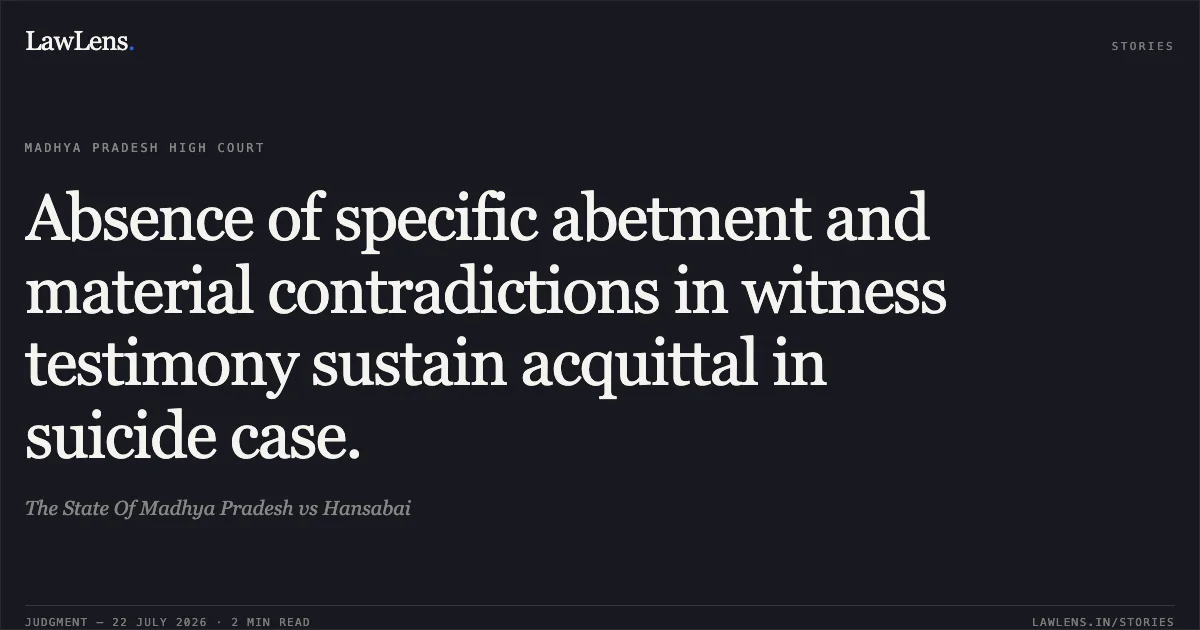
The State filed a petition under Section 378 (III) of the CrPC challenging a Trial Court judgment dated 22.08.2017, which acquitted the respondents of charges under Section 306 of the IPC.
Source reference: para. 1The prosecution alleged that the respondents harassed the deceased, Shubham, and threatened him with false criminal implications—specifically cases of attempted murder and rape—leading him to commit suicide.
Source reference: para. 2–3The State contended that the Trial Court failed to appreciate oral and documentary evidence, including complaints made by the deceased prior to his death and the testimony of several witnesses.
Source reference: para. 3Issues
1. Whether the Trial Court committed a manifest error or perversity by acquitting the respondents despite the testimony of prosecution witnesses regarding harassment and threats.
Source reference: para. 3–52. Whether the appellate court should interfere with a judgment of acquittal when the Trial Court’s findings are based on a plausible appreciation of evidence.
Source reference: para. 6–9Law Applied
The court applied the standard for abetment of suicide under Section 306 of the IPC and the procedural parameters for appealing acquittals under Section 378 of the CrPC.
Source reference: para. 1, 3It relied on the Supreme Court precedent in Ramesh Babulal Doshi v. State of Gujarat, which mandates that an acquittal should only be disturbed if the findings are palpably wrong or unsustainable.
Source reference: para. 6It further applied principles from Ajit Savant Majagvai v. State of Karnataka, emphasizing that the presumption of innocence is strengthened by an acquittal and that if two reasonable views exist, the view favoring the accused must be adopted.
Source reference: para. 7It cited Nikhil Chandra Mondal v. State of W.B. regarding the "double presumption" of innocence in appellate reviews of acquittals.
Source reference: para. 8Reasoning
The High Court examined the evidence and found no perversity in the Trial Court’s reasoning. It noted that the police failed to investigate a critical mobile call received by the deceased just before his death, which created significant doubt.
Source reference: para. 5The Court observed that several witnesses were either hearsay, inconsistent in their statements, or contradicted by other witnesses regarding their location during the incident. Crucially, the Court highlighted that while close relatives of the deceased were present, their testimony lacked specific evidence regarding actual abetment by the respondents.
Source reference: para. 5The court reasoned that the Trial Court had assigned cogent reasons for disbelieving the prosecution's case and that the alleged material omissions and contradictions in testimony justified the benefit of doubt granted to the accused.
Source reference: para. 5, 9Holding
The High Court held that the Trial Court’s judgment was well-reasoned and free from illegality or perversity.
It affirmed that the appellate court should not substitute its own view for that of the Trial Court simply because a different conclusion might be possible. Consequently, the petition was dismissed, and the acquittal of the respondents was upheld.
Source reference: para. 7–8, 10Acts & Sections Cited
3 provisions across 2 statutes referred to in this judgment. Each provision opens on LawLens.
Code of Criminal Procedure, 19731
Indian Penal Code, 18602
Original Court PDF
The State Of Madhya PradeshvsHansabai
Click to open original judgment
Original judgment, available to read, download and summarize on LawLens.in