Facts
The applicants filed a petition under Section 482 of the Cr.P.C. seeking to quash a chargesheet and summoning order dated 07.08.2020 issued by the Chief Judicial Magistrate, Pauri Garhwal in Criminal Case No. 618 of 2020
Source reference: para. 4The case originated from an FIR lodged by respondent no. 2 (wife) against her husband (applicant no. 1) and his relatives (applicants nos. 2 to 4) following matrimonial discord, alleging offenses under Sections 498-A and 323 of the IPC and Sections 3/4 of the Dowry Prohibition Act
Source reference: para. 4-5Applicant no. 2 is the husband’s brother residing in Delhi, applicant no. 3 is a married sister living at her matrimonial home, and applicant no. 4 is the mother-in-law
Source reference: para. 6It was argued that the relatives were implicated falsely with overbroad and general allegations
Source reference: para. 6Issues
1. Whether the criminal proceedings against the relatives of the husband (applicant nos. 2 to 4) constitute an abuse of the process of law in the absence of specific allegations
Source reference: para. 102. Whether a prima facie case for cruelty and dowry harassment is established against the husband (applicant no. 1) to warrant the continuation of the trial
Source reference: para. 12Law Applied
The Court applied Section 482 of the Code of Criminal Procedure (Cr.P.C.) regarding the inherent powers of the High Court to prevent abuse of the process of any Court
Source reference: para. 4The Court relied on the judicial precedents of Geeta Mehrotra vs. State of U.P. and Kahkashan Kausar @ Sonam vs. State of Bihar, which established that in matrimonial disputes, the tendency to implicate all family members without specific allegations must be discouraged to prevent harassment
Source reference: para. 10The court also considered the essential elements of Section 498-A and 323 of the Indian Penal Code (IPC) and Sections 3/4 of the Dowry Prohibition Act
Source reference: para. 4Reasoning
The Court scrutinized the FIR and the material on record, noting that while there were specific allegations against the husband (applicant no. 1), the allegations against the relatives (applicants nos. 2 to 4) were "general in nature" without any specific instances of cruelty or dowry demands attributed to them
Source reference: para. 10, 12The Court observed that applicant no. 2 lived separately for studies and applicant no. 3 lived in her own matrimonial home, supporting the defense that their inclusion was intended to harass and settle personal scores
Source reference: para. 6Consequently, the Court determined that the Investigating Officer had filed the chargesheet in a "routine and mechanical manner" without establishing a prima facie case against the relatives
Source reference: para. 7, 11Applying the ratio from Kahkashan Kausar, the Court found that continuing proceedings against the relatives would amount to an abuse of the legal process because the record lacked material evidence of their direct involvement
Source reference: para. 10-11Holding
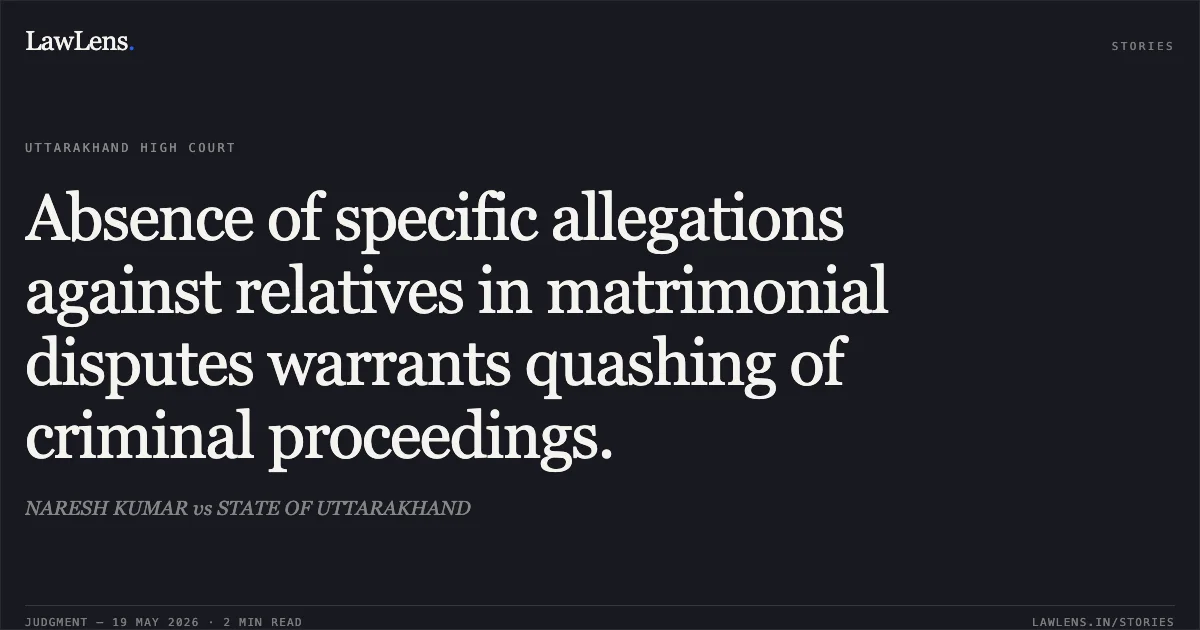
The Court partly allowed the application. It quashed the chargesheet, the summoning order dated 07.08.2020, and the entire proceedings of Criminal Case No. 618 of 2020 specifically against applicant nos. 2, 3, and 4
The Court held that since specific allegations were made against applicant no. 1 (the husband), the criminal proceedings against him shall continue in accordance with the law. The application was disposed of accordingly
Source reference: para. 12-13Acts & Sections Cited
4 provisions across 3 statutes referred to in this judgment. Each provision opens on LawLens.
Code of Criminal Procedure, 19731
Indian Penal Code, 18601
Original Court PDF
NARESH KUMARvsSTATE OF UTTARAKHAND
Click to open original judgment
Original judgment, available to read, download and summarize on LawLens.in