Facts
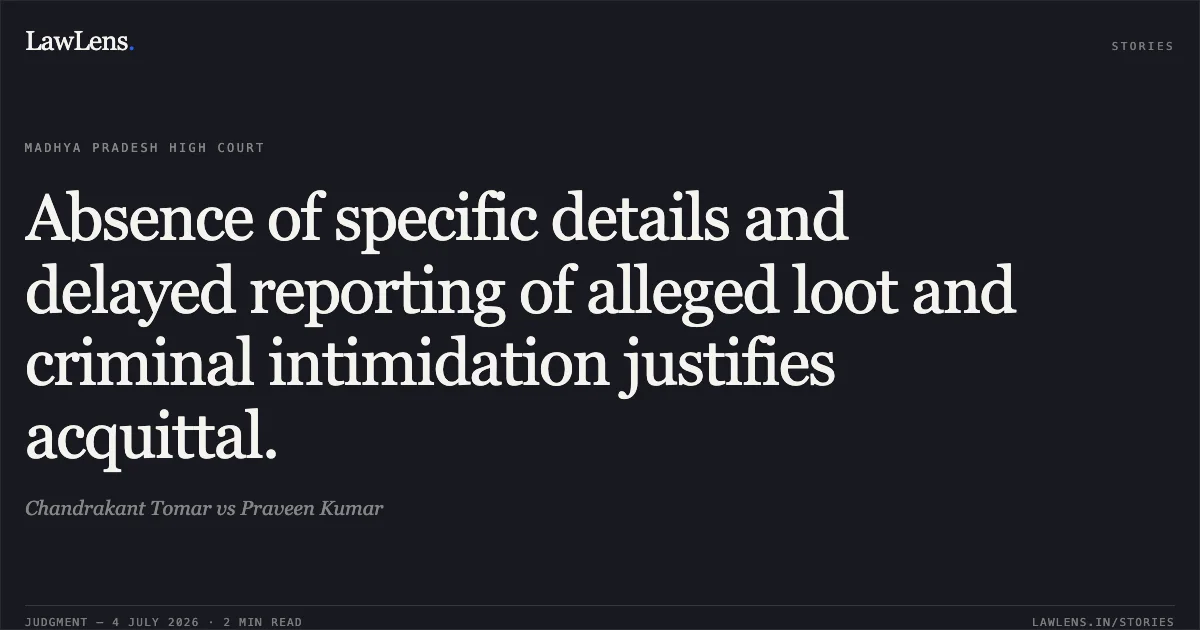
The appellant/complainant alleged that on September 16, 2015, the respondent entered his mobile shop, used filthy language, assaulted him, and looted approximately ₹1,000–₹1,100.
Source reference: para. 2An initial report (Ex. P/1) was signed by the complainant on the day of the incident, but a more detailed complaint (Ex. P/4) mentioning specific abuses, death threats, and the loot was filed three days later.
Source reference: para. 8The Trial Court (1st Additional Sessions Judge, Maihar) convicted the respondent under Section 323 of the IPC for assault but acquitted him of charges under Sections 392 (robbery), 294 (obscene acts/songs), and 506 (criminal intimidation).
Source reference: para. 1, 4The appellant sought leave to appeal against this partial acquittal.
Source reference: para. 1Issues
1. Whether the Trial Court erred in acquitting the respondent under Sections 392, 294, and 506 of the IPC despite the testimony of the complainant.
Source reference: para. 5, 72. Whether the appellate court can interfere with an order of acquittal when the view taken by the Trial Court is a "possible view" based on the evidence.
Source reference: para. 11, 14Law Applied
The court applied Section 378(3) and Section 372 of the CrPC regarding appeals against acquittal.
Source reference: para. 1, 7It relied on the Supreme Court precedents H.D. Sundara v. State of Karnataka (2023), Babu Sahebagouda Rudragoudar v. State of Karnataka (2024), and Mallappa v. State of Karnataka (2024), which establish that an appellate court should not overturn an acquittal unless the judgment is patently perverse, illegal, or based on a misreading of evidence, and that if two views are possible, the one favoring the accused must prevail.
Source reference: para. 11, 12, 13Reasoning
The High Court observed significant discrepancies between the initial report (Ex. P/1) and subsequent complaints (Ex. P/3, P/4). Specifically, the first report omitted any mention of abusive language, death threats, or looted money.
Source reference: para. 8The complainant (PW-1) failed to specify the exact amount or denomination of the notes allegedly taken and did not explain why these details were missing from the first report he signed.
Source reference: para. 9The prosecution failed to examine a key witness—the complainant’s brother—who was allegedly the target of the death threats.
Source reference: para. 10The Court reasoned that these contradictions and omissions created reasonable doubt. Following the principles in Mallappa, the Court found that the Trial Court’s acquittal was a "legally plausible view" and lacked any patent perversity or error of law that would justify reversal.
Source reference: para. 14, 15Holding
The High Court held that the prosecution failed to prove the charges under Sections 392, 294, and 506 of the IPC beyond a reasonable doubt.
The application for leave to appeal (I.A. No. 25761/2023) was dismissed, and consequently, the criminal appeal was dismissed.
Source reference: para. 16Acts & Sections Cited
7 provisions across 2 statutes referred to in this judgment. Each provision opens on LawLens.
Code of Criminal Procedure, 19732
Indian Penal Code, 18605
Original Court PDF
Chandrakant TomarvsPraveen Kumar
Click to open original judgment
Original judgment, available to read, download and summarize on LawLens.in