Facts
The Petitioner (Defendant) challenged an order by the District Munsif Court, Sholinghur, which dismissed his application (I.A. No. 2 of 2024) to condone a 70-day delay in filing a petition to set aside an ex-parte decree.
Source reference: p.2The underlying suit was filed in 2016 for declaration of title and injunction.
Source reference: p.2The Petitioner filed a written statement but subsequently failed to appear for cross-examination on six separate dates between October 2022 and January 2023, leading to him being set ex-parte on 11.01.2023.
Source reference: p.5-6An ex-parte decree was eventually passed on 10.06.2024.
Source reference: p.6The Petitioner claimed the delay was due to ill-health and the need to bring legal heirs of the deceased first plaintiff on record.
Source reference: p.3Issues
1. Whether the Petitioner demonstrated "sufficient cause" under Section 5 of the Limitation Act to warrant condonation of the 70-day delay.
Source reference: p.6-72. Whether the Trial Court was justified in refusing a liberal approach in light of the Petitioner’s litigation conduct and the veracity of the reasons provided.
Source reference: p.7-8Law Applied
The Court applied Section 5 of the Limitation Act, 1963, regarding the condonation of delay upon showing "sufficient cause".
Source reference: p.7It relied on Collector, Land Acquisition, Anantnag v. Mst. Kathiji, which advocated a liberal approach for substantial justice.
Source reference: p.7It tempered this with Pathapati Subba Reddy v. Special Deputy Collector, which held that a liberal approach cannot defeat the law of limitation or revive stale matters without mandatory sufficient cause.
Source reference: p.7It applied Basawaraj v. Land Acquisition Officer, establishing that negligence, lack of bona fides, or inaction by a party disentitles them to discretionary relief, regardless of the length of delay.
Source reference: p.7-8Reasoning
The Court found the Petitioner’s explanations to be factually incorrect and unsupported by evidence. Specifically, the claim that delay occurred because legal heirs needed to be brought on record was deemed false, as the records showed the legal heirs had already joined the suit during its pendency.
Source reference: p.6The Court observed that the Petitioner offered no explanation for his absence during the 1.5-year interval between being set ex-parte (January 2023) and the final decree (June 2024).
Source reference: p.6The Court reasoned that the "liberal approach" is not a substitute for the mandatory requirement of "sufficient cause".
Source reference: p.7Given that the suit had pended for eight years and the Petitioner repeatedly failed to participate in the trial despite multiple opportunities, the Court concluded his conduct was indolent and lacked bona fides.
Source reference: p.6, 8Holding
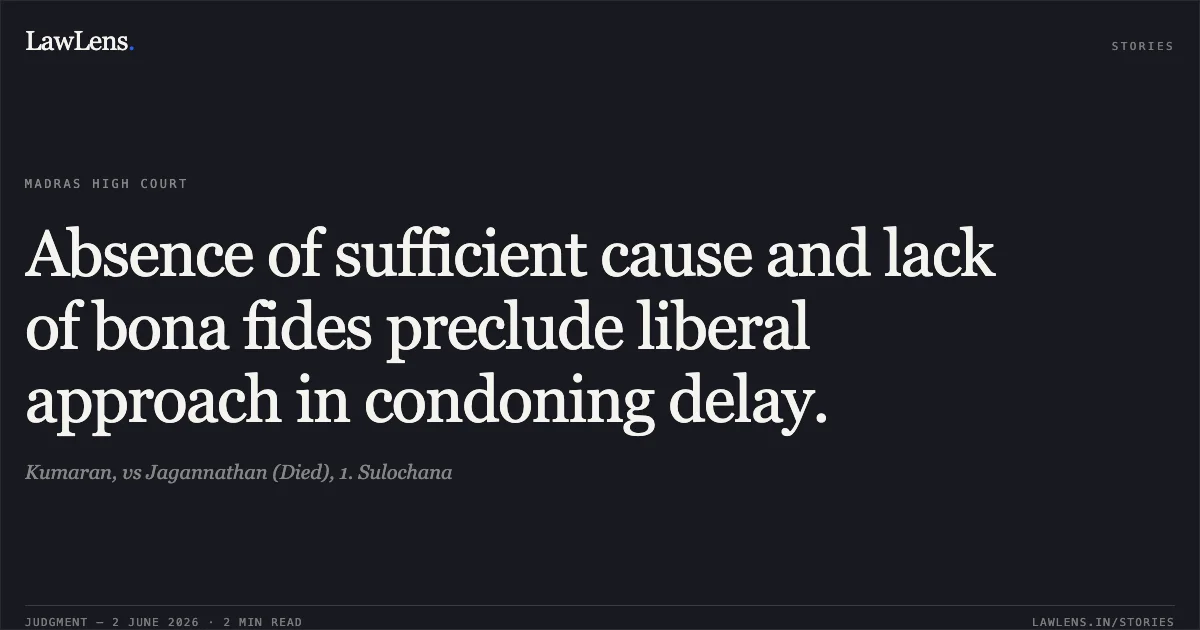
The Court held that despite the delay being relatively short (70 days), the absence of a truthful and sufficient cause, coupled with the Petitioner’s history of prolonging the proceedings, precluded the exercise of discretionary relief.
The High Court dismissed the Civil Revision Petition, affirming the Trial Court's order. The connected miscellaneous petition was closed, and no costs were awarded.
Source reference: p.8Acts & Sections Cited
2 provisions across 2 statutes referred to in this judgment. Each provision opens on LawLens.
Code of Civil Procedure, 19081
Limitation Act, 19631
Original Court PDF
Kumaran,vsJagannathan (Died), 1. Sulochana
Click to open original judgment
Original judgment, available to read, download and summarize on LawLens.in