Facts
The claimant was traveling via the Jamu Tawi Express on May 1, 2004, from Ahmedabad to Mathura
Source reference: p. 2During the journey, he fell from the running train, resulting in injuries that necessitated the amputation of both legs
Source reference: p. 2, 7The Railway Administration contested the claim, asserting that the claimant was not a bona fide passenger due to the absence of a ticket and that the injuries were "self-inflicted" through negligence by sitting on the footboard
Source reference: p. 2, 3The Railway Claims Tribunal originally dismissed the petition on February 28, 2012
Source reference: p. 1The claimant's legal heirs subsequently appealed this dismissal
Source reference: p. 1, 2Issues
1. Whether the claimant qualifies as a "bona fide passenger" in the absence of a physical ticket
Source reference: para. 6, 72. Whether falling from a train due to alleged negligence (such as sitting on a footboard) constitutes a "self-inflicted injury" or an "untoward incident" under the Railways Act
Source reference: para. 8, 9Law Applied
The court primarily applied Section 124A and Section 123(c) of the Railways Act, 1989, which establish a system of "strict liability" or "no-fault liability" for "untoward incidents," including accidental falls from a train
Source reference: para. 8, 9It relied on the Supreme Court precedent in Union of India v. Rina Devi, which held that a claimant’s affidavit of having a ticket shifts the burden of proof to the Railways
Source reference: para. 6It further cited Rajni v. Union of India regarding the rejection of hyper-technical approaches to ticket possession
Source reference: para. 7and Jameela & Ors. v. Union of India, which clarified that negligence or standing at an open door does not constitute a "criminal act" or "self-inflicted injury" under the statutory provisos
Source reference: para. 9Reasoning
The Court reasoned that the issue of passenger status is settled; an affidavit by the claimant is sufficient evidence of being a bona fide passenger unless the Railway Administration provides rebuttal evidence, which it failed to do
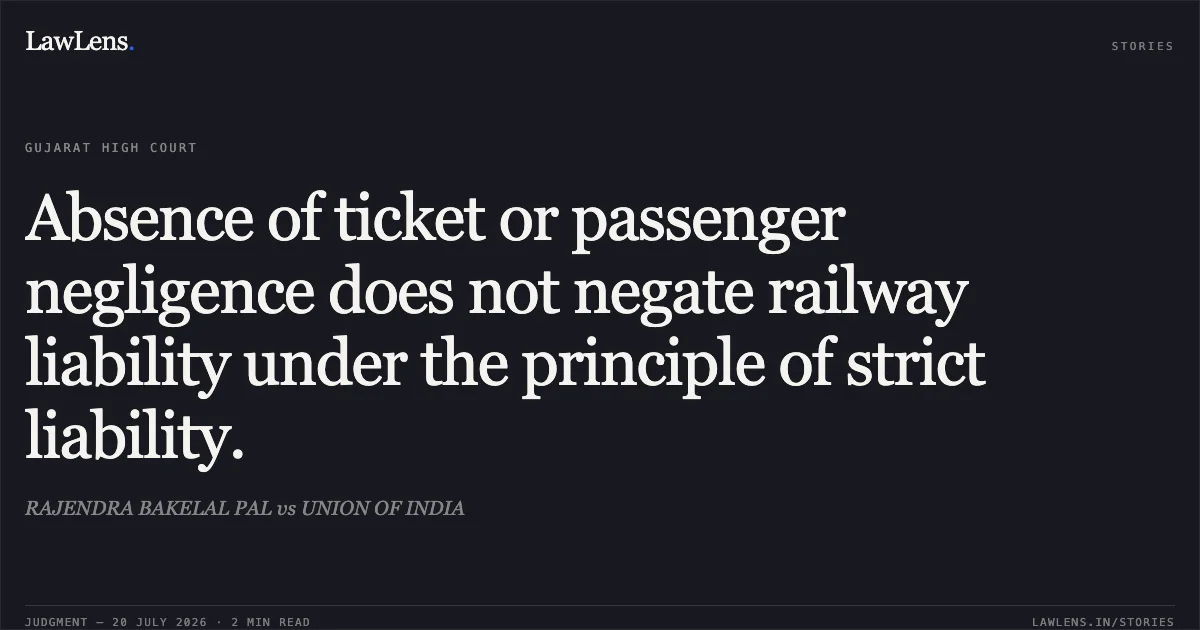
Source reference: para. 6, 7Regarding the "self-inflicted injury" defense, the Court found that the principle of strict liability under Section 124A displaces traditional negligence
Source reference: para. 8It determined that "self-inflicted injury" requires a malicious intent or a "criminal act" (mens rea), whereas falling due to a jerk while on the footboard is merely a negligent or rash act
Source reference: para. 8, 9Since the fall was accidental and did not involve suicide or a criminal attempt, it falls squarely within the definition of an "untoward incident"
Source reference: para. 9, 10Holding
The Court allowed the appeal and set aside the Tribunal's dismissal
It held that the claimant was a bona fide passenger who suffered an untoward incident. The Court ordered the Railway Administration to pay compensation of ₹4,00,000/- with 9% interest from the date of the incident (May 1, 2004), or a flat rate of ₹8,00,000/-, whichever is higher
Source reference: para. 12The amount must be deposited with the Tribunal within eight weeks for disbursement to the claimant
Source reference: para. 13Acts & Sections Cited
2 provisions across 2 statutes referred to in this judgment. Each provision opens on LawLens.
Railway Claims Tribunal Act, 19871
Railways Act, 19891
Original Court PDF
RAJENDRA BAKELAL PALvsUNION OF INDIA
Click to open original judgment
Original judgment, available to read, download and summarize on LawLens.in