Facts
In August 2016, a driver operating a three-wheeled goods vehicle was killed when a milk van allegedly struck his vehicle from behind on the Tindivanam–Pondicherry highway
Source reference: p. 2The deceased's family filed a claim under the Motor Vehicles Act, which the Tribunal allowed, directing the appellant insurance company to pay the compensation and then recover it from the vehicle owner due to licensing issues
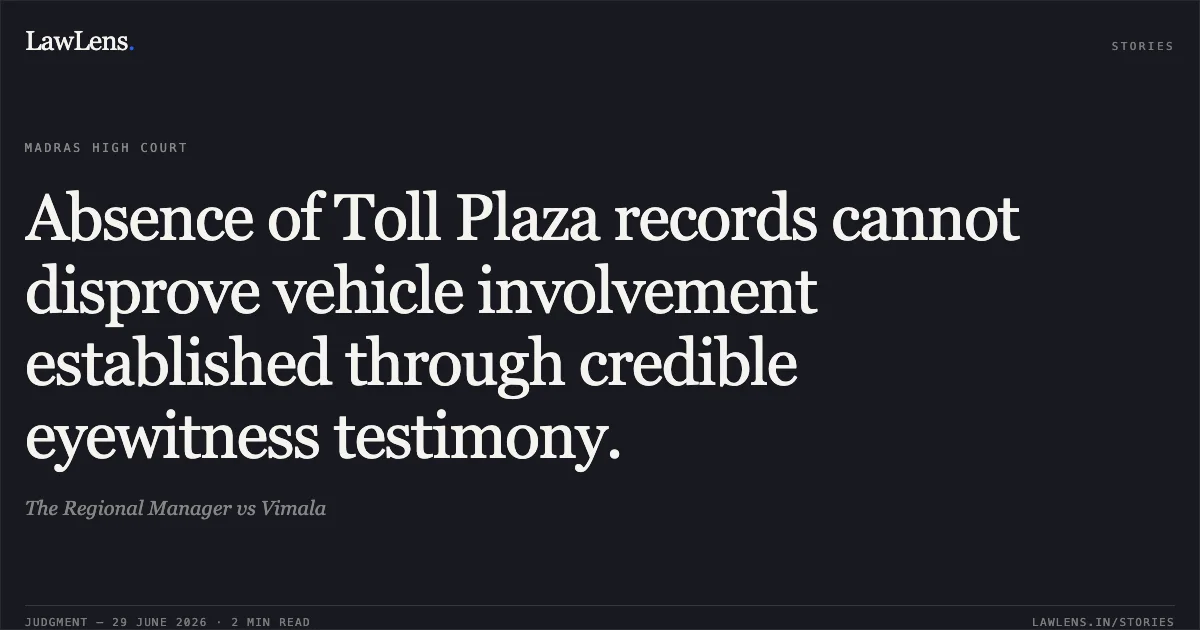
Source reference: p. 3The insurance company appealed, arguing that the milk van was not involved in the accident, citing toll plaza records that showed the vehicle never crossed the nearby toll gate at the time of the incident
Source reference: p. 4Issues
1. Whether the milk van was involved in the accident and if the driver’s negligence caused the fatality
Source reference: p. 52. Whether the Tribunal erred in ordering a "pay and recover" mandate based on the driver's license type
Source reference: p. 8Law Applied
Section 166 of the Motor Vehicles Act regarding compensation claims for motor accidents
Source reference: p. 3M/s. Bajaj Alliance General Insurance Co. Ltd v. Rambha Devi & Ors (2024), which clarifies that a person holding a Light Motor Vehicle (LMV) license is authorized to drive vehicles of that class without additional endorsements, provided the vehicle’s gross weight does not exceed 7,500 kgs
Source reference: p. 8Reasoning
The court found the eyewitness testimony more credible than the documentary evidence presented by the insurance company. Although toll records suggested the van did not cross the plaza, the court noted the accident occurred three kilometers away and the vehicle could have changed direction before reaching the gate
Source reference: p. 7The toll manager admitted that technical limitations could prevent recording vehicles in close proximity
Source reference: p. 6-7Regarding the license, the court observed that the vehicle inspection report classified the van as an LMV. Following recent Supreme Court jurisprudence, since the driver held a valid LMV license, there was no breach of policy conditions that would justify a "pay and recover" order
Source reference: p. 8-9Holding
The High Court dismissed the appeal and confirmed the insurance company's liability to pay the compensation
The court set aside the "pay and recover" direction, ruling that the driver possessed a valid license for the category of vehicle involved in the accident. No costs were awarded
Source reference: p. 9Acts & Sections Cited
2 provisions across 1 statute referred to in this judgment. Each provision opens on LawLens.
Motor Vehicles Act, 19882
Original Court PDF
The Regional ManagervsVimala
Click to open original judgment
Original judgment, available to read, download and summarize on LawLens.in