Facts
The appellant challenged his conviction under Section 3(1)(xi) of the Scheduled Castes and Scheduled Tribes (Prevention of Atrocities) Act, 1989 (the Act), for which he was sentenced to six months of rigorous imprisonment
Source reference: para. 1The prosecution alleged that on 24.12.2006, the prosecutrix (PW-1), belonging to the Uraon (ST) community, went to the appellant’s house to cook food at the request of the appellant's wife
Source reference: para. 2It was alleged that the appellant caught her hand and attempted to push her toward a bed with the intent to outrage her modesty
Source reference: para. 2The prosecutrix escaped, and the appellant reportedly followed her to her house and banged on the door
Source reference: para. 2An FIR was lodged on 26.01.2007, resulting in a 32-day delay
Source reference: para. 5The trial court convicted the appellant based on an oral admission of the victim's caste status without a formal caste certificate being placed on record
Source reference: para. 9Issues
1. Whether a conviction under the SC/ST Act can be sustained in the absence of a social status certificate issued by a competent authority
Source reference: para. 9-102. Whether the unexplained 32-day delay in lodging the FIR vitiates the prosecution's case
Source reference: para. 113. Whether the prosecution proved that the alleged assault was committed with the specific intent to outrage modesty on the ground of the victim’s caste
Source reference: para. 12, 19-20Law Applied
Section 3(1)(xi) of the Scheduled Castes and Scheduled Tribes (Prevention of Atrocities) Act, 1989, which requires that force be used against a woman of a protected community with the intent to dishonour or outrage her modesty specifically on the ground of her caste
Source reference: para. 19-20The Supreme Court precedent in Kumari Madhuri Patil v. Additional Commissioner, Tribal Development, which mandates that social status certificates must be issued by a Revenue Sub-Divisional Officer or higher to be legally valid
Source reference: para. 10Dashrath Sahu v. State of Chhattisgarh, establishing that the "caste-based ground" is a sine qua non for attracting the provisions of the SC/ST Act
Source reference: para. 19-20Reasoning
The Court observed that the prosecution failed to produce a valid caste certificate for the prosecutrix issued by a competent authority.
Source reference: para. 10-11Citing Madhuri Patil and Meghnath v. State of Chhattisgarh, the Court held that the trial court's reliance on the appellant's admission of the victim's caste was legally insufficient to prove her status beyond reasonable doubt
Source reference: para. 10-11The Court found the 32-day delay in filing the FIR to be "inordinate and unexplained," noting that the justification of "fear" did not inspire confidence given the circumstances
Source reference: para. 11On the merits of intent, the Court highlighted the prosecutrix’s own testimony that the families shared cordial relations and that the appellant treated her like a daughter
Source reference: para. 14Applying the Dashrath Sahu principle, the Court reasoned that there was no evidence to suggest the alleged act was motivated by the victim's tribal identity, thereby failing to satisfy the essential ingredients of Section 3(1)(xi) of the Act
Source reference: para. 20Holding
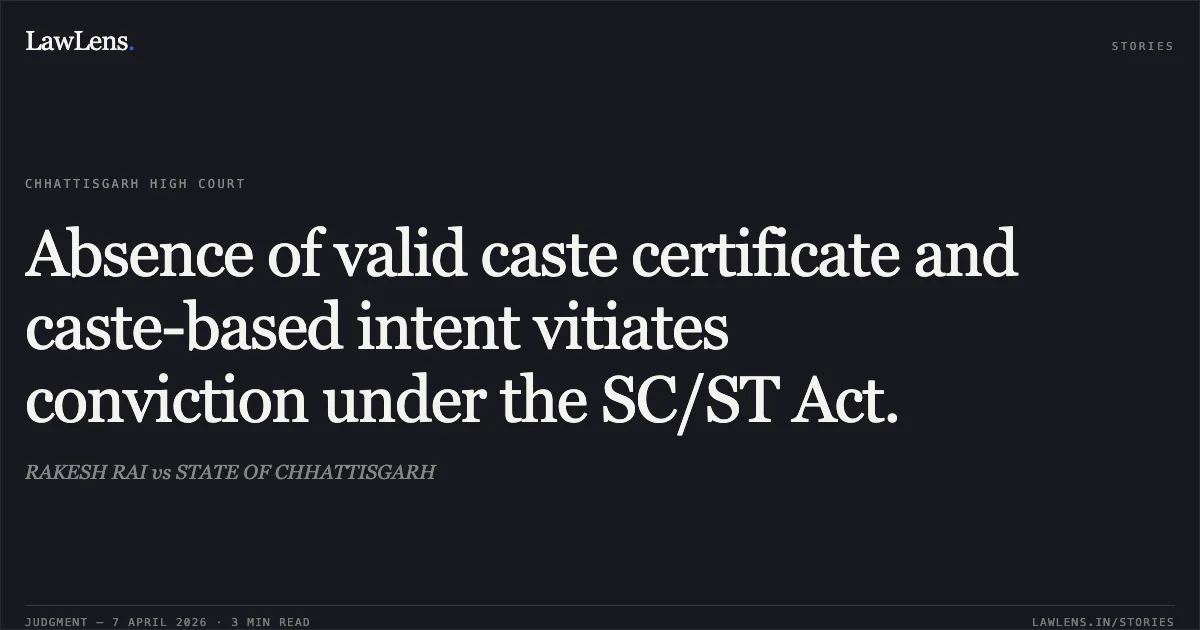
The High Court allowed the appeal and set aside the judgment of conviction and order of sentence dated 29.10.2007
The Court held that in the absence of a documentary social status certificate and proof of caste-based intent, the conviction under the SC/ST Act was unsustainable
Source reference: para. 11, 20The appellant was acquitted of the charge, and his bail bonds were discharged subject to the provisions of Section 437-A of the CrPC
Source reference: para. 21-22Acts & Sections Cited
6 provisions across 4 statutes referred to in this judgment. Each provision opens on LawLens.
Code of Criminal Procedure, 19733
Scheduled Castes and the Scheduled Tribes (Prevention of Atrocities) Act, 19891
Indian Penal Code, 18601
Bharatiya Nagarik Suraksha Sanhita, 20231
Original Court PDF
RAKESH RAIvsSTATE OF CHHATTISGARH
Click to open original judgment
Original judgment, available to read, download and summarize on LawLens.in