Facts
The petitioners were arrested on 26.02.2026 in connection with Jakhalabandha P.S. Case No. 21/2025 under Sections 22, 25, and 29 of the NDPS Act, 1985, following the recovery of commercial quantities of contraband
Source reference: p. 2, 10The petitioners sought regular bail under Section 483 of the Bharatiya Nagrik Suraksha Sanhita (BNSS), 2023, contending that their arrest was illegal because the arrest memo lacked the signature of a family member or a respectable locality member
Source reference: p. 2The prosecution admitted the lack of signatures on the memo but argued that the grounds of arrest and information regarding the detention were duly communicated to the first petitioner's wife via notices under Sections 47 and 48 of the BNSS on the day of arrest
Source reference: p. 3, 9Issues
1. Whether the absence of the signature of a family member or a respectable member of the locality on the arrest memo, as required under Section 36(b)(i) of the BNSS, vitiates the arrest or renders it illegal
Source reference: p. 32. Whether the petitioners are entitled to bail considering the rigors of Section 37 of the NDPS Act
Source reference: p. 10Law Applied
The court applied Section 36 of the BNSS, which mandates the procedure for arrest, including the attestation of the arrest memo by a witness
Source reference: p. 5Section 48 of the BNSS, which requires the police to inform a relative or friend of the arrestee about the detention
Source reference: p. 6, 7Section 62 of the BNSS, which mandates that arrests be made strictly according to the Sanhita
Source reference: p. 5The core legal principle was derived from D.K. Basu v. State of West Bengal (1997), which established mandatory safeguards for arithmetic and detention to prevent custodial torture
Source reference: p. 3, 4Section 37 of the NDPS Act, which restricts bail in cases involving commercial quantities unless there are reasonable grounds to believe the accused is not guilty
Source reference: p. 10Reasoning
The court analyzed the interplay between Section 36(b) and Section 36(c) of the BNSS. It reasoned that while Section 36(b)(i) requires attestation by a family or locality member, Section 36(c) suggests that if such attestation is not possible at the spot, the requirement is satisfied by informing a relative or friend of the arrestee
Source reference: p. 5, 6The court held that the primary purpose of the arrest memo is legal accountability and recording the deprivation of liberty
Source reference: p. 7Since the police had served a formal notice under Section 48 of the BNSS to the petitioner’s wife on the same day, detailing the time, date, and place of arrest, the underlying purpose of attestation was fulfilled
Source reference: p. 8, 9The court distinguished previous Bench decisions where no such Section 48 notice existed on record
Source reference: p. 9Regarding the merits, the court found that because commercial quantities were involved, the petitioners failed to overcome the statutory hurdles under Section 37 of the NDPS Act
Source reference: p. 10Holding
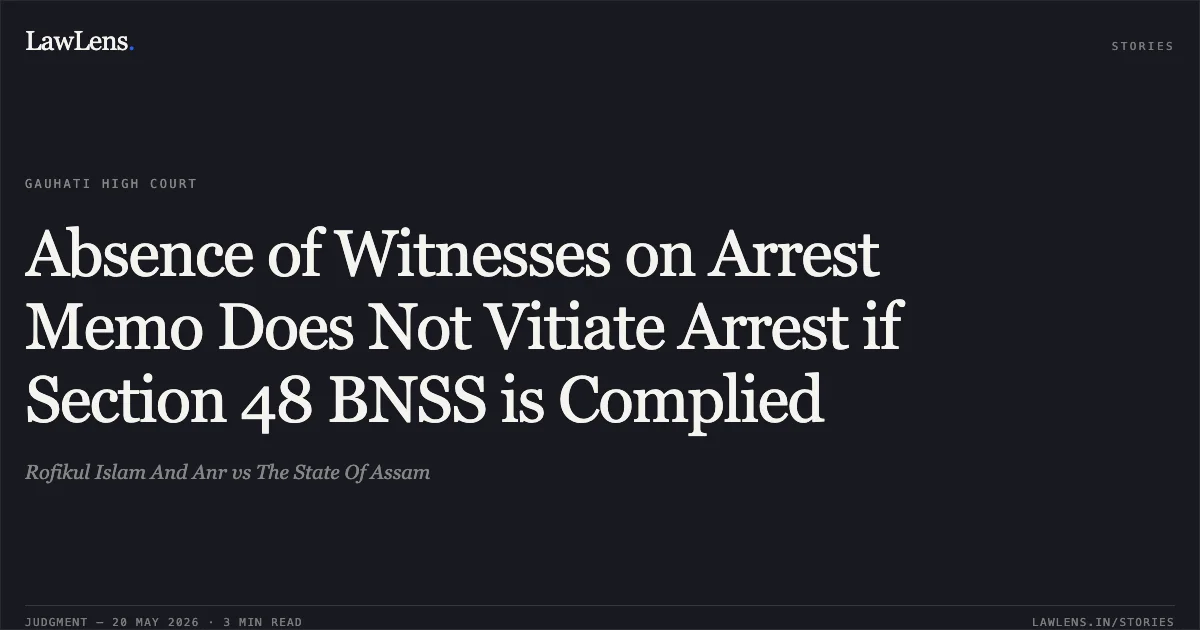
The court concluded that the absence of witness signatures on the arrest memo did not ipso facto vitiate the arrest, provided the information was duly communicated to the family under Section 48 of the BNSS
The court held that the arrest was not illegal and, given the recovery of commercial quantities of contraband, the rigors of Section 37 of the NDPS Act were not satisfied. Consequently, the bail application was rejected and the petition dismissed
Source reference: p. 10Acts & Sections Cited
9 provisions across 2 statutes referred to in this judgment. Each provision opens on LawLens.
Bharatiya Nagarik Suraksha Sanhita, 20236
Narcotic Drugs and Psychotropic Substances Act, 19853
Original Court PDF
Rofikul Islam And AnrvsThe State Of Assam
Click to open original judgment
Original judgment, available to read, download and summarize on LawLens.in