01Facts
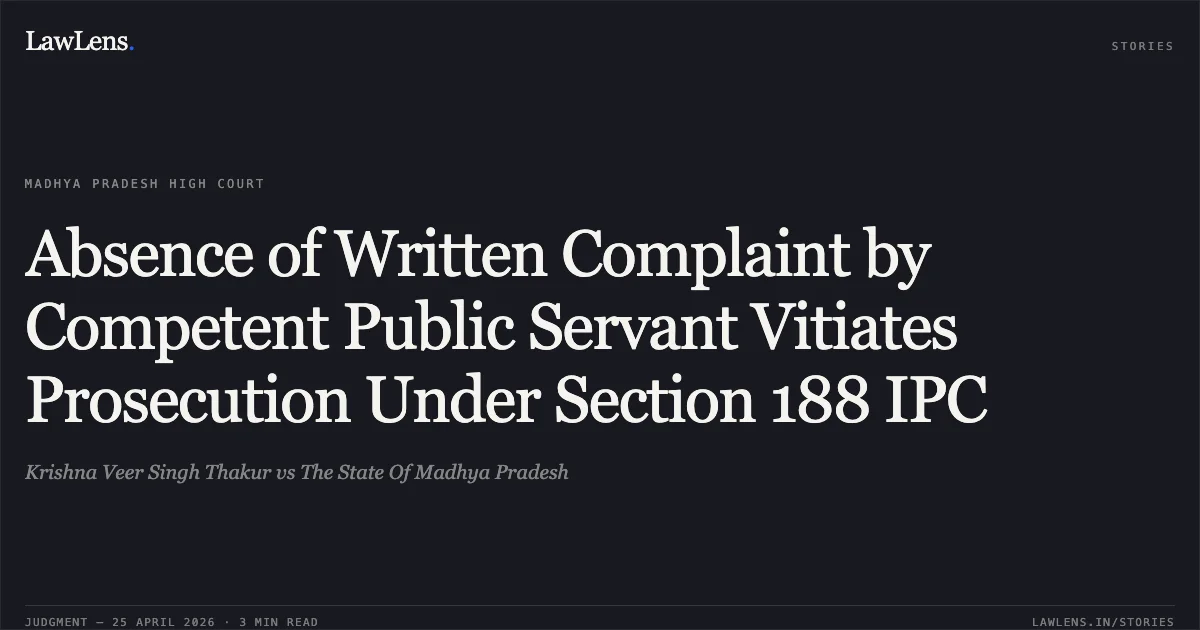
The petitioner, a 74-year-old senior advocate and former President of the District Bar Association, Sagar, participated in a protest on 16.08.2019.
¶ 2The protest allegedly violated a prohibitory order issued by the District Magistrate under Section 144 CrPC on 18.06.2019.
¶ 2Based on a complaint by an Assistant Sub-Inspector (Respondent No. 2), an FIR was registered under Section 188 of the IPC.
¶ 3The Trial Court took cognizance on 23.12.2019.
¶ 3The petitioner filed an application under Section 195 CrPC challenging the cognizance, which the Trial Court rejected on 04.12.2025, stating it lacked the power to revoke cognizance.
¶ 4The petitioner subsequently moved the High Court under Section 528 of the Bharatiya Nagarik Suraksha Sanhita (BNSS), 2023.
¶ 102Issues
i.1. Whether the Trial Court could take cognizance of an offence under Section 188 IPC based on a police FIR rather than a written complaint by the concerned public servant as mandated by Section 195 CrPC.
¶ 7 & 9ii.2. Whether the FIR disclosed the essential ingredients of an offence under Section 188 IPC in the absence of allegations regarding obstruction or danger to human life.
¶ 12iii.3. Whether the High Court should exercise its inherent powers to quash proceedings initiated without jurisdiction.
¶ 13-1403Law Applied
Section 195(1)(a)(i) of the CrPC, 1973 (corresponding to the era of the offence), which creates a mandatory jurisdictional bar against taking cognizance of offences under Sections 172 to 188 IPC except upon a written complaint by the public servant concerned or their superior.
¶ 8-10The absence of such a complaint renders the court incompetent to take cognizance as affirmed in Devendra Kumar v. State (NCT of Delhi) & Anr. (2025 INSC 1009).
¶ 11Section 188 IPC requires disobedience to result in actual obstruction, annoyance, or danger as established in Ramlila Maidan Incident Dt. vs Home Secretary, (2012) 5 SCC 1.
¶ 12Inherent powers under Section 528 of the Bharatiya Nagarik Suraksha Sanhita (BNSS), 2023, to prevent abuse of process.
¶ 13Provisions in the judgment · 20 · Linked ones open on LawLens
Bharatiya Nagarik Suraksha Sanhita, 2023 Section 528
Code of Criminal Procedure, 1973 Section 2Section 195
04Reasoning
The Court reasoned that Section 195 CrPC is a mandatory provision designed to prevent frivolous prosecutions by ensuring only the authority whose order was disobeyed can initiate legal action.
¶ 7In this case, the FIR was lodged by an Assistant Sub-Inspector, who was neither the issuing authority of the prohibitory order (the District Magistrate) nor the administrative superior of that authority.
¶ 9Consequently, the police report did not satisfy the definition of a "complaint" under Section 2(d) CrPC required for Section 195.
¶ 9The court observed a substantive defect: the FIR lacked allegations that the petitioner’s participation caused obstruction, injury, or danger to human life, which are essential ingredients for a conviction under Section 188 IPC.
¶ 5 & 12The Trial Court’s refusal to rectify this jurisdictional error on the grounds that "cognizance cannot be revoked" was deemed legally untenable, as proceedings void ab initio can be quashed at any stage to secure the ends of justice.
¶ 1305Holding
The High Court allowed the petition, holding that the criminal proceedings were vitiated due to non-compliance with the mandatory requirements of Section 195 CrPC and the absence of essential ingredients of the offence.
¶ 15-16The Court quashed the FIR dated 16.08.2019, the cognizance order dated 23.12.2019, and the order dated 04.12.2025; all consequential proceedings in Criminal Case No. RCT/2755/2019 pending before the trial court were set aside regarding the petitioner.
¶ 16Original Court PDF
Krishna Veer Singh ThakurvsThe State Of Madhya Pradesh
Click to open original judgment
Original judgment, available to read, download and summarize on LawLens.in