Facts
The applicant, Karan, sought regular bail in a murder case registered under Sections 109(1)/3(5) of the Bharatiya Nyaya Sanhita (BNS), 2023
Source reference: p. 1On August 16, 2024, a vehicle collision led to an altercation where the applicant, armed with a knife, allegedly stabbed two individuals, Dharmender (who succumbed to injuries) and Vimal Prakash
Source reference: p. 2The applicant was arrested on the same day.
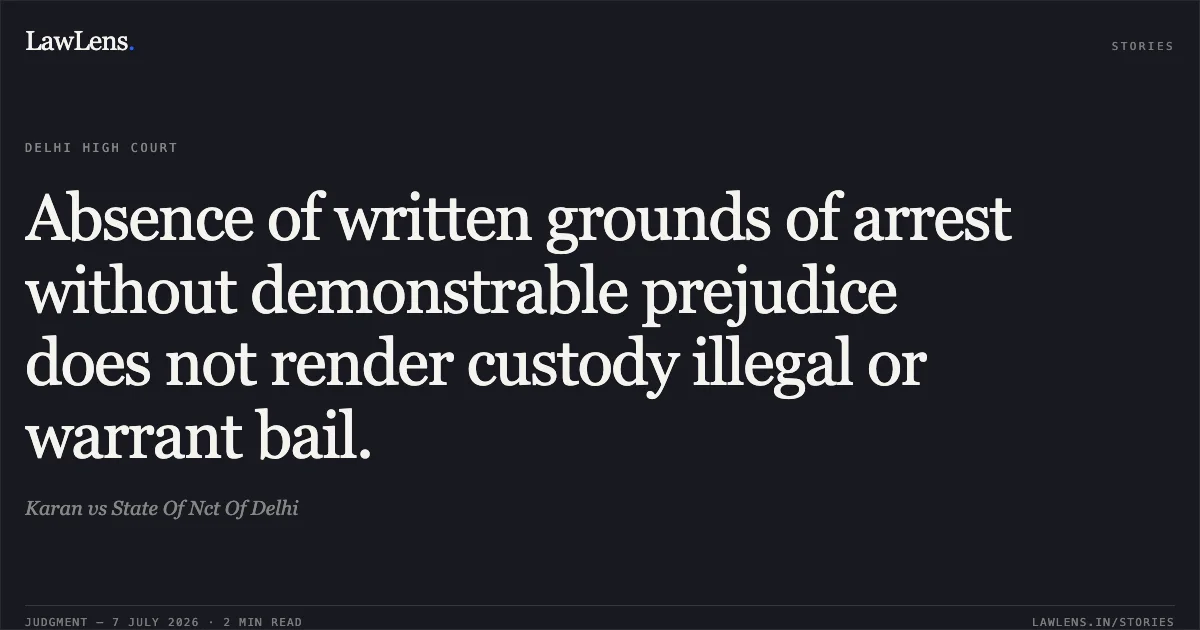
Source reference: p. 2The primary contention for bail was that the arrest was illegal and violated Article 22(1) of the Constitution and Sections 36, 47, 48, and 49 of the BNSS, as the "grounds of arrest" were allegedly never provided in writing to the applicant or his relatives
Source reference: p. 2The State countered that the grounds were provided in writing, signed by the accused, and recorded in the case diary
Source reference: p. 3Issues
1. Whether the arrest of the applicant was illegal due to the alleged non-communication of the "grounds of arrest" in writing in accordance with the mandate of the Constitution and BNSS.
Source reference: p. 2 / para. 22. Whether the requirement of providing written grounds of arrest as per Mihir Rajesh Shah applies retrospectively to an arrest made on August 16, 2024.
Source reference: p. 3 / para. 12Law Applied
The court applied Article 22(1) of the Constitution of India and Section 47 of the BNSS (formerly Section 50 Cr.P.C.), which mandates informing an arrestee of the grounds of arrest
Source reference: p. 2It relied on Mihir Rajesh Shah v. State of Maharashtra, which clarified that the mandatory written communication of grounds operates prospectively from November 6, 2025
Source reference: p. 3-4The court applied the "prejudice-oriented test" established in State of Karnataka v. Sri Darshan, which holds that substantial compliance is sufficient and a mere absence of written grounds does not render an arrest illegal unless demonstrable prejudice is shown
Source reference: p. 6-8Reasoning
The court found that the applicant's arrest occurred on August 16, 2024, well before the prospective cutoff for mandatory written grounds established in Mihir Rajesh Shah
Source reference: p. 4Upon examining the case diary, the court noted that the police had indeed detailed specific grounds for arrest—including CCTV footage and eyewitness identification—and that the applicant had signed these grounds
Source reference: p. 3, 5-6The court observed that during the first remand on August 17, 2024, the applicant was represented by legal aid counsel and raised no grievances regarding the grounds of arrest, only mentioning his own injuries
Source reference: p. 4-5Applying the principles from Sri Darshan, the court determined that the applicant failed to show any "demonstrable prejudice," as he was aware of the reasons for his arrest and was legally represented from the outset
Source reference: p. 7-8Holding
The court answered the first issue in the negative, holding that there was no violation of procedural safeguards as the grounds were substantially communicated and acknowledged
On the second issue, the court reaffirmed that prospective application of written communication rules meant the applicant’s prior arrest was not vitiated
Source reference: p. 4The Court dismissed the bail application, concluding that procedural lapses in furnishing grounds, absent prejudice, do not render custody illegal or entitle an accused to bail in a grave offence under Section 302 IPC (now BNS)
Source reference: p. 8Acts & Sections Cited
2 provisions across 1 statute referred to in this judgment. Each provision opens on LawLens.
Bharatiya Nyaya Sanhita, 20232
Original Court PDF
KaranvsState Of Nct Of Delhi
Click to open original judgment
Original judgment, available to read, download and summarize on LawLens.in