Facts
ONGC invited tenders for the supply of Ordinary Portland Cement to various destinations. Balaram Cements Limited (“BCL”) submitted a tender dated 8 August 1990, accompanied by earnest money of ₹2,00,000, but stipulated several conditions, including a 90-day validity period and payment terms requiring 95% payment against proof of dispatch.
Source reference: pp. 3–4, 16, 24ONGC sought clarifications by telex dated 15 September 1990 and required BCL to furnish the balance earnest money of ₹9,00,000. BCL provided the clarifications and furnished a bank guarantee for the balance amount. Thereafter, the parties engaged in negotiations regarding prices and payment incentives. BCL extended the validity of its offer up to 30 November 1990, subsequently revised its rates due to increased duties and petroleum prices, and offered to supply a limited quantity at the old rate as a goodwill gesture. ONGC issued a limited supply order and later asserted that a contract had been concluded, invoking the bank guarantee when BCL did not accept the alleged contractual obligations. BCL instituted Special Civil Suit No. 2 of 1991 seeking refund of the earnest money and an injunction against invocation of the bank guarantee. The trial court decreed the suit, directing ONGC to refund ₹2,00,000 with interest and declaring invocation of the bank guarantee illegal. ONGC preferred the present first appeal.
Source reference: pp. 3–8, 16–19; p. 2Issues
1. Whether the correspondence and conduct of the parties resulted in a concluded and enforceable contract for the supply of cement.
Source reference: paras. 1, 15.1; pp. 23–262. Whether, in the absence or presence of such a concluded contract, ONGC was legally entitled to forfeit or retain the earnest money and invoke the bank guarantee.
Source reference: paras. 1, 15.1, 30–31Law Applied
The Court applied Sections 3 and 4 of the Indian Contract Act, 1872 concerning communication of proposals, acceptances and revocations, and Section 7 requiring acceptance to be absolute and unqualified; an acceptance introducing a new condition is a counter-proposal and does not conclude a contract unless accepted by the original proposer.
Source reference: paras. 20–24Relying on Bhagwandas Goverdhandas Kedia v. Girdharilal Parshottamdas & Co., AIR 1966 SC 543, the Court reiterated that acceptance and, where required, communication of acceptance are necessary for formation of a binding contract. It also relied on Padia Timber Company Pvt. Ltd. v. Board of Trustees of Visakhapatnam Port Trust, (2021) 3 SCC 24, for the rule that acceptance with variation is merely a counter-proposal, and Rickmers Verwaltung GmbH v. Indian Oil Corporation, (1999) 1 SCC 1, for the proposition that whether negotiations have culminated in a contract depends on the facts and circumstances. The Court distinguished National Highways Authority of India v. Ganga Enterprises, (2003) 7 SCC 410, which concerned withdrawal after an unqualified acceptance and formation of a concluded contract. It further relied on the tender’s own Condition No. 14, under which the contract would be concluded only upon issuance of a letter or telegram of acceptance.
Source reference: paras. 22–25, 28–31Reasoning
The Court held that BCL’s tender was not an unconditional acceptance of ONGC’s tender terms because it introduced material deviations regarding payment and validity, thereby operating as a counter-offer. ONGC’s telex of 15 September 1990 merely sought clarifications and additional earnest money; it did not constitute the unequivocal letter or telegram of acceptance contemplated by Condition No. 14.
Source reference: paras. 26, 28–29The subsequent correspondence demonstrated continuing negotiations concerning rates, payment incentives and quantities. BCL’s offer to supply 2,500 metric tonnes at the old rate was treated as a limited goodwill proposal rather than evidence of acceptance of a larger, binding contract. The limited supply order also did not amount to acceptance of BCL’s original offer in its entirety. Since no unconditional acceptance or formal acceptance communication was proved, the parties remained at the negotiation stage. The mandatory deposit of earnest money at the tender stage did not, by itself, establish a concluded contract or confer upon ONGC a right to retain the money. Consequently, ONGC could neither forfeit the earnest money nor invoke the bank guarantee in the absence of a contractual breach arising from a binding agreement.
Source reference: paras. 26–30Holding
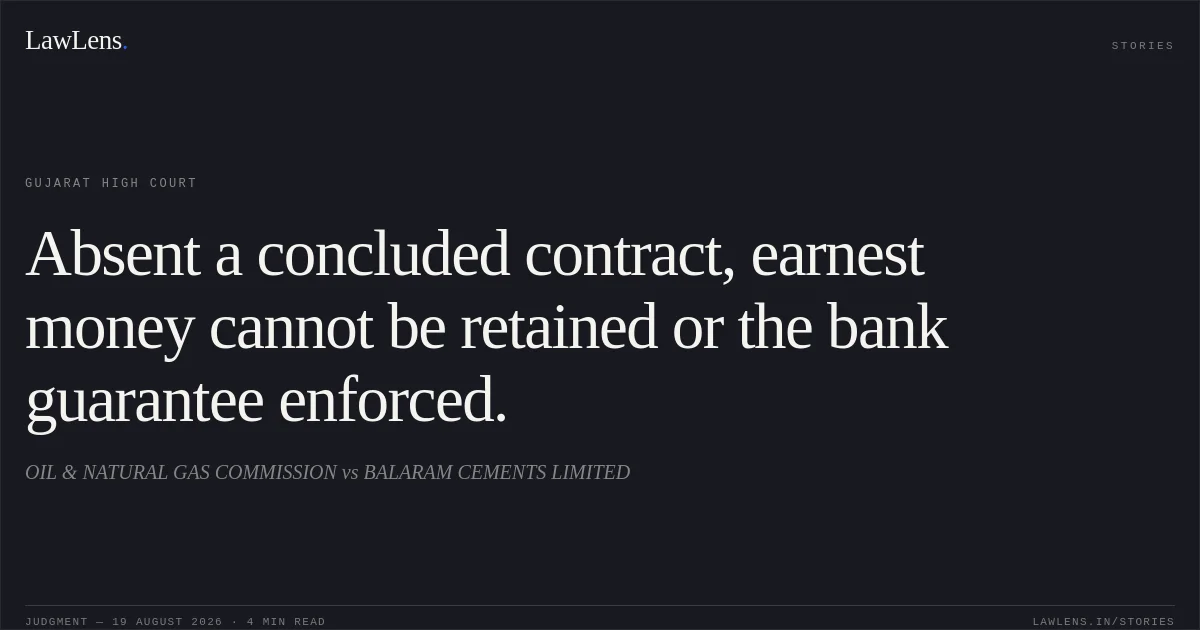
The Court answered both issues in favour of BCL. It held that no concluded, enforceable or binding contract had come into existence between BCL and ONGC. ONGC therefore had no legal right to retain the ₹2,00,000 earnest money or invoke and enforce the ₹9,00,000 bank guarantee.
The trial court’s decree directing refund of ₹2,00,000 with 6% interest from institution of the suit and declaring invocation of the bank guarantee illegal was upheld. The first appeal was dismissed, and the interim relief, if any, was discontinued.
Source reference: p. 2; para. 32Acts & Sections Cited
5 provisions across 2 statutes referred to in this judgment. Each provision opens on LawLens.
Code of Civil Procedure, 19081
Original Court PDF
OIL & NATURAL GAS COMMISSIONvsBALARAM CEMENTS LIMITED
Click to open original judgment
Original judgment, available to read, download and summarize on LawLens.in