01Facts
The plaintiff instituted a suit for specific performance of an alleged agreement dated 30 May 1980, executed by Bahadur K. Marfatia and his mother, Smt. Gulbano, for sale of “Roxy Talkies” and its fixtures for ₹10 lakh.
¶ 5The plaintiff claimed to have paid ₹3.50 lakh, comprising ₹2.60 lakh through pay order and ₹40,000 in cash, with further payment contemplated under the agreement.
¶ 5The agreement required the parties to obtain requisite permissions/NOCs and contemplated execution of the sale deed within three months.
¶ 5The defendant denied that the document was an agreement for sale and contended that it had been executed only as security for an interest-free loan of ₹3.50 lakh.
¶ 10The attesting witness Moolchand Yadav supported the loan transaction and denied that the property was intended to be sold.
¶ 14, 28–29The other attesting witness, Parmanand, was not examined, and the defendant and his mother were unavailable for examination owing to their deaths.
¶ 13–14, 25The Trial Court rejected the claim for specific performance but directed refund of ₹3.50 lakh with compound interest at 15% per annum from the date of suit.
¶ 15The defendant preferred the present appeal, principally challenging the award of compound interest, while the plaintiff filed cross-objections seeking specific performance.
¶ 16Purchasers claiming to have acquired the property during pendency of the appeal also sought impleadment under Order XXII Rules 10 and 11 CPC; their application was rejected as their presence was unnecessary for adjudication of the appeal and they would be bound by the result of the litigation.
¶ 2–302Issues
i.1. Whether the plaintiff established that the document dated 30 May 1980 was an agreement for sale enforceable by specific performance, rather than a security document executed in connection with a loan transaction?
¶ 25–32, 35–41ii.2. Whether, after denying specific performance, the Trial Court could award compound interest at 15% per annum on the refundable amount?
¶ 42–47iii.3. Whether the alleged pendente lite purchasers were necessary or proper parties to the appeal under Order XXII Rules 10 and 11 CPC?
¶ 2–303Law Applied
Specific performance is a discretionary equitable relief and is not granted merely because the contract is legally enforceable; the Court must consider all surrounding circumstances and ensure that the remedy is not used oppressively or to secure an unfair advantage, as stated in Parakunnan Veetill Joseph’s Son Mathew v. Nedumbara Kuruvila’s Son.
¶ 23The true character of a transaction may be determined from the circumstances and conduct of the parties, notwithstanding the nomenclature of the document, as recognised in Mangala Kunhimina Umma v. Puthiyaveettil Paru Amma.
¶ 26Delay and lack of promptitude may also justify refusal of specific performance, particularly where the plaintiff waits nearly until the limitation period, as reflected in U.N. Krishnamurthy v. A.M. Krishnamurthy and Alagammal v. Ganesan.
¶ 33–34Under Section 34 CPC, in a money decree the Court may award reasonable interest from the date of suit to the decree, but post-decree interest ordinarily cannot exceed 6% per annum in the absence of a contractual or statutory basis permitting a higher rate; compound interest cannot be awarded under Section 34 CPC merely as a matter of discretion.
¶ 44–47In a specific-performance suit, the intending seller and purchaser are the necessary parties, while a pendente lite purchaser is ordinarily bound by the outcome of the litigation.
¶ 3Provisions in the judgment · 4 · Linked ones open on LawLens
Code of Civil Procedure, 1908 Section 34Section 96Section 151
Specific Relief Act, 1963 Section 20
04Reasoning
The Court held that the plaintiff failed to establish that the document represented a genuine agreement for sale.
¶ 25–32, 35–41The attesting witness Moolchand consistently deposed that Bahadur Marfatia had borrowed money and that the document was executed as security, expressly denying any agreement to sell Roxy Talkies.
¶ 28–30The defendant did not apply for the Income Tax NOC, and the plaintiff’s application under the Ceiling Act was made only on 30 July 1980, after the stipulated period had substantially elapsed; no requisite permission or NOC was ever obtained during the lifetime of the executants.
¶ 31, 40The plaintiff also failed to examine the other attesting witness or the Notary, and his testimony disclosed material gaps regarding the negotiations, execution, and supporting affidavits.
¶ 36–41His failure to institute proceedings promptly after the defendant’s public denial of the sale agreement further militated against the grant of discretionary relief.
¶ 32As to interest, the Court accepted that the payment of ₹3.50 lakh was undisputed and that refund was proper.
¶ 43However, the agreement contained no stipulation for interest, and the Trial Court identified no lawful basis for awarding compound interest at 15% per annum.
¶ 44–47The Court distinguished Indian Council for Enviro-Legal Action v. Union of India, observing that the Supreme Court in that case exercised constitutional powers, whereas the Trial Court was confined to the statutory framework of Section 34 CPC.
¶ 46–47Accordingly, the compound-interest direction was held to be without jurisdiction.
¶ 46–4705Holding
The plaintiff’s cross-objections were dismissed, and the refusal to grant specific performance was affirmed because the transaction was not sufficiently proved to be an agreement for sale and the surrounding circumstances supported the defendant’s loan-security version.
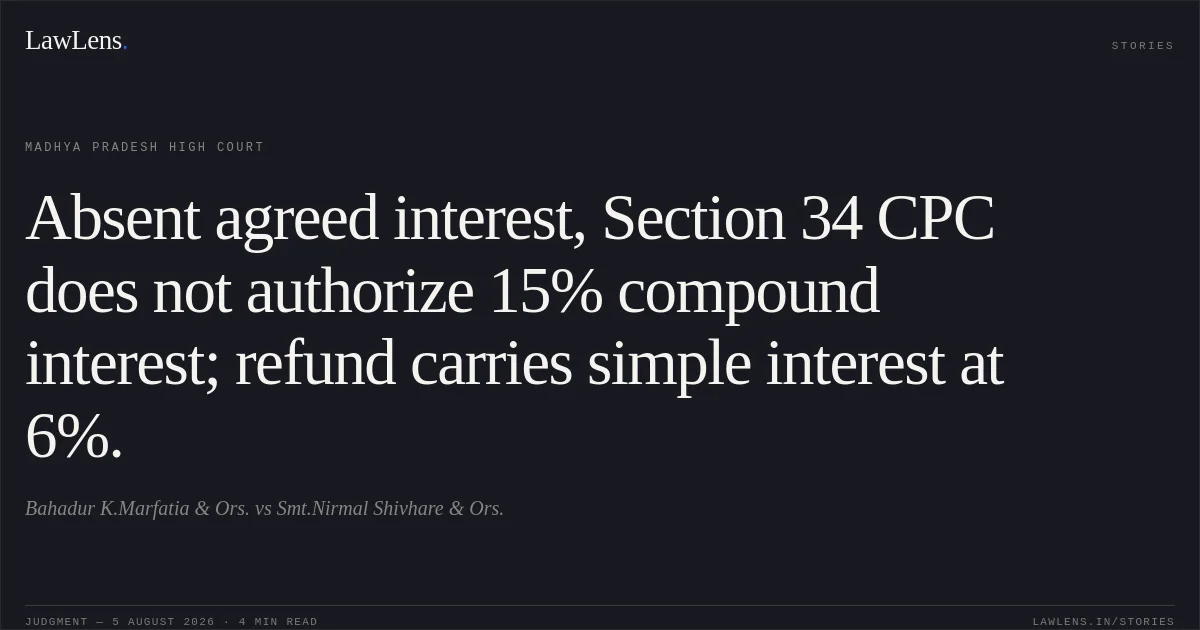
¶ 47(i)The defendant’s appeal was partly allowed: the decree for refund of ₹3.50 lakh was maintained, but the award of compound interest at 15% per annum was set aside and replaced with simple interest at 6% per annum from the date of institution of the suit until actual payment.
¶ 47(ii)The parties were directed to bear their own costs, and the impleadment application of the alleged pendente lite purchasers was rejected.
¶ 3, 47(iii)Original Court PDF
Bahadur K.Marfatia & Ors.vsSmt.Nirmal Shivhare & Ors.
Click to open original judgment
Original judgment, available to read, download and summarize on LawLens.in