Facts
The complainant, an employee of the petitioner, alleged that on 14 December 2016, inside the petitioner’s showroom at Kirti Nagar, the petitioner abused and insulted him using caste-based slurs in the presence of other employees, confiscated his mobile phone, threatened him, and withheld his salary.
Source reference: paras. 1–3, 5–8; pp. 1–4An FIR was registered on 3 February 2017 under Sections 3(1)(r) and 3(1)(s) of the Scheduled Castes and Scheduled Tribes (Prevention of Atrocities) Act, 1989, as amended in 2015.
Source reference: paras. 1–3; pp. 1–4The Trial Court framed charges against the petitioner on 13 April 2018.
Source reference: paras. 1–3; pp. 1–4The complainant was subsequently proceeded against ex parte due to repeated non-appearance.
Source reference: para. 4; p. 2Issues
Whether the materials on record disclosed the essential ingredients of offences under Sections 3(1)(r) and 3(1)(s) of the SC/ST Act, including intentional caste-based insult or abuse occurring “in any place within public view”.
Source reference: paras. 10–11, 13–16; pp. 4–8Whether the Trial Court erred in mechanically framing charges without properly sifting the prosecution material to determine whether a prima facie case existed under Sections 227 and 228 CrPC.
Source reference: para. 12; pp. 5–6Whether the High Court should exercise its inherent jurisdiction under Section 482 CrPC to set aside the order framing charges and discharge the petitioner.
Source reference: paras. 17–19; p. 8Law Applied
Sections 3(1)(r) and 3(1)(s) of the SC/ST Act require, respectively, intentional insult or intimidation with intent to humiliate, or abuse by caste name, against a member of a Scheduled Caste or Scheduled Tribe, and the act must occur “in any place within public view”.
Source reference: para. 10; p. 4Relying on Hitesh Verma v. State of Uttarakhand, Karuppudayar v. State, and Ramkrishna Chauhan v. State of U.P., the Court held that the place must be one where members of the public could see, hear, or witness the alleged utterances; an incident occurring within the confines of a room, without such public presence, does not satisfy this requirement.
Source reference: para. 11; pp. 4–5Under Sections 227 and 228 CrPC, the Court must consider and sift the prosecution material to ascertain whether sufficient grounds or a prima facie basis for proceeding exist, rather than frame charges mechanically.
Source reference: para. 12; p. 5This principle was supported by Sajjan Kumar v. CBI, Ghulam Hassan Beigh v. Mohd. Maqbool Magrey, and Dr. Anand Rai v. State of Madhya Pradesh.
Source reference: para. 12; p. 5Section 482 CrPC empowers the High Court to prevent abuse of process and secure the ends of justice.
Source reference: para. 17; p. 8Reasoning
The Court found that the alleged utterances were made inside the petitioner’s showroom, described as a space within the four corners of a room, and therefore lacked the requisite element of being made in a place within public view.
Source reference: para. 13; p. 6More importantly, although the Trial Court relied on the statements of Ganesh Kapoor and Jagriti to frame charges, neither witness’s Section 161 CrPC statement recorded any casteist slur or derogatory caste-based remark by the petitioner.
Source reference: paras. 13–16; pp. 6–8Their statements, at most, suggested a general quarrel or altercation.
Source reference: paras. 13–16; pp. 6–8The prosecution also acknowledged that two witnesses named in the FIR had declined to give statements and that three recorded witnesses had not supported the allegation of caste-based abuse.
Source reference: para. 8; p. 4Consequently, the basic statutory ingredients of Sections 3(1)(r) and 3(1)(s) were absent.
Source reference: paras. 16–17; pp. 7–8The Trial Court’s approach of leaving the conflicting evidence entirely for trial, without first verifying whether the essential ingredients of the offences were disclosed, amounted to mechanical framing of charges.
Source reference: paras. 12–17; pp. 5–8Holding
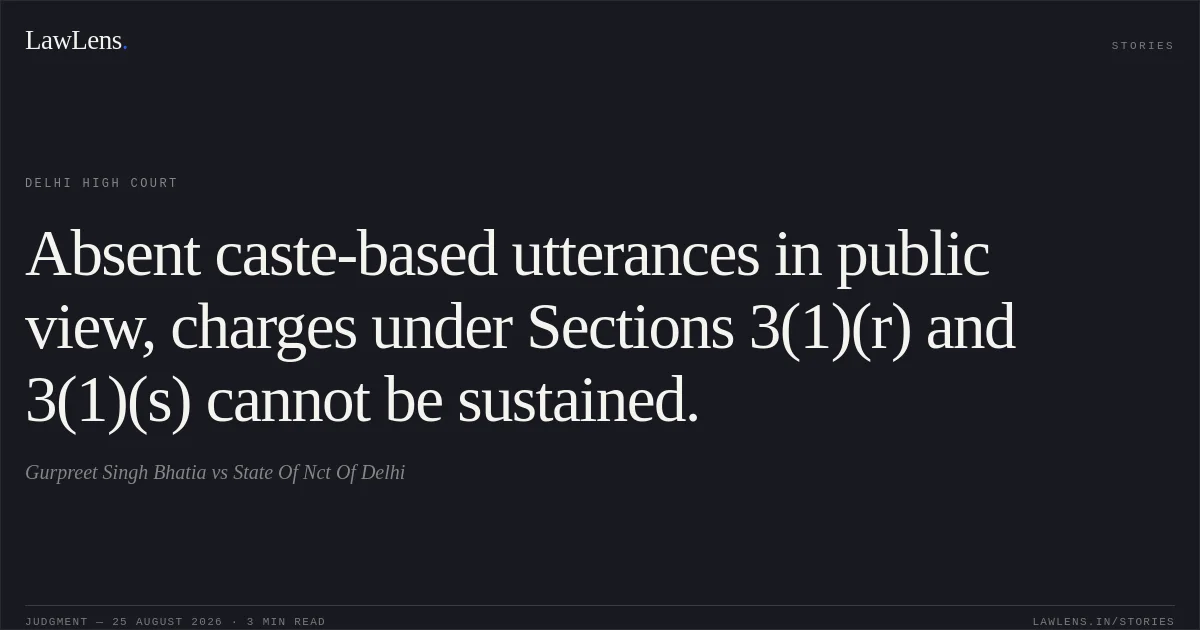
The High Court held that the prosecution material did not establish a prima facie case under Sections 3(1)(r) and 3(1)(s) of the SC/ST Act because the alleged remarks were not shown to have been made in a place within public view and the material witnesses did not substantiate the caste-based allegations.
Exercising jurisdiction under Section 482 CrPC, the Court set aside the Trial Court’s order dated 13 April 2018 and discharged the petitioner from the offences under Sections 3(1)(r) and 3(1)(s) of the Act.
Source reference: paras. 18–19; p. 8The petition and pending application were accordingly disposed of.
Source reference: paras. 18–19; p. 8Acts & Sections Cited
5 provisions across 2 statutes referred to in this judgment. Linked provisions open on LawLens.
Code of Criminal Procedure, 19734
Scheduled Caste and Scheduled Tribe (Prevention of Atrocities) Amendment Act, 20151
Original Court PDF
Gurpreet Singh BhatiavsState Of Nct Of Delhi
Click to open original judgment
Original judgment, available to read, download and summarize on LawLens.in
![Courts will not interfere with transfers absent mala fides or violation of statutory rules.. M Ramya vs EMPLOYEES STATE INSURANCE CORPORATION (ESIC). CAT - ['Chennai']. LawLens](/stories/thumbnails/courts-will-not-interfere-with-transfers-absent-mala-fides-or-violation-of-statutory-rules-a6845e9ca6f548fca284c51c8351957f.webp)
![Courts cannot direct one-time recruitment age relaxation absent authority in the governing rules or advertisement.. UT OF PUDUCHERRY vs M ANDAL. CAT - ['Chennai']. LawLens](/stories/thumbnails/courts-cannot-direct-one-time-recruitment-age-relaxation-absent-authority-in-the-governing-895d78fde47143e2a8ed0207c4b6a44f.webp)
![A review cannot correct an allegedly erroneous decision absent an error apparent on the record.. Ajit Kumar Jha vs RAILWAY BOARD. CAT - ['Delhi']. LawLens](/stories/thumbnails/a-review-cannot-correct-an-allegedly-erroneous-decision-absent-an-error-apparent-on-the-re-8ac952fd4eba470c92f7da20af72a220.webp)