Facts
The respondents/plaintiffs instituted a suit for specific performance in 2009 concerning property bearing No. C-82, Anand Niketan, New Delhi, based on an agreement to sell dated 16 June 2004 allegedly executed by B.P. Sharma for a consideration of ₹60,00,000.
Source reference: p.2, para. 2B.P. Sharma, the sole defendant, contested the suit and denied execution of any enforceable agreement.
Source reference: p.2, para. 3The petitioner, Diwakar Kaushik, represented B.P. Sharma as his General Power of Attorney holder during the proceedings.
Source reference: p.2, para. 4The defendant’s evidence was closed on 30 April 2019 and the matter was listed for final arguments.
Source reference: p.2, para. 5B.P. Sharma executed a registered Will dated 14 November 2022 bequeathing the suit property to the petitioner and died on 1 February 2024.
Source reference: p.2, para. 6The petitioner thereafter sought, under Section 151 CPC, to be substituted as the deceased defendant’s legal representative on the basis of the Will.
Source reference: p.2, para. 6The plaintiffs separately sought substitution of the deceased defendant’s Class I legal heirs under Order XXII Rule 4 CPC, which was allowed by the Trial Court on 7 November 2025.
Source reference: p.2–3, para. 7The petitioner also instituted probate proceedings concerning the Will, which remained pending.
Source reference: p.3, para. 8By order dated 26 May 2026, the Trial Court dismissed the petitioner’s substitution application, holding that his rights depended on the validity of the contested Will and that allowing his impleadment would convert the specific-performance suit into a title dispute.
Source reference: p.3, para. 9The petitioner challenged that order under Article 227 of the Constitution through the present petition.
Source reference: p.3, para. 10Issues
Whether the petitioner, claiming under a contested Will, was entitled to be substituted as the legal representative of the deceased defendant in the pending suit for specific performance under Section 151 and Order XXII Rule 5 CPC?
Source reference: p.3–4, paras. 11–13Whether the petitioner’s substitution was necessary when the deceased defendant’s Class I legal heirs had already been brought on record under Order XXII Rule 4 CPC?
Source reference: p.4, paras. 14–15, 22Whether impleading the petitioner would improperly enlarge the scope of the specific-performance suit into an adjudication of title and testamentary rights?
Source reference: p.4–6, paras. 16, 18–21Law Applied
The Court considered Section 2(11) CPC, which defines a legal representative to include a person who in law represents the estate of a deceased person, along with Section 151 CPC and Order XXII Rules 4 and 5 CPC governing substitution and determination of legal representatives.
Source reference: p.3–4, paras. 11–12It applied the principle that a suit for specific performance primarily concerns enforcement of contractual obligations and ordinarily requires the contracting parties or their legal representatives, not persons asserting an independent title.
Source reference: p.5, paras. 18–19Relying on Kasturi v. Iyyamperumal, (2005) 6 SCC 733, the Court held that the scope of a specific-performance suit should not be expanded into a title dispute.
Source reference: p.4–5, para. 16Relying on Varadarajan v. Kanakavalli, (2020) 11 SCC 598, read with Jaladi Suguna v. Satya Sai Central Trust, (2008) 8 SCC 521, and Suresh Kumar Bansal v. Krishna Bansal, (2010) 2 SCC 162, the Court reiterated that determination of a legal representative under Order XXII Rule 5 CPC is only for limited representation of the deceased’s estate in that proceeding and does not determine inter se title or testamentary rights, which must be adjudicated independently, including in probate proceedings.
Source reference: p.5–6, para. 21Reasoning
The petitioner’s claim arose solely from the registered Will and not from the agreement to sell that formed the subject matter of the suit.
Source reference: p.5, paras. 18–20Since the Will was contested and its validity was pending determination in probate proceedings, permitting the petitioner to enter the suit as an asserting beneficiary would introduce an independent title dispute into a contractual action for specific performance.
Source reference: p.5, paras. 18–20Although the petitioner relied on the broad definition of “legal representative” under Section 2(11) CPC, the Court held that his substitution was neither necessary nor proper for adjudicating the contractual dispute, particularly because he was not a party to the agreement to sell and an effective decree could be passed in his absence.
Source reference: p.5, paras. 18–19Further, the deceased defendant’s estate was already represented by the Class I legal heirs brought on record under Order XXII Rule 4 CPC; therefore, the object of Order XXII—ensuring representation of the deceased party’s estate—had been satisfied.
Source reference: p.6, para. 22Any determination concerning the petitioner’s testamentary entitlement was to remain confined to the probate proceedings and could not be resolved in the specific-performance suit.
Source reference: p.5–6, para. 21The Court also considered the advanced stage of the litigation, which had been pending since 2009 and was awaiting final arguments since 2019, and held that it should not be derailed by collateral title disputes.
Source reference: p.6, para. 23Holding
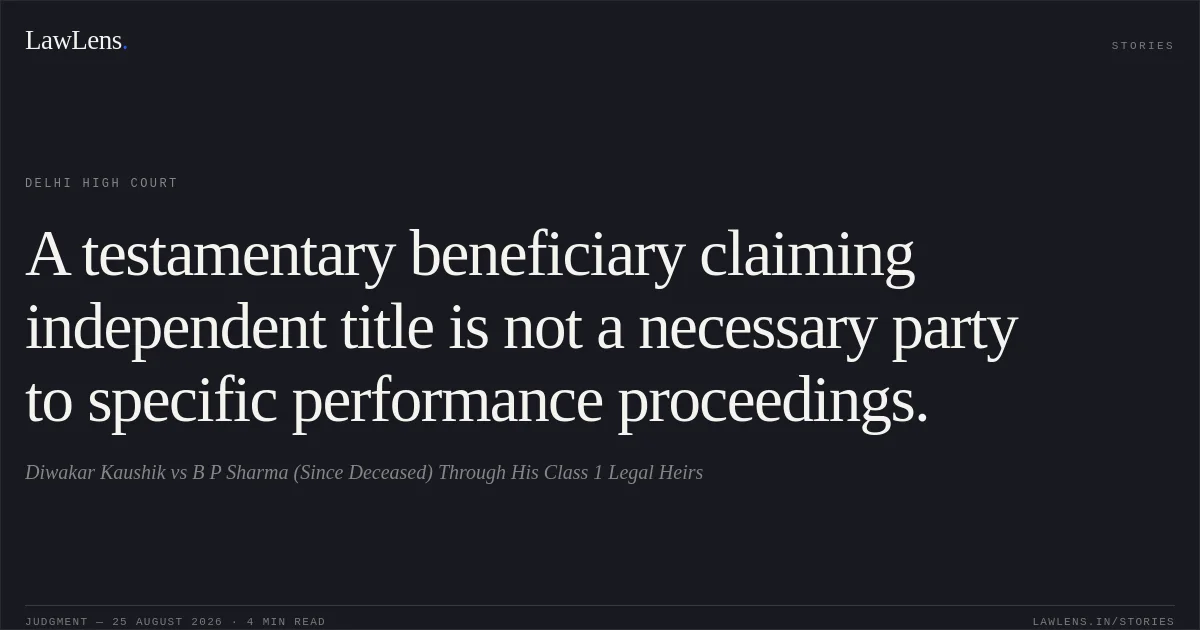
The Court held that the petitioner was not entitled to be substituted as the deceased defendant’s legal representative in the specific-performance suit.
His claim under the contested Will raised an independent title issue, was not necessary for effective adjudication of the contractual dispute, and was unnecessary since the Class I legal heirs already represented the deceased defendant’s estate.
Source reference: p.6, paras. 22–24Finding no illegality, material irregularity, or jurisdictional error in the Trial Court’s order dated 26 May 2026, the High Court dismissed the petition and disposed of all pending applications.
Source reference: p.7, paras. 24–25Acts & Sections Cited
2 provisions across 1 statute referred to in this judgment. Each provision opens on LawLens.
Code of Civil Procedure, 19082
Original Court PDF
Diwakar KaushikvsB P Sharma (Since Deceased) Through His Class 1 Legal Heirs
Click to open original judgment
Original judgment, available to read, download and summarize on LawLens.in
![Courts will not interfere with transfers absent mala fides or violation of statutory rules.. M Ramya vs EMPLOYEES STATE INSURANCE CORPORATION (ESIC). CAT - ['Chennai']. LawLens](/stories/thumbnails/courts-will-not-interfere-with-transfers-absent-mala-fides-or-violation-of-statutory-rules-a6845e9ca6f548fca284c51c8351957f.webp)
![Courts cannot direct one-time recruitment age relaxation absent authority in the governing rules or advertisement.. UT OF PUDUCHERRY vs M ANDAL. CAT - ['Chennai']. LawLens](/stories/thumbnails/courts-cannot-direct-one-time-recruitment-age-relaxation-absent-authority-in-the-governing-895d78fde47143e2a8ed0207c4b6a44f.webp)
![A review cannot correct an allegedly erroneous decision absent an error apparent on the record.. Ajit Kumar Jha vs RAILWAY BOARD. CAT - ['Delhi']. LawLens](/stories/thumbnails/a-review-cannot-correct-an-allegedly-erroneous-decision-absent-an-error-apparent-on-the-re-8ac952fd4eba470c92f7da20af72a220.webp)