01Facts
On 09.04.2024, the deceased, Gopi (aged about 25), was travelling as a cleaner in Bolero City Pick-Up No. TN 29 CY 3288 on the Salem–Trichy Main Road.
¶ 3 · p. 2At about 3.15 a.m., the first respondent, the driver and owner, allegedly drove rashly and negligently, lost control, and collided with a TNSTC bus.
¶ 3 · p. 2Gopi died the same day from his injuries.
¶ 3 · p. 2His wife (first claimant) and parents (second and third claimants) filed a claim under Section 166 of the Motor Vehicles Act, 1988, alleging a monthly income of Rs. 15,000.
¶ 2 · p. 1 · ¶ 4 · p. 2The first respondent was ex parte.
¶ 5 · p. 2The second respondent (insurer) denied the manner of accident but led no evidence.
¶ 6–7 · p. 3The claimants examined P.W.1 and P.W.2 and marked Exs. P1–P13.
¶ 7 · p. 3The Tribunal held the driver negligent. It found no evidence of the claimed Rs. 15,000 income and fixed notional income at Rs. 10,000 per month.
¶ 8 · pp. 3–4After deducting one-third for personal expenses and applying a multiplier of 18 under Sarla Varma, the Tribunal awarded Rs. 20,86,000 in total.
¶ 8 · pp. 3–4The claimants appealed for enhancement.
¶ 9 · p. 402Issues
i.1. Whether the Tribunal erred in fixing the deceased's monthly income at Rs. 10,000 instead of the claimed Rs. 15,000, despite the absence of documentary proof of income.
¶ 10–11 · pp. 4–5 · ¶ 14 · pp. 5–6ii.2. Whether the amount awarded under the head of loss of consortium/love and affection was inadequate in light of the number of dependants.
¶ 10 · p. 4 · ¶ 15 · p. 603Law Applied
The court applied Section 166 of the Motor Vehicles Act, 1988 (compensation for death) and Section 173 (appeals) as the statutory basis for enhancement.
¶ 2 · p. 1 · ¶ 17 · p. 7It adopted the Tribunal's reliance on Sarla Varma v. Delhi Transport Corporation (2009) 2 TNMAC 1 (SC) for the multiplier of 18 and for the one-third deduction for personal expenses where there are multiple dependants.
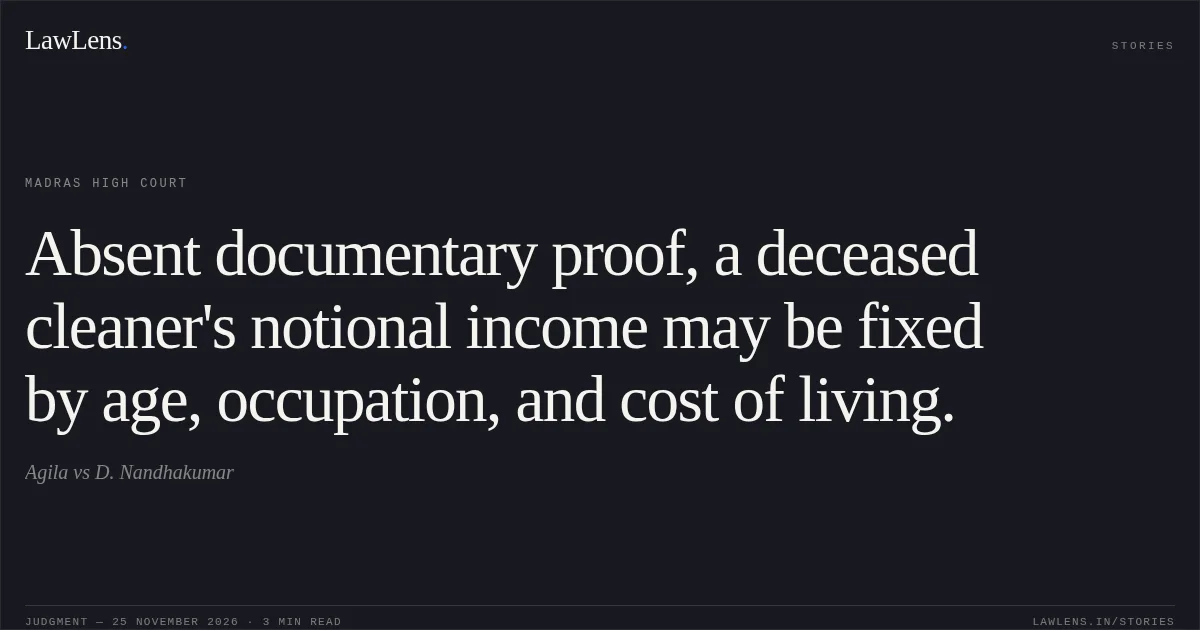
¶ 8 · p. 3 · ¶ 14 · p. 6The court held that, absent documentary proof, notional income may be fixed by considering the victim's age, the nature of his occupation, the year of the accident, and the prevailing cost of living.
¶ 14 · pp. 5–6It further held that 40% of income is added as future prospects.
¶ 14 · p. 6Each dependant is entitled to a separate consortium award, here Rs. 40,000 each.
¶ 15 · p. 6The judgment cites no other authority for these propositions.
Provisions in the judgment · 2 · Linked ones open on LawLens
Motor Vehicles Act, 1988 Section 173Section 166
04Reasoning
The court accepted that no documentary evidence proved the claimed Rs. 15,000 income.
¶ 14 · p. 5It nonetheless held that the Tribunal's figure of Rs. 10,000 was "on the lower side." It reached this conclusion by weighing the 2024 accident date, the deceased's age of about 25, the nature of his work as a cleaner, and the cost of living at the relevant time, and so fixed notional income at Rs. 15,000.
¶ 14 · pp. 5–6Applying 40% future prospects, a one-third deduction for personal expenses (with three dependants), and a multiplier of 18, the court computed the loss of dependency at Rs. 30,24,000.
¶ 14 · p. 6 · ¶ 16 · p. 7On consortium, the Tribunal had awarded one Rs. 40,000 sum. The court held that each of the three dependants (wife and both parents) is entitled to Rs. 40,000, totalling Rs. 1,20,000.
¶ 15 · p. 6It found the Tribunal's awards of Rs. 15,000 each for loss of estate and funeral expenses reasonable and left them undisturbed.
¶ 15 · p. 605Holding
The court held that the deceased's notional monthly income is Rs. 15,000, not Rs. 10,000, and that each of the three dependants is entitled to Rs. 40,000 for loss of consortium.
¶ 14–15 · pp. 5–6The appeal is partly allowed. The compensation is enhanced from Rs. 20,86,000 to Rs. 31,74,000 (loss of dependency Rs. 30,24,000; consortium Rs. 1,20,000; estate Rs. 15,000; funeral Rs. 15,000).
¶ 16 · pp. 6–7Interest is payable at 7.5% per annum from the date of the claim petition until deposit, excluding any default period, with proportionate costs.
¶ 17(ii) · p. 7The second respondent insurer must deposit the enhanced award within six weeks to the credit of M.C.O.P. No. 66 of 2024.
¶ 17(iii) · p. 8Claimants may withdraw their shares after adjusting prior withdrawals, subject to the Tribunal's disbursement directions.
¶ 17(iv)–(vii) · p. 8No order as to costs is made in the appeal itself.
¶ 17(vii) · p. 8Original Court PDF
AgilavsD. Nandhakumar
Click to open original judgment
Original judgment, available to read, download and summarize on LawLens.in