01Facts
The deceased, Syed Masood, rode a scooter on 14.06.2014 at about 2.15 pm on a road near Melagaram.
p. 3 · ¶ 3 · ¶ 16A Qualis car (TN-72-L-4599), owned and driven by the first respondent and uninsured, was parked on the roadside. Its driver opened the front right door without checking the rear or front, and the deceased struck the door and fell onto the road.
p. 3 · ¶ 3 · ¶ 16A Toyota car (TN-72-AM-1261), driven by the second respondent and owned by the third respondent (who later died; his son, the fifth respondent, was impleaded and later given up), then came from the opposite direction and ran over the deceased's head.
pp. 3–4 · ¶ 3The Toyota was insured with the appellant.
p. 4 · ¶ 3 · ¶ 7The claimants (wife and son) sought Rs. 50,00,000.
p. 4 · ¶ 3The Tribunal awarded Rs. 9,13,072 with 7.5% interest, apportioning negligence 90% on the Toyota driver and 10% on the Qualis driver.
p. 2 · ¶ 8Only the insurer appealed. Its primary contention was that negligence should be split 50:50.
p. 7 · ¶ 9The claimants supported the Tribunal's apportionment.
pp. 7–8 · ¶ 10The eyewitness (P.W.2) and the first petitioner (P.W.1) testified that the death would not have occurred but for the Qualis door being opened.
pp. 9–10 · ¶ 14–1502Issues
i.1. Whether the contributory negligence fixed by the Tribunal at 90% on the second respondent (Toyota driver) and 10% on the first respondent (Qualis driver) is required to be modified to 50:50.
p. 8 · ¶ 12ii.2. Whether the uninsured status of the Qualis vehicle justifies a higher apportionment of liability against the Toyota driver.
pp. 13–14 · ¶ 21iii.3. Whether the drivers are jointly and severally liable, or are liable only for contributory negligence, where only the apportionment is under challenge.
p. 12 · ¶ 1903Law Applied
The court relied on the Motor Vehicles Act, 1988, s.173, which governs appeals against Tribunal awards.
p. 2 · ¶ 1The court applied the principle of contributory negligence, under which liability is apportioned according to the relative fault of each driver whose negligence caused the accident.
p. 13 · ¶ 20–21The court referred to Pawan Kumar & Anr. v. Harkrishna Dass Mohan Lal & Ors. (2014) 1 TNMAC 321 (SC), which holds that where two negligent vehicles cause an accident, their drivers or owners may be held jointly and severally liable.
pp. 11–12 · ¶ 18The principle of joint and several liability did not apply here because no party had appealed the joint and several finding, so the case turned only on the apportionment of contributory negligence.
p. 12 · ¶ 19A vehicle's insurance status is irrelevant to the allocation of fault between drivers.
pp. 13–14 · ¶ 21Provisions in the judgment · 1 · Linked ones open on LawLens
Motor Vehicles Act, 1988 Section 173
04Reasoning
The court reviewed the oral evidence and found that the Qualis driver negligently opened the door without checking for approaching traffic, and that this act was a direct cause of the deceased striking the door and falling.
p. 10 · ¶ 16The court found that the Toyota driver was negligent in failing to control the vehicle while approaching a visibly parked car on the main road, and that his speed and control were the immediate cause of the fatal impact.
pp. 10–11 · ¶ 17The Tribunal's 90:10 split was held to be unsupported, because the court could not determine how the accident occurred in a way that justified assigning primary fault to one driver. Both drivers were therefore treated as equally culpable.
p. 13 · ¶ 20The uninsured status of the Qualis was rejected as a basis for shifting fault, since the apportionment must depend on conduct and not on insurance coverage.
pp. 13–14 · ¶ 21The court declined to treat the drivers as jointly and severally liable, because that finding was not challenged and only the ratio was in issue.
p. 12 · ¶ 1905Holding
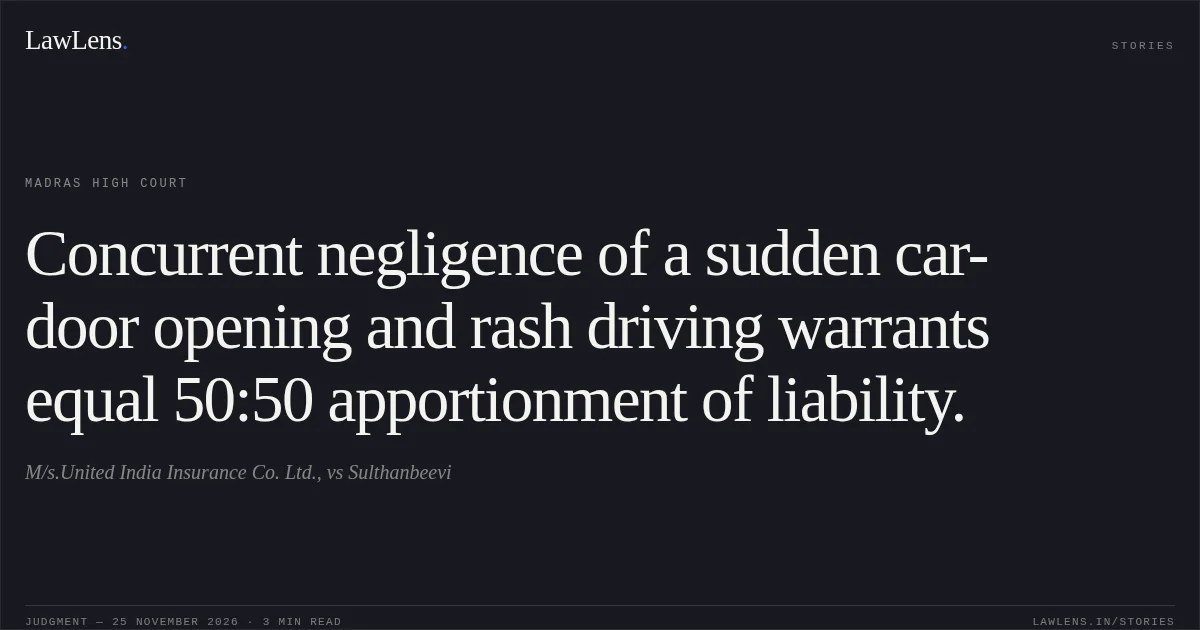
The court answered Issue 1 in favour of the appellant. It held that the 90:10 apportionment was erroneous and that both drivers were equally negligent, so the liability should be split 50:50 between the first respondent (Qualis driver) and the second respondent (Toyota driver).
pp. 13–14 · ¶ 20–21The appeal was partly allowed and the award modified accordingly. All other aspects of the award were confirmed. The insurer's liability was reduced to 50%.
p. 14 · ¶ 21–22If the insurer has already deposited 90% of the award with interest and costs, the Tribunal is directed to disburse 50% to the claimants and refund the balance to the insurer. No order as to costs was made.
p. 15 · ¶ 23(ii)–(iii) · ¶ 22, 23(iv)Original Court PDF
M/s.United India Insurance Co. Ltd.,vsSulthanbeevi
Click to open original judgment
Original judgment, available to read, download and summarize on LawLens.in