Facts
The deceased, Arijit Samaddar, married Petitioner No. 1 on December 1, 2021
Source reference: p. 1Petitioner No. 1 left the matrimonial home in February 2022, citing her husband’s refusal to treat a medical condition (epidermoid cysts) and his indifferent attitude
Source reference: p. 2On July 2, 2022, she briefly returned to collect her belongings
Source reference: p. 2On September 19, 2022—nearly two and a half months after their last contact—the deceased committed suicide by hanging
Source reference: p. 2, 6A suicide note was found blaming the petitioners and their relatives for his mental pain and alleging they circulated a picture of his private parts
Source reference: p. 5-6The police filed a charge sheet under Sections 306/506/34 of the IPC. The petitioners moved the High Court to quash the proceedings
Source reference: p. 1Issues
1. Whether the allegations in the FIR and the contents of the suicide note satisfy the ingredients of "abetment" under Section 107 of the IPC to sustain a charge under Section 306 IPC
Source reference: p. 72. Whether there exists a proximate "live link" or nexus between the acts of the petitioners and the suicide committed two and a half months after their last meeting
Source reference: p. 3, 63. Whether the proceedings under Section 506 IPC are maintainable in the absence of evidence of a threat intended to cause alarm
Source reference: p. 13Law Applied
Section 306 of the IPC (abetment of suicide) and Section 107 of the IPC, which defines abetment as instigation, conspiracy, or intentional aid
Source reference: p. 7Ramesh Kumar v. State of Chhattisgarh, defining "instigation" as a provincial urge or provocation to do an act
Source reference: p. 8State of West Bengal v. Orilal Jaiswal, which warned against prosecuting for ordinary matrimonial discord where the victim is hypersensitive
Source reference: p. 9Chitresh Kumar Chopra v. State, emphasizing the requirement of mens rea
Source reference: p. 9Shenbagavalli v. Inspector of Police, establishing that a significant time gap and lack of direct contact between the alleged harassment and the suicide negate the charge of abetment
Source reference: p. 11-13Section 506 IPC regarding criminal intimidation
Source reference: p. 13Reasoning
The court observed that for a conviction under Section 306 IPC, there must be a clear mens rea and an active act intended to push the deceased to suicide
Source reference: p. 9, 13In the present case, the Petitioner had no physical or verbal contact with the deceased after July 2, 2022—more than two months before the suicide
Source reference: p. 6, 12The court reasoned that the suicide note mentioned frustration over matrimonial discord but failed to detail any specific act of instigation or intentional aid by the petitioners
Source reference: p. 7-8Following the precedent in Shenbagavalli, the court noted that even hurtful remarks (such as questioning manhood) do not constitute abetment, especially when there is no proximity of time between the remark and the incident
Source reference: p. 12, 14Since the ingredients of Section 107 were absent and the deceased appeared to have reacted with disproportionate sensitivity to common marital friction, the court found no legal basis for the trial
Source reference: p. 10, 14Holding
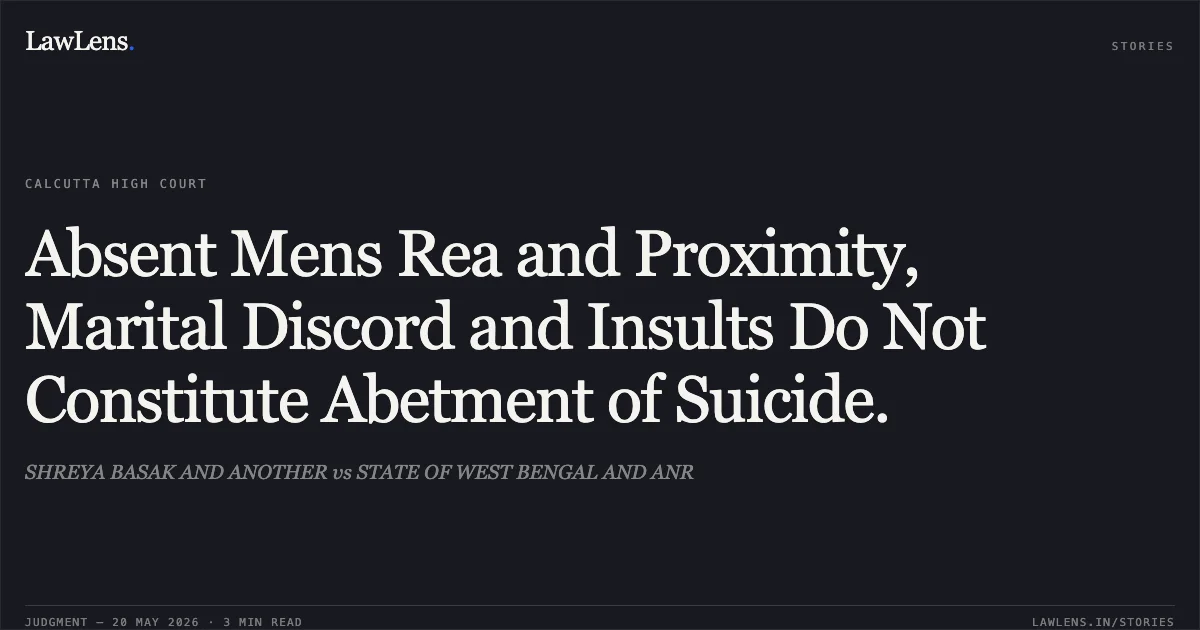
The court answered the issues in the negative, holding that the materials on record, even if taken as true, do not establish the offence of abetment to suicide or criminal intimidation
The court held that continuing the prosecution would be an abuse of the process of law. Consequently, the High Court allowed the revisional application and quashed the proceeding being GR Case no. 3892 of 2022 pending before the Sessions Judge, Barasat
Source reference: p. 14Acts & Sections Cited
5 provisions across 2 statutes referred to in this judgment. Each provision opens on LawLens.
Indian Penal Code, 18604
Code of Criminal Procedure, 19731
Original Court PDF
SHREYA BASAK AND ANOTHERvsSTATE OF WEST BENGAL AND ANR
Click to open original judgment
Original judgment, available to read, download and summarize on LawLens.in


