Facts
The Appellant, an Internet Service Provider (ISP), challenged an order dated June 20, 2023, issued by the Respondent (TRAI), which reiterated an earlier order dated January 19, 2022
Source reference: para. 1The order imposed a Financial Disincentive (FD) of ₹1,00,000 for the quarter ending December 2020 due to an alleged violation of the "Quality of Service (QoS) of Broadband Service Regulations, 2006"
Source reference: para. 1Specifically, the Appellant achieved a 99.70% success rate in "service provisioning/activation time" against a benchmark of 100%
Source reference: para. 2The Appellant contended that the 0.3% shortfall (affecting approximately 80 out of 30,000 subscribers) was due to the COVID-19 pandemic, lockdown restrictions, and technical teams being barred from containment zones
Source reference: para. 2, 9TRAI had exempted other quarters (June 2020, September 2020, and June 2021) from FDs but refused to exempt the December 2020 quarter because the Appellant failed to provide a "bifurcated" performance report for COVID and non-COVID periods
Source reference: para. 17, 47Issues
1. Whether it was technically feasible for the Appellant to achieve a 100% benchmark during the COVID-19 pandemic in 2020–2021?
Source reference: para. 31, 322. Whether it is practicable to prescribe a rigid benchmark of 100% within the Regulations?
Source reference: para. 31, 423. Whether TRAI was justified in denying the Appellant the same exemption for the December 2020 quarter that was granted to preceding and subsequent quarters?
Source reference: para. 31, 464. Whether the imposition of the maximum FD (₹1,00,000) was proportionate to a 0.3% shortfall during a global pandemic?
Source reference: para. 31, 51Law Applied
The Tribunal applied the Telecom Regulatory Authority of India Act, 1997, specifically Section 14A(2) regarding appellate jurisdiction
Source reference: para. 1The primary regulations involved were the "Quality of Service of Broadband Service Regulations, 2006" and its 2012 Amendment
Source reference: para. 5, 6Regulation 3 sets the 100% benchmark for service provisioning "subject to technical feasibility"
Source reference: para. 36Regulation 3A (introduced in 2012) mandates FDs "not exceeding" ₹50,000 for the first contravention and ₹1,00,000 for subsequent contraventions
Source reference: para. 24The court also considered the principle of force majeure and the doctrine of proportionality in administrative law, emphasizing that discretionary penalties must reflect the gravity of the breach
Source reference: para. 52, 53Reasoning
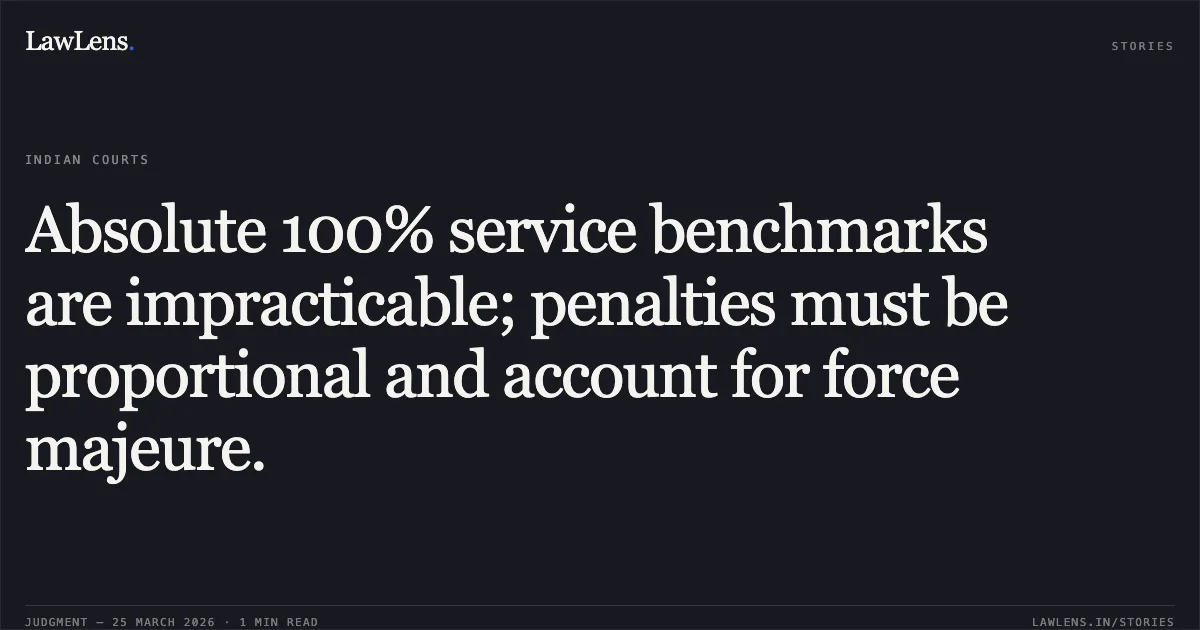
The Tribunal reasoned that a 100% benchmark is inherently impracticable, noting that even critical infrastructure like power grids or emergency services typically operate on SLAs between 99.5% and 99.9%
Source reference: para. 42, 44During the pandemic, the inability of technical teams to enter containment zones or quarantined homes constituted "technical non-feasibility," a factor TRAI failed to consider despite the 2006 Regulations allowing for such exclusions
Source reference: para. 36, 41The Tribunal found TRAI’s demand for a "bifurcation" of COVID and non-COVID periods arbitrary, as the entire period from March 2020 to December 2022 was uniformly impacted by the pandemic
Source reference: para. 48, 50Furthermore, the Tribunal critiqued TRAI’s "mechanical" application of the maximum penalty. Since Regulation 3A uses the phrase "not exceeding ₹1,00,000," TRAI was required to exercise discretion based on the degree of compliance
Source reference: para. 52Imposing the maximum fine for a 99.7% achievement—the same penalty that might apply to a 1% achievement—was deemed a failure to exercise reasoned discretion
Source reference: para. 52, 53Holding
The Tribunal allowed the appeal and set aside TRAI’s orders dated June 20, 2023, and January 19, 2022, along with related demand letters
It held that the Respondent was not justified in treating the December 2020 quarter differently from other COVID-impacted quarters
Source reference: para. 50The Tribunal formally recorded its appreciation for the Appellant’s technical teams for maintaining a 99.7% compliance rate during the pandemic
Source reference: para. 55All financial disincentives imposed for the period were quashed
Source reference: para. 54Original Court PDF
GTPL BROADBAND PVT. LTDvsTELECOM REGULATORY AUTHORITY OF INDIA
Click to open original judgment
Original judgment, available to read, download and summarize on LawLens.in


