Facts
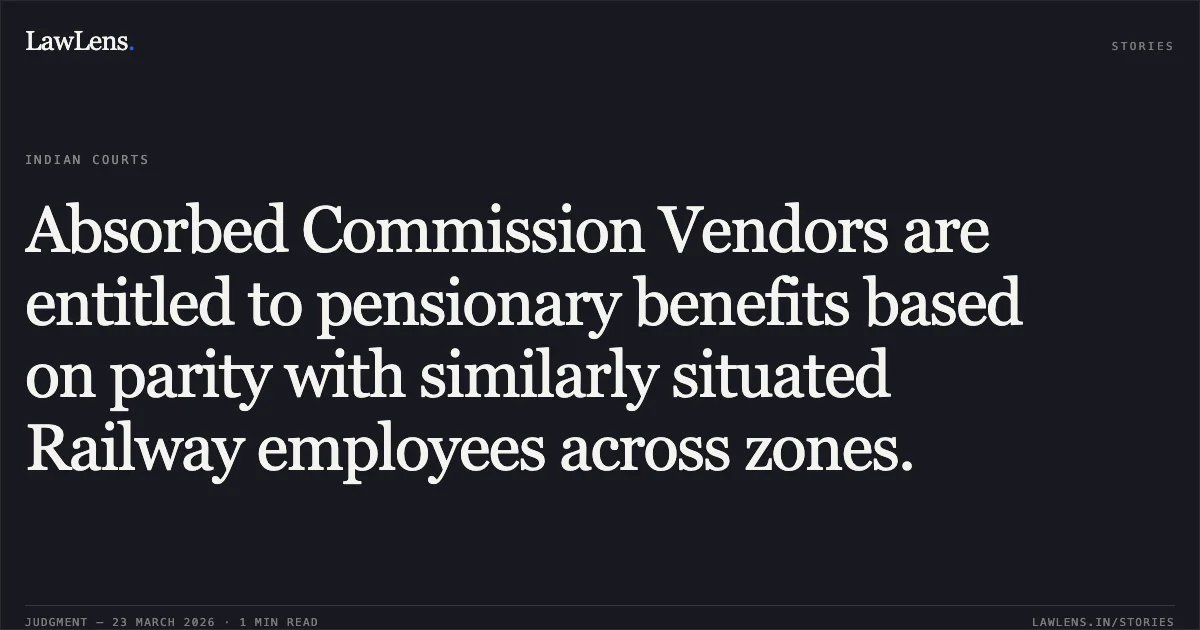
The seven applicants were formerly employed as Commission Vendors/Bearers in the Northern Railways
Source reference: para. 2While they were eventually absorbed as permanent employees and have since superannuated, they contend that they were entitled to regularization from 1995 onwards based on directions from senior Railway officials
Source reference: para. 1-2They seek the grant of pensionary benefits equivalent to those received by permanent employees in other Railway zones, such as the Central and Southern Railways
Source reference: para. 3The applicants asserted that their representations remained unaddressed despite the legal issue being settled by the Supreme Court
Source reference: para. 3-4The respondents opposed the application, arguing that the Railway Board possesses no records regarding the applicants' absorption or the duration of their service, rendering the claim unsustainable
Source reference: para. 5Issues
1. Whether the applicants are entitled to pensionary benefits and the benefit of regularization from 1995 on par with similarly situated employees in other Railway zones?
Source reference: para. 1-22. Whether the judgment of the Hon’ble Supreme Court in Union of India v. Munshi Ram is applicable to the applicants' claims for pensionary benefits?
Source reference: para. 4, 7Law Applied
The Tribunal primarily relied on the legal precedent established by the Hon’ble Supreme Court in Union of India v. Munshi Ram (Civil Appeal No. 2811 of 2022), decided on 31.10.2022
Source reference: para. 4This judgment settled the entitlement of absorbed Commission Vendors/Bearers in the Northern Railways to receive pensionary benefits equivalent to those in other Railway zones
Source reference: para. 4The application was filed under Section 19 of the Administrative Tribunals Act, 1985, which governs the adjudication of disputes regarding conditions of service of persons appointed to public services
Source reference: para. 1Reasoning
The Tribunal noted that the applicants’ grievance centered on parity in pensionary benefits, a matter they claimed was already settled by the Supreme Court in the Munshi Ram case
Source reference: para. 4The respondents’ primary defense was an evidentiary one—specifically, the alleged absence of service records
Source reference: para. 5However, the Tribunal did not adjudicate the merits of the service record availability. Instead, it held that the respondents must evaluate the applicants' claims by examining whatever documents are available and applying the "analogy of similarly situated employees" as per the Munshi Ram precedent
Source reference: para. 7The Tribunal emphasized the necessity of administrative accountability, requiring the respondents to issue a "reasoned and speaking order" to demonstrate how the Supreme Court's mandate has been implemented in this specific instance
Source reference: para. 8Holding
The Tribunal disposed of the Original Application without a final determination on the merits
It directed the respondents to consider the applicants' cases for the release of pensionary benefits based on available documentation and the principles laid down in Union of India v. Munshi Ram
Source reference: para. 7The respondents are ordered to pass a reasoned and speaking order within twelve weeks from the date of receipt of the certified copy of the order
Source reference: para. 8-9No order was made as to costs
Source reference: para. 10Acts & Sections Cited
1 provisions across 1 statute referred to in this judgment. Each provision opens on LawLens.
Administrative Tribunals Act, 19851
Original Court PDF
Ramesh ChandervsRAIL BHAWAN
Click to open original judgment
Original judgment, available to read, download and summarize on LawLens.in