Facts
The appellants, currently serving as Lecturers and Assistant Teachers (L.B.) in the School Education Department, were originally appointed as Shiksha Karmi Grade-II and Grade-III under the Panchayat Department between 2008 and 2013
Source reference: para 4, citing WA 191/2026 at para 18Following a State Government policy decision dated 30.06.2018, they were absorbed into the School Education Department effective from 01.07.2018
Source reference: para 4, citing WA 191/2026 at para 21The appellants sought the benefit of Kramonnati Vetanman (time-bound pay scale) based on a State Government Circular dated 10.03.2017
Source reference: para 4, citing WA 191/2026 at para 17A learned Single Judge dismissed their writ petition (WPS No. 12346/2025) on 24.11.2025, leading to this intra-court appeal
Source reference: para 3The Division Bench first condoned a 36-day delay in filing the appeal
Source reference: para 1-2Issues
1. Whether the appellants, as erstwhile employees of the Panchayat Cadre (Shiksha Karmi), are entitled to the benefit of Kramonnati Vetanman under the Circular dated 10.03.2017 for the service period rendered prior to their absorption into the State Government service?
Source reference: para 4, citing WA 191/2026 at para 28-292. Whether the appellants can claim parity with the relief granted in Smt. Sona Sahu v. State of Chhattisgarh (WA No. 261/2023)?
Source reference: para 4, citing WA 191/2026 at para 24-25Law Applied
The Court primarily applied the State Government Circular dated 10.03.2017, which mandates the grant of Kramonnati Vetanman to Assistant Teachers in Government service upon completion of 10 and 20 years of service
Source reference: para 4, citing WA 191/2026 at para 17It relied on the Chhattisgarh Panchayat Shiksha Karmi (Recruitment and Conditions of Service) Rules, 2007 and the Panchayat Raj Adhiniyam, 1993, which govern the service conditions of Panchayat employees as a distinct cadre from State Government employees
Source reference: para 4, citing WA 191/2026 at para 22Furthermore, it applied Clauses 4 and 5 of the Absorption Order dated 30.06.2018, which explicitly restrict the entitlement to arrears or financial benefits for any period prior to the absorption date of 01.07.2018
Source reference: para 4, citing WA 191/2026 at para 26Reasoning
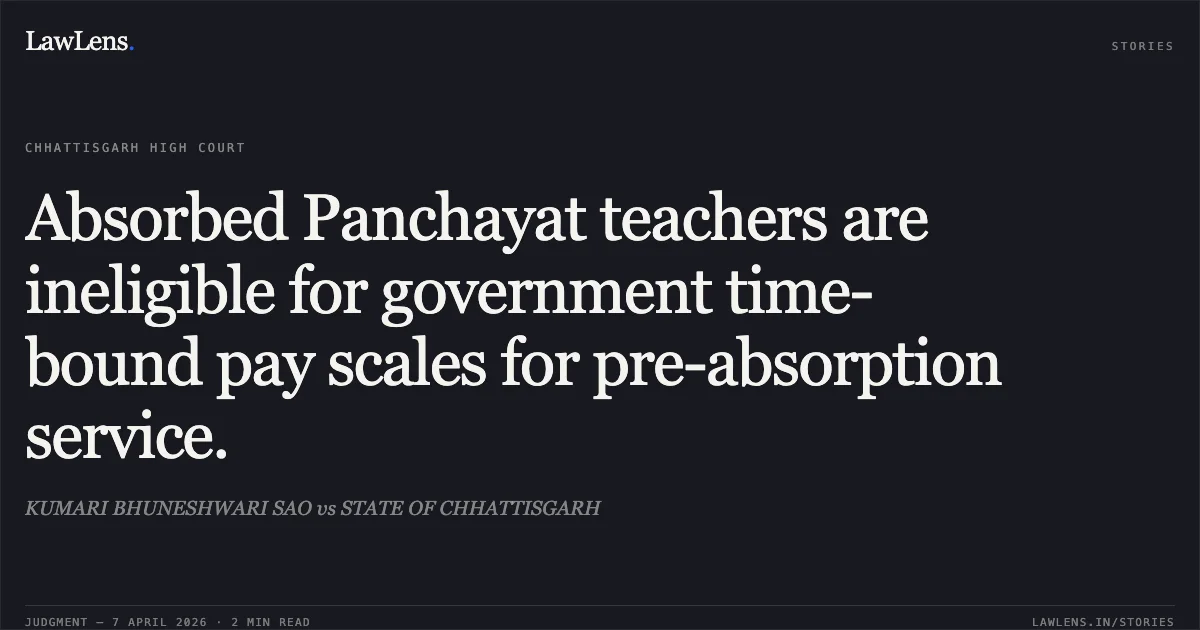
The Court reasoned that the Circular dated 10.03.2017 applies exclusively to regular Government servants and does not extend to the Panchayat Cadre, including Shiksha Karmi
Source reference: para 4, citing WA 191/2026 at para 20-21It noted that since the appellants were Panchayat employees until their absorption in 2018, they could not claim the status of Government servants for the purpose of seeking time-bound pay scales under rules applicable to the School Education Department
Source reference: para 4, citing WA 191/2026 at para 22-23The Court distinguished the case of Smt. Sona Sahu, noting that her relief was granted based on "peculiar facts" and different circulars (dated 02.11.2011 and 17.05.2013) that did not apply to the appellants' timeline or cadre
Source reference: para 4, citing WA 191/2026 at para 24-25Finally, the Court emphasized that the 2018 absorption policy specifically barred claims for past arrears, thus precluding the appellants from seeking retrospective benefits
Source reference: para 4, citing WA 191/2026 at para 26-27Holding
The High Court dismissed the writ appeal, affirming the Single Judge's order
It held that the appellants, having been part of the Panchayat Cadre at the time the 2017 Circular was issued, were not "similarly situated" to regular Government employees and thus could not claim parity or the benefit of Kramonnati Vetanman for their pre-absorption service
Source reference: para 4, citing WA 191/2026 at para 29-31The Court concluded that the impugned order contained no perversity or infirmity and aligned with its previous judgment in Writ Appeal No. 191/2026
Source reference: para 5-6Acts & Sections Cited
1 provisions across 1 statute referred to in this judgment. Linked provisions open on LawLens.
Chhattisgarh Panchayat Raj Adhiniyam, 19931
Original Court PDF
KUMARI BHUNESHWARI SAOvsSTATE OF CHHATTISGARH
Click to open original judgment
Original judgment, available to read, download and summarize on LawLens.in