Facts
The applicants sought quashing of FIR C.R. No. 11191027220283 registered at Karanj Police Station.
Source reference: p. 1-2The complainant, a workers' leader at Continental Mill, alleged that on February 22, 2022, in the lobby of the Majur Mahajan Sangh office, Applicant No. 1 used the caste-based slur "sālā ḍheḍā," followed by similar abuses and death threats from Applicants No. 2 and 3.
Source reference: p. 2-3The applicants contended the FIR was a retaliatory measure and a misuse of the Atrocity Act, noting a history of similar false complaints and a prior acquittal in 2014 where the same witness was cited.
Source reference: p. 3-8, 16Issues
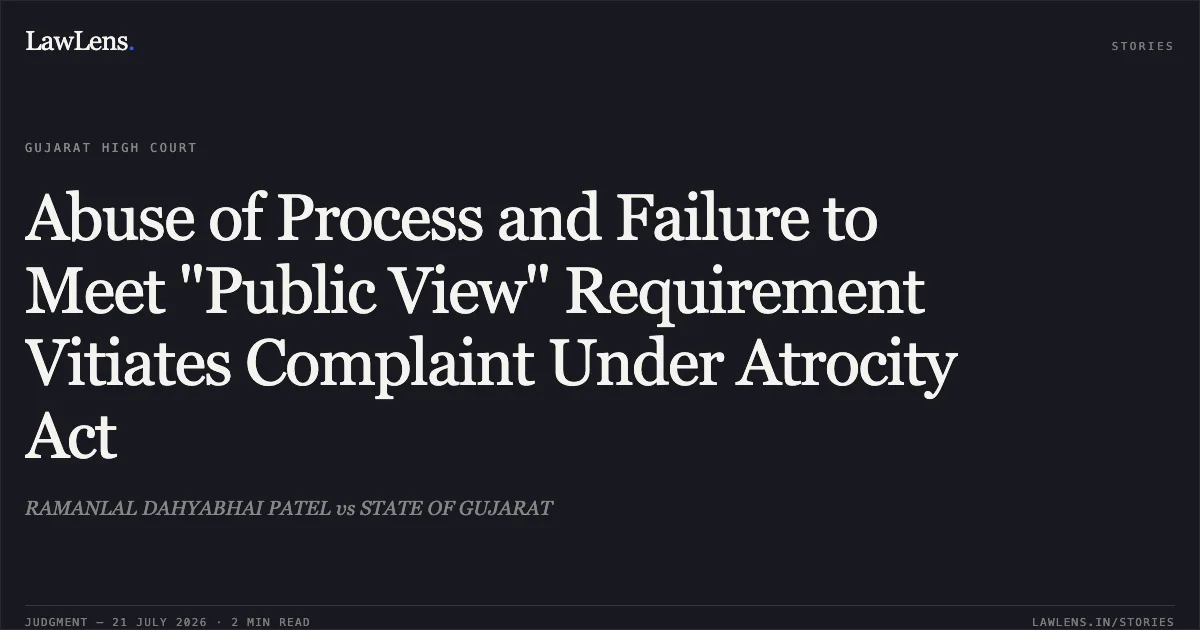
1. Whether the alleged incident occurred "in any place within public view" as required to constitute an offence under Sections 3(1)(r) and 3(1)(s) of the SC/ST Act.
Source reference: p. 102. Whether the initiation of the criminal proceedings was a "bad faith exercise" intended to wreak vengeance or settle personal scores.
Source reference: p. 19, 223. Whether the ingredients for criminal intimidation under Section 506(2) and obscene acts under Section 294(b) of the IPC were satisfied.
Source reference: p. 23, 26Law Applied
Sections 3(1)(r), 3(1)(s), and 3(2)(va) of the SC/ST (Prevention of Atrocities) Act, 1989, and Sections 506(2), 294(b), and 114 of the IPC.
Source reference: p. 10-11, 23, 26Swaran Singh v. State settled that a "place within public view" requires the presence of independent members of the public, not just friends or relatives.
Source reference: p. 11-13Under Salib @ Shalu @ Salim v. State of U.P., the court has a duty to scrutinize FIRs more closely if they appear frivolous or motivated by personal grudge.
Source reference: p. 18-19Konde Nageshwar Rao v. A. Srirama Chandra Murty established that the misuse of the SC/ST Act to settle personal scores must be stopped at the outset.
Source reference: p. 22Regarding Section 506(2) IPC, Vikram Johar v. State of U.P. requires proof of an intent to "cause alarm" to the complainant.
Source reference: p. 23-25Reasoning
The court found that the lobby of the office where the incident allegedly took place was not "within public view" because the only witnesses were two friends/acquaintances of the complainant, failing the requirement for independent public presence.
Source reference: p. 17Scrutinizing the "attending circumstances," the court noted the complainant’s habitual filing of false FIRs, a prior acquittal involving the same parties, and a representation from dozens of workers (including SC/ST members) denying the incident occurred.
Source reference: p. 16-17, 20The court observed the complainant's narrative—staying to chat with friends after being threatened twice by different individuals—was "highly improbable and unnatural".
Source reference: p. 21Applying the Salib protocol, the court determined the FIR was weaponized to pressure the applicants after previous failures to implicate others.
Source reference: p. 20-22Regarding the IPC sections, the court found no evidence of intent to cause alarm (Section 506) or that the words were uttered in a public place as contemplated by Section 294(b).
Source reference: p. 25-27Holding
The court answered the issues in the negative and held that the FIR was an abuse of the process of law, filed with an ulterior motive to wreak vengeance.
The FIR No. 11191027220283 and all consequential proceedings were quashed and set aside. The application was allowed, and Rule was made absolute.
Source reference: p. 27Acts & Sections Cited
8 provisions across 3 statutes referred to in this judgment. Each provision opens on LawLens.
Code of Criminal Procedure, 19731
Indian Penal Code, 18606
Scheduled Castes and the Scheduled Tribes (Prevention of Atrocities) Act, 19891
Original Court PDF
RAMANLAL DAHYABHAI PATELvsSTATE OF GUJARAT
Click to open original judgment
Original judgment, available to read, download and summarize on LawLens.in