Facts
The Appellant, appointed as a Manager (I) by the Respondent Bank via an appointment letter dated 29.10.2007, was promoted to Area Manager on 07.05.2009.
Source reference: p. 2, p. 3On 07.07.2009, he received a termination letter dated 05.06.2009, terminating his services effective as of the letter's date.
Source reference: p. 3The Bank provided a cheque for Rs. 99,634, representing 90 days' gross salary in lieu of the notice period, which the Appellant encashed.
Source reference: p. 4The Appellant filed a suit for recovery of Rs. 70,00,000 for loss of future salary and mental agony, alleging the termination was arbitrary and lacked assigned reasons.
Source reference: p. 3, 4The Trial Court partially decreed the suit with Rs. 35,000 as salary for June 2009 (since the termination was communicated in July) but dismissed claims for damages and reinstatement.
Source reference: p. 2, 6The Appellant challenged this partial dismissal.
Source reference: p. 6Issues
Whether, in terms of the appointment letter dated 29.10.2007, it was obligatory for the Bank to assign reasons before terminating the Appellant's services?
Source reference: p. 5, Issue 1Whether the termination was illegal and arbitrary given the Appellant was a confirmed employee?
Source reference: p. 5, Issues 2 & 5Whether the Appellant is entitled to compensation for mental agony and financial loss after encashing the cheque provided in lieu of the notice period?
Source reference: p. 5, Issue 6; p. 7, para 31Law Applied
The court primarily applied the law of contract governing private employment and Section 96 of the Code of Civil Procedure, 1908 regarding first appeals.
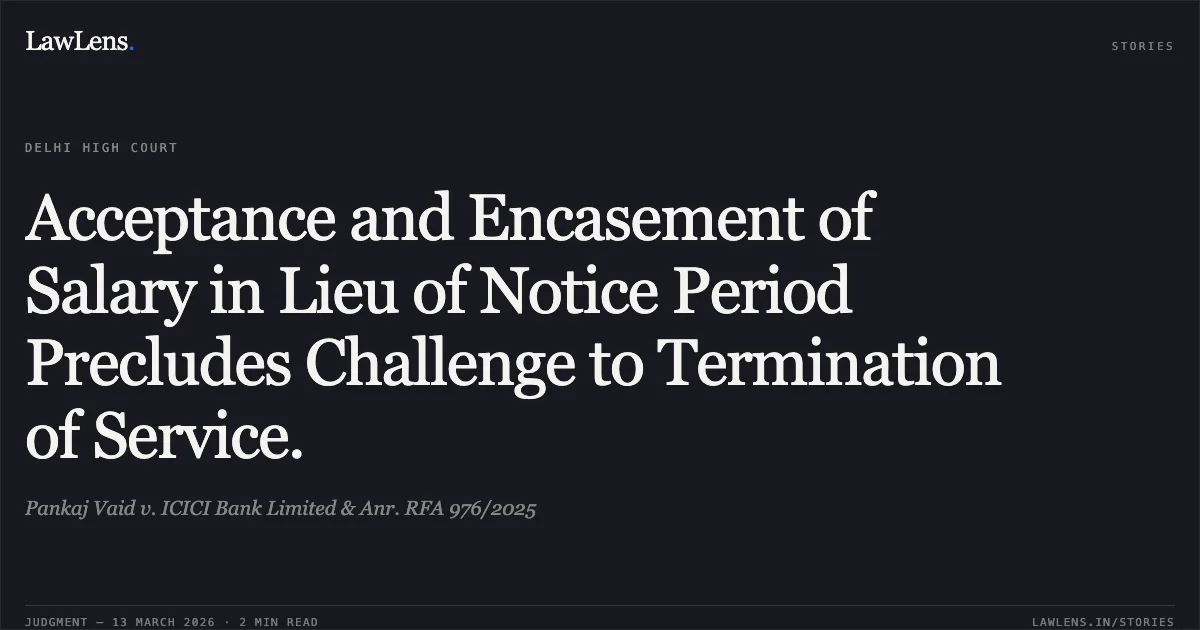
Source reference: p. 2It relied on the principle of "Accord and Satisfaction" or waiver, noting that contractual termination clauses providing for salary in lieu of notice are valid under Indian contract law.
Source reference: p. 7The court emphasized that in private contracts of service, terms regarding termination by notice are binding, and the acceptance of benefits under such terms precludes a challenge to the validity of the termination.
Source reference: p. 7Reasoning
The Court examined the Appointment Letter (Ex. PW1/A), which explicitly allowed the Bank to terminate a confirmed employee by providing 90 days' notice or equivalent salary.
Source reference: p. 6-7The Court reasoned that because the Appellant encashed the cheque for Rs. 99,634 (the 90 days' pay), he effectively accepted the termination in accordance with his contract.
Source reference: p. 7By this act of encashment, the Court held he was left with no legal ground to subsequently challenge the termination as arbitrary or seek damages.
Source reference: p. 7Regarding the delayed communication, the Court upheld the Trial Court’s finding that since the Appellant worked through June 2009 and only received the notice on 07.07.2009, he was entitled to one month’s salary for work performed, but this procedural delay did not render the entire termination void or entitle him to reinstatement.
Source reference: p. 7Holding
The High Court dismissed the appeal, affirming the Trial Court’s judgment.
It held that the termination was valid as it followed the contractual provision of providing salary in lieu of notice, and the Appellant’s act of encashing said cheque disentitled him from seeking further relief.
Source reference: p. 7The holding confirmed the decree for Rs. 35,000 plus 6% interest for the month of June 2009 but denied all claims for reinstatement and damages.
Source reference: p. 7All pending applications were dismissed.
Source reference: p. 7Acts & Sections Cited
2 provisions across 2 statutes referred to in this judgment. Each provision opens on LawLens.
Limitation Act, 19631
Code of Civil Procedure, 19081
Original Court PDF
Pankaj Vaid v. ICICI Bank Limited & Anr. RFA 976/2025
Click to open original judgment
Original judgment, available to read, download and summarize on LawLens.in