Facts
An FIR was registered on 6 August 2005 at Police Station Bewar, District Mainpuri, against the applicant and others under Sections 147, 148, 149, 307 and 302 IPC and Section 7 of the Criminal Law Amendment Act, concerning the alleged murder of the informant’s parents.
Source reference: para. 3During investigation, the informant filed an affidavit stating that she had not witnessed the incident and that the applicant had been falsely implicated. Her and her sister’s statements under Section 164 CrPC similarly stated that they did not know who had committed the murders.
Source reference: para. 3The police submitted Final Report No. 156 of 2006, which was accepted by the Magistrate on 4 April 2006.
Source reference: para. 4By order dated 5 August 2025, the Magistrate observed that prior permission was not required for further investigation under Section 173(8) CrPC and disposed of the application accordingly.
Source reference: para. 7The applicant challenged the Magistrate’s order and the consequential proceedings under Section 528 BNSS.
Source reference: no citationIssues
Whether further investigation under Section 173(8) CrPC can be conducted after the Magistrate has accepted a final or closure report under Section 173(2) CrPC?
Source reference: paras. 13, 26–28Whether the police must obtain prior permission or leave of the Magistrate before commencing further investigation after acceptance of the final report?
Source reference: paras. 21–25, 37–43Whether the accused has a right to prior notice or hearing at the stage of further investigation?
Source reference: paras. 45–49Law Applied
Section 173(8) CrPC permits further investigation after submission of a police report under Section 173(2), including after acceptance of a closure report, and authorises the filing of a supplementary report based on further oral or documentary evidence.
Source reference: para. 18In Vinay Tyagi v. Irshad Ali, the Supreme Court held that further investigation is legally permissible after submission of the police report and that, as a matter of propriety and judicial safeguard, the investigating agency should seek the Court’s prior leave.
Source reference: paras. 21–22Vinubhai Haribhai Malaviya v. State of Gujarat recognised the Magistrate’s power to direct further investigation at any stage before commencement of trial.
Source reference: para. 24State of Rajasthan v. Aruna Devi, U.P.S.C. v. S. Pappaiah, N.P. Jharia v. State of M.P., and Kari Choudhary v. Mst. Sita Devi establish that acceptance of a final report does not bar further investigation or subsequent cognizance if fresh material emerges.
Source reference: paras. 29, 33–35However, under K. Chandrasekhar v. State of Kerala, further investigation must be a continuation or supplementation of the earlier investigation, not a fresh investigation or reinvestigation conducted de novo.
Source reference: paras. 30–32Under Union of India v. W.N. Chadha, an accused has no right to prior notice or hearing during the investigative stage.
Source reference: paras. 46–49Reasoning
The Court held that acceptance of the final report in 2006 did not terminate the statutory power of the police or the supervisory jurisdiction of the Magistrate under Section 173(8) CrPC.
Source reference: paras. 38–43The informant’s later application alleged that she and her siblings had been minors, had been compelled to sign affidavits, and that their statements had not been properly recorded; these allegations constituted fresh material warranting further investigation.
Source reference: para. 44The proposed inquiry was treated as further investigation aimed at discovering additional evidence, rather than an impermissible reinvestigation or de novo inquiry.
Source reference: no citationThe Court also held that the accused could not challenge the manner or commencement of investigation at that stage, since no statutory right of prior hearing existed during investigation.
Source reference: paras. 45–49Although the Court observed that the police should ordinarily inform the Magistrate and seek formal permission, it found no illegality in the impugned order permitting the investigation to proceed.
Source reference: paras. 40–43, 50Holding
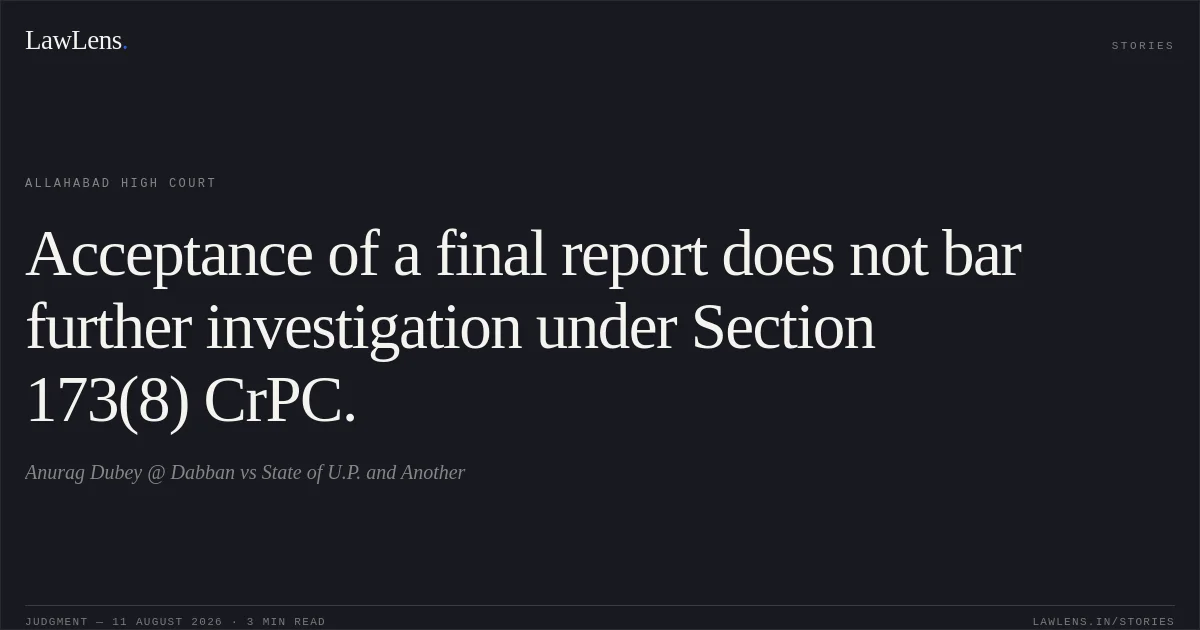
The Court answered the principal issue in the affirmative: further investigation under Section 173(8) CrPC is permissible even after acceptance of a final report by the Magistrate, and the earlier order need not be recalled or reviewed.
The accused has no right to prior notice or hearing at the investigation stage.
Source reference: para. 49Accordingly, the application under Section 528 BNSS was dismissed, the order dated 5 August 2025 was upheld, and the Court expected the Investigating Officer to conduct a fair, judicious and transparent investigation.
Source reference: paras. 50–53Acts & Sections Cited
46 provisions across 5 statutes referred to in this judgment. Each provision opens on LawLens.
Bharatiya Nagarik Suraksha Sanhita, 20231
Indian Penal Code, 1860
Code of Criminal Procedure, 1973
Delhi Special Police Establishment Act, 19461
Original Court PDF
Anurag Dubey @ DabbanvsState of U.P. and Another
Click to open original judgment
Original judgment, available to read, download and summarize on LawLens.in