Facts
The petitioner and respondents, who are brothers, carried on business as partners under the name M/s Nagpal Sports.
Source reference: p. 2–3The petitioner claimed that Shop No. 184, Sarojini Nagar Market, was acquired using partnership funds and was jointly owned by the partners.
Source reference: p. 2–3After the business closed, Respondent No. 1 remained in possession of the shop; the petitioner sought partition, possession, rent arrears and mesne profits through arbitration under the partnership deed.
Source reference: p. 2–3The arbitrator held that the shop had not been established as a partnership asset and that the claims fell outside the arbitration clause, leaving the substantive claims open for determination by an appropriate forum.
Source reference: p. 4–6The petitioner challenged that decision under Section 34 of the Arbitration and Conciliation Act, 1996.
Source reference: p. 6Issues
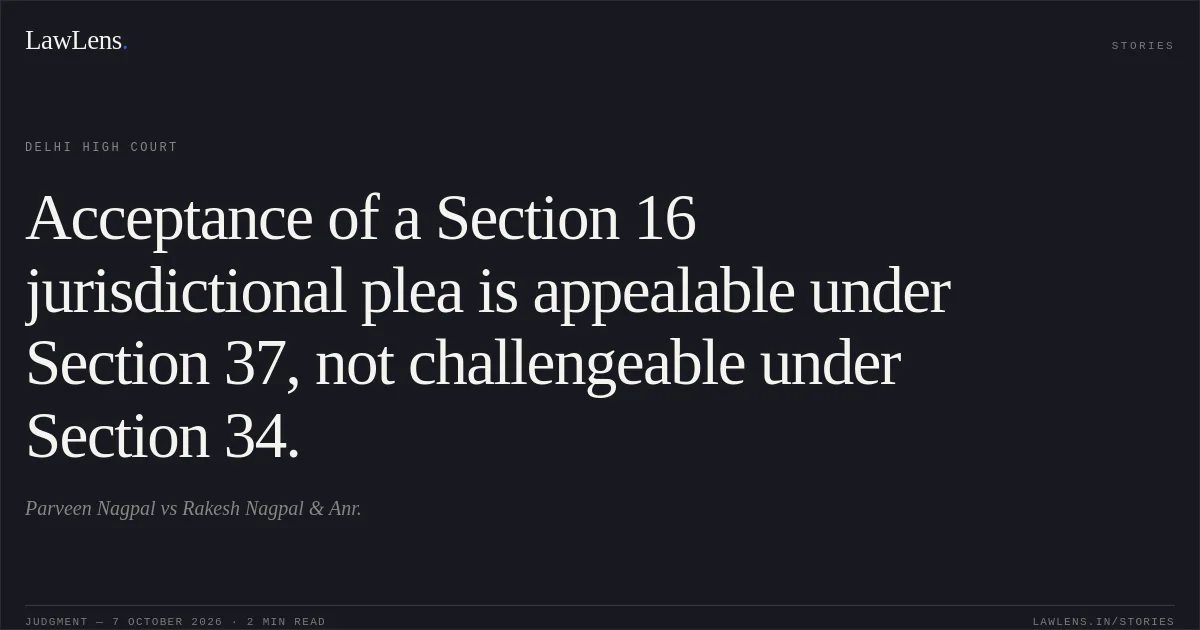
1. Whether the arbitral tribunal’s decision that the disputes fell outside the arbitration agreement was an acceptance of a jurisdictional plea appealable under Section 37(2)(a), rather than a decision challengeable under Section 34.
Source reference: p. 8, 12–132. Whether the petitioner’s Section 34 petition was maintainable despite the decision being described as a “Final Award” and the petitioner’s challenges to the tribunal’s reasoning and procedure.
Source reference: p. 15–17Law Applied
Section 16 of the Arbitration and Conciliation Act, 1996 empowers an arbitral tribunal to rule on its jurisdiction; where it rejects a plea under Section 16(2) or (3), it must continue the proceedings and make an award, which may then be challenged under Section 34.
Source reference: p. 9–10, 12Conversely, an order accepting such a plea is appealable under Section 37(2)(a).
Source reference: p. 11In M/s MCM Worldwide Pvt. Ltd. v. Construction Industry Development Council, 2026 INSC 425, the Supreme Court clarified that accepting a plea of lack of jurisdiction attracts an immediate appeal under Section 37(2)(a), whereas rejection of the plea is challengeable after the final award under Section 34.
Source reference: p. 13–15Reasoning
The High Court found that the arbitrator framed and decided maintainability as a threshold question, concluded that the arbitration clause did not cover disputes concerning title, ownership, partition or possession of the shop, and consequently declined to adjudicate the substantive claims.
Source reference: p. 12–16The decision therefore accepted the respondent’s jurisdictional objection in substance, notwithstanding its description as a “Final Award”; the fact that the tribunal left other issues open reinforced that it had not decided the claims on their merits.
Source reference: p. 15–16The petitioner’s arguments concerning the source of purchase funds, use of the premises, title documents, partnership status, waiver and adequacy of opportunity concerned the correctness of the jurisdictional determination and could not make Section 34 the applicable remedy.
Source reference: p. 16–17Holding
The Court held that the impugned determination was appealable under Section 37(2)(a) and that the Section 34 petition was not maintainable.
It dismissed the petition, while clarifying that it expressed no opinion on the parties’ title, ownership or other substantive rights in the shop, and leaving those issues open for determination by a competent forum.
Source reference: p. 17–19The petitioner was at liberty to pursue any remedy otherwise available in law.
Source reference: p. 17–19Acts & Sections Cited
9 provisions across 2 statutes referred to in this judgment. Each provision opens on LawLens.
Arbitration and Conciliation Act, 19968
Indian Partnership Act, 19321
Original Court PDF
Parveen NagpalvsRakesh Nagpal & Anr.
Click to open original judgment
Original judgment, available to read, download and summarize on LawLens.in