01Facts
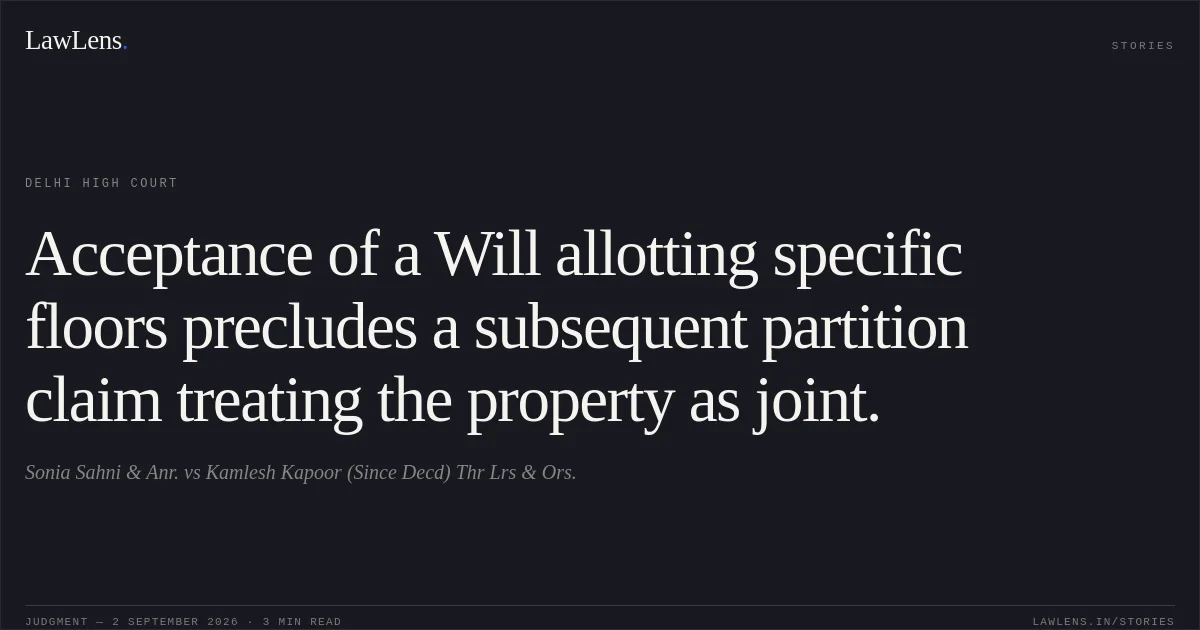
The Appellants instituted CS(OS) No. 747/2022 seeking partition by sale of property bearing No. H-18-19, Kirti Nagar, New Delhi, purchased by their grandmother, Late Smt. Harbans Kaur Oberoi, under a registered sale deed dated 26.03.1962.
p. 2 · ¶ 2By a registered Will dated 30.10.1998, the grandmother bequeathed the ground floor and roof rights above the second floor jointly to her three daughters, the first floor to one son, and the second floor without roof rights to the Appellants’ father; the staircase and ground-floor passage were to remain common.
pp. 2–3 · ¶ 2–3After the testator’s death on 03.01.2007, the Appellants’ father occupied and enjoyed the second floor until his death in 2021.
p. 4 · ¶ 4The Appellants alleged obstruction of access to the common staircase and passage and claimed that the second-floor structure was dilapidated and incapable of effective enjoyment.
p. 4 · ¶ 4During the proceedings, Respondent Nos. 2 and 3 disclosed that they had purchased the shares of three beneficiaries under a registered sale deed dated 31.01.2019.
p. 4 · ¶ 4The Appellants filed an application under Order XII Rule 6 CPC seeking a preliminary decree of partition on the basis of alleged admissions in the Written Statements.
p. 4 · ¶ 5The learned Single Judge dismissed the application on 17.02.2026, holding that the Will had already divided the property floor-wise and that the remaining disputes required evidence.
p. 4 · ¶ 5–6The present appeal was filed under Section 10(1) of the Delhi High Court Act, 1996.
p. 1 · ¶ 102Issues
i.1. Whether the Appellants were entitled to a preliminary decree of partition under Order XII Rule 6 CPC on the basis of alleged admissions concerning their right in the second floor.
p. 4 · ¶ 5 · p. 5 · ¶ 10ii.2. Whether the suit property continued to be jointly held and required fresh partition, notwithstanding its floor-wise bequest under the Will dated 30.10.1998.
pp. 5–6 · ¶ 11–12iii.3. Whether the Appellants’ grievances regarding access to the common staircase, the dilapidated condition of the second floor, and the inability to reconstruct it justified partition by sale.
p. 6 · ¶ 1103Law Applied
The Court considered Section 10(1) of the Delhi High Court Act, 1996, under which the appeal was preferred.
p. 1 · ¶ 1Order XII Rule 6 CPC permits judgment on admissions but confers a discretionary power to be exercised only where the admission is clear, unambiguous, unconditional, and made with an intention to be bound by it.
p. 4 · ¶ 6A preliminary decree of partition presupposes the existence of property held jointly or in an undivided state; where a valid and accepted testamentary disposition has already allocated specific portions to beneficiaries as absolute owners, a fresh partition is not maintainable.
pp. 5–6 · ¶ 11–12Disputes concerning obstruction of access, use of common areas, or the condition and enjoyment of an already allotted portion are factual disputes requiring evidence and do not, by themselves, establish a right to fresh partition.
p. 6 · ¶ 11Provisions in the judgment · 1
Delhi High Court Act, 1996 Section 10
04Reasoning
The Court held that the Will expressly allotted specific floors to the beneficiaries and conferred on each beneficiary the right to hold, enjoy, dispose of, and receive rents and profits from the allotted portion as an absolute owner; only the ground-floor staircase and passage were retained as common areas.
pp. 2–3 · ¶ 3 · p. 6 · ¶ 11The Appellants’ father had accepted the bequest, occupied the second floor exclusively during his lifetime, and never asserted any right over the other floors or challenged the Will.
p. 6 · ¶ 11The Appellants themselves relied upon, rather than disputed, the Will.
p. 6 · ¶ 11This longstanding and undisputed conduct demonstrated that the floor-wise allocation had been accepted and acted upon, meaning that the property no longer remained undivided for the purpose of a partition decree.
pp. 5–6 · ¶ 11–12The alleged obstruction of the common passage, structural dilapidation, and financial inability to reconstruct the second floor concerned the effective enjoyment of an already separately allotted portion.
p. 4, 6 · ¶ 6, 11These matters required evidence and could not establish clear and unconditional admissions warranting judgment under Order XII Rule 6 CPC.
p. 4, 6 · ¶ 6, 11Accordingly, the foundation for granting a preliminary decree of partition was absent.
05Holding
The Court answered the issues against the Appellants.
It held that the property had already been divided floor-wise under the undisputed Will and was not being jointly held in a manner requiring fresh partition.
pp. 5–6 · ¶ 11–12The Appellants’ grievances related only to the use and enjoyment of their separately allotted second-floor portion and did not justify a preliminary decree under Order XII Rule 6 CPC.
pp. 5–6 · ¶ 11–12The judgment of the learned Single Judge dated 17.02.2026 was upheld, the appeal was dismissed as devoid of merit, and all pending applications were disposed of.
p. 7 · ¶ 13–14Original Court PDF
Sonia Sahni & Anr.vsKamlesh Kapoor (Since Decd) Thr Lrs & Ors.
Click to open original judgment
Original judgment, available to read, download and summarize on LawLens.in