01Facts
The appellant-claimant sustained grievous injuries in a motor accident on 21 May 2014 while travelling in a bus bearing Registration No. OR-05-AD-0085, which collided with a stationary truck at Balijodi Chhak on N.H. 215. His left leg was amputated below the knee, and he remained hospitalised from 21 May 2014 to 2 June 2014.
¶ 6 · pp. 3–4The Medical Board assessed his permanent physical disability at 75%.
¶ 7 · p. 4The claimant asserted that he was working as a manager in a stone-crusher unit and earned ₹10,000 per month, whereas the Tribunal assessed his monthly income at ₹5,700 on the basis of estimation.
¶ 5 · p. 2In Motor Accident Claim Case No. 660 of 2014, the learned 3rd Additional District Judge-cum-4th M.A.C.T., Cuttack awarded ₹10,79,625 with interest at 6% per annum, together with penal interest at 12% if the amount was not deposited within two months.
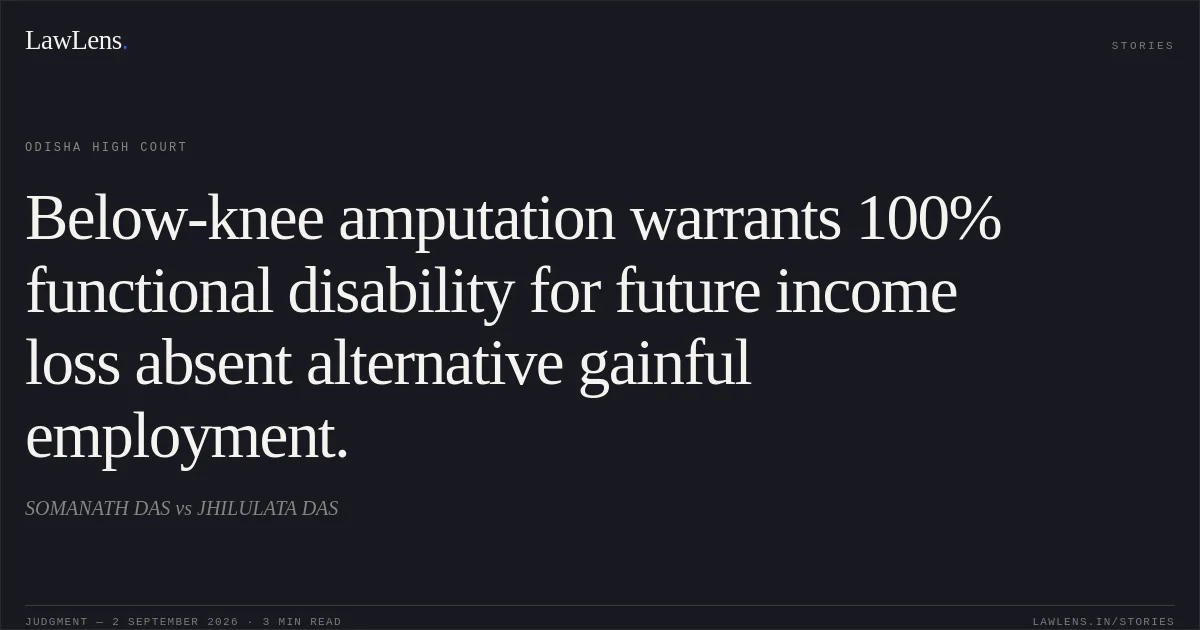
¶ 4 · p. 2The claimant preferred the present appeal under Section 173 of the Motor Vehicles Act, 1988, seeking enhancement of compensation, principally on the ground that the amputation rendered him 100% functionally disabled for the purpose of future earning capacity.
¶ 4 · p. 202Issues
i.1. Whether the Tribunal erred in assessing the claimant’s monthly income at ₹5,700 instead of the asserted ₹10,000 per month?
¶ 5, 11 · pp. 2–3, 7ii.2. Whether, despite the Medical Board assessing permanent disability at 75%, the claimant’s functional disability for calculating loss of future income ought to be assessed at 100% because of the below-knee amputation and the nature of his work?
¶ 7–9, 12–15 · pp. 4–9iii.3. What enhancement in compensation and consequential directions should be made?
¶ 16–19 · pp. 9–1003Law Applied
The Court exercised appellate jurisdiction under Section 173 of the Motor Vehicles Act, 1988 to examine the quantum of compensation.
¶ 4 · p. 2It applied the settled principle that compensation for loss of future earning capacity must be based on functional disability, rather than merely the percentage of physical disability assessed medically.
¶ 7 · p. 4Relying on Pratap Narain Singh Deo v. Srinivas Sabata, AIR 1976 SC 222, the Court recognised that an injury which prevents the claimant from performing the work undertaken before the accident may amount to total loss of earning capacity.
¶ 7 · p. 4It further relied on S. Ettiappan v. D. Kumar, 2025 SCC OnLine SC 3690, which held that where below-knee amputation prevents a claimant engaged in physical or manual work from performing his occupation and there is no evidence of another gainful avocation, the loss of future income may be assessed at 100% functional disability, notwithstanding a lower percentage of physical disability.
¶ 8–9, 13–15 · pp. 4–9Provisions in the judgment · 1 · Linked ones open on LawLens
Motor Vehicles Act, 1988 Section 173
04Reasoning
The Court declined to interfere with the Tribunal’s income assessment because the claimant produced no conclusive evidence establishing a monthly income of ₹10,000, and there was no specific material warranting substitution of the Tribunal’s estimation.
¶ 11 · p. 7However, it distinguished medical disability from functional disability.
¶ 13–15 · pp. 8–9Although the Medical Board assessed permanent disability at 75%, the claimant had suffered below-knee amputation of his left leg and was consequently unable to undertake the physical or manual activities associated with his livelihood.
¶ 13–15 · pp. 8–9Applying S. Ettiappan, the Court held that, in the absence of evidence that the claimant had secured another gainful occupation, his loss of future earning capacity had to be treated as 100%.
¶ 13–15 · pp. 8–9On that basis, using an income of ₹7,125 per month, multiplier 13, and 100% functional disability, the Court recalculated the compensation at ₹13,57,500.
¶ 16 · p. 905Holding
The appeal was partly allowed.
¶ 15–16 · p. 9The Court held that the claimant’s loss of future income was to be assessed at 100% functional disability, despite the medically assessed disability of 75%, and fixed the total compensation at ₹13,57,500.
¶ 15–16 · p. 9Since ₹10,79,625 had already been deposited and the parties agreed to round off the balance, Respondent Nos. 2 and 4—the concerned insurance companies—were directed to deposit a further consolidated sum of ₹2,50,000 in equal proportion within eight weeks.
¶ 17–18 · p. 10The award of 12% penal interest was waived, while the remaining terms of the Tribunal’s award were left undisturbed.
¶ 17–19 · p. 10Original Court PDF
SOMANATH DASvsJHILULATA DAS
Click to open original judgment
Original judgment, available to read, download and summarize on LawLens.in