Facts
Deepen Mukhia died in a motor vehicle accident on 12.11.2019 involving a vehicle owned by respondent no. 3 and driven by respondent no. 2.
Source reference: para. 1–3His wife, minor son, father and mother filed a claim under Section 166 of the Motor Vehicles Act, 1988, seeking compensation of ₹19,07,560.
Source reference: para. 1–2The vehicle was insured with Tata AIG General Insurance Company under an “Auto Secure Commercial Vehicle Package Policy”.
Source reference: para. 7, 9The insurer did not appear before the Motor Accident Claims Tribunal and was proceeded ex parte.
Source reference: para. 4The Tribunal accepted that the accident and death were proved, and that the insurance policy and driving licence were valid, but dismissed the claim on the ground that the accident resulted from brake failure and was not caused by rash or negligent driving.
Source reference: para. 5In appeal, the claimants confined their challenge to whether compensation could nevertheless be awarded under the no-fault liability provision, Section 140 of the Motor Vehicles Act.
Source reference: para. 7Issues
1. Whether the claimants could be awarded compensation under Section 140 of the Motor Vehicles Act despite the dismissal of their claim under Section 166 on the finding that the accident was not caused by rash or negligent driving.
Source reference: para. 7, 20–232. Whether the deceased’s heirs were disentitled from claiming compensation because the deceased was allegedly the tortfeasor or driver responsible for the accident.
Source reference: para. 8, 213. Whether the insurer was liable under the package policy to indemnify the vehicle owner’s liability towards the deceased occupant under Section 140.
Source reference: para. 9–19, 22–23Law Applied
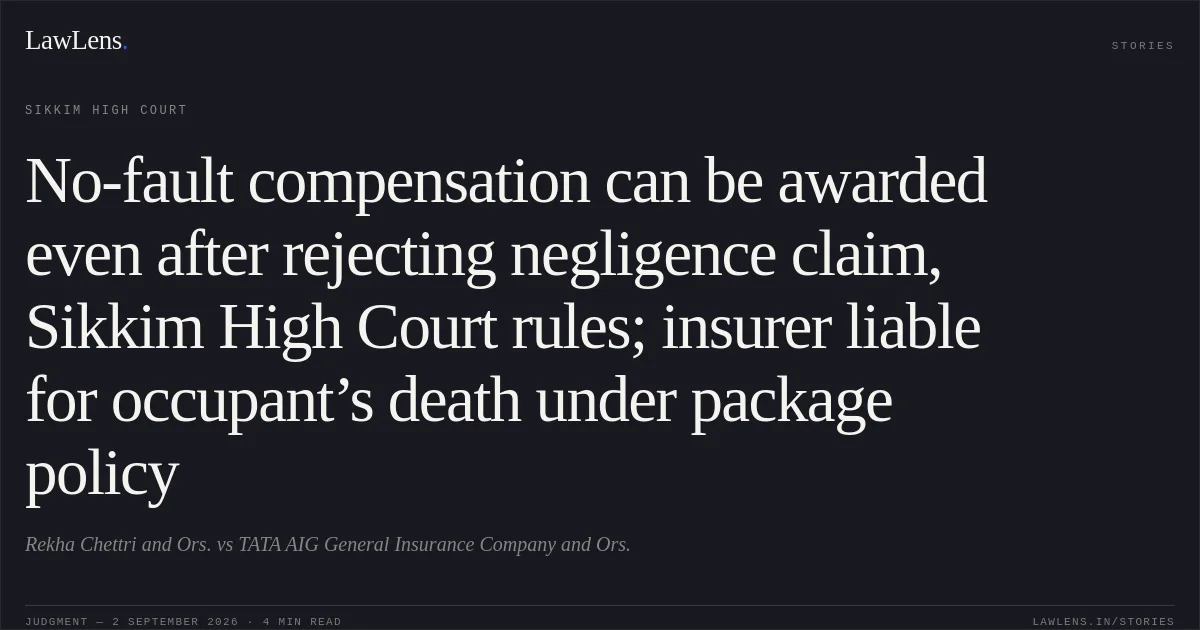
Section 140 of the Motor Vehicles Act imposes no-fault liability on the owner of the vehicle where death or permanent disablement results from the use of a motor vehicle; the claimant need not plead or establish wrongful act, neglect or default, and the claim is not defeated by the wrongful act or share of responsibility of the deceased.
Source reference: para. 20The Court relied on Eshwarappa alias Maheshwarappa v. C.S. Gurushanthappa, Indra Devi v. Bagada Ram, Nishan Singh v. Oriental Insurance Co. Ltd., and Ram Murti v. Punjab State Electricity Board, which establish that compensation under Section 140 may be granted even where negligence is not proved or the claim under Section 166 fails.
Source reference: para. 22The Court also relied on the principle in National Insurance Co. Ltd. v. Jugal Kishore, requiring an insurer in possession of the policy to produce it before the Tribunal and disclose the extent of coverage and indemnity.
Source reference: para. 17–19A comprehensive or package policy, read with the applicable IRDA circular dated 16.10.2009, covers occupants of the insured vehicle and requires the insurer to indemnify the owner for the relevant liability.
Source reference: para. 22The Court further treated the prevailing no-fault provision under Section 164, prescribing ₹5 lakhs for death, as a beneficial statutory measure applicable to the relief granted in the circumstances of the case.
Source reference: para. 24–25Reasoning
The Tribunal’s finding that brake failure negated rash and negligent driving could defeat a claim under Section 166, but it did not eliminate the statutory no-fault liability under Section 140.
Source reference: para. 1, 20–23Section 140 expressly dispenses with proof of negligence and provides that the deceased’s own wrongful act or responsibility cannot defeat the claim; accordingly, the insurer’s argument that the deceased was the tortfeasor was rejected.
Source reference: para. 21The insurance certificate identified a package policy, while the policy terms available on the insurer’s website covered death or bodily injury arising from the use of the vehicle and indemnified the insured against sums legally payable.
Source reference: para. 9–15Since the vehicle was insured, the owner was liable under the no-fault provision and the insurer was required to indemnify him.
Source reference: para. 22–23The Court also criticised the insurer’s failure to place the complete policy before the Tribunal, observing that such disclosure was necessary for effective adjudication.
Source reference: para. 16–19Considering the beneficial nature of the legislation and the fact that the compensation was being granted in 2026 for a 2019 death, the Court awarded ₹5 lakhs rather than limiting relief to the then-statutory amount of ₹50,000 under Section 140.
Source reference: para. 24–25Holding
The Court held that the Tribunal could and should have awarded no-fault compensation even after rejecting the claim under Section 166 for want of rash and negligent driving.
The deceased’s heirs were not barred merely because he was alleged to have been responsible for the accident.
Source reference: para. 21The vehicle owner was liable under Section 140, and Tata AIG, as insurer under the package policy, was liable to indemnify him.
Source reference: para. 23The appeal was allowed to that extent, and the insurer was directed to pay ₹5,00,000, with interest at 7% per annum from 14.02.2023, the date of filing of the claim, until actual payment.
Source reference: para. 25–26Acts & Sections Cited
7 provisions across 2 statutes referred to in this judgment. Each provision opens on LawLens.
Motor Vehicles Act, 19885
Indian Penal Code, 18602
Original Court PDF
Rekha Chettri and Ors.vsTATA AIG General Insurance Company and Ors.
Click to open original judgment
Original judgment, available to read, download and summarize on LawLens.in