Facts
The plaintiff (owner) filed suits for possession and damages against defendants who were originally tenants in shops located on Ashram Road, Ahmedabad
Source reference: p. 1-3In 1986, the Ahmedabad Municipal Corporation (AMC) initiated road widening, affecting these shops. The tenants moved the High Court in 1986, resulting in a scheme where the AMC provided alternative accommodations at a subsidized rent in lieu of compensation
Source reference: p. 4, 13-14The shops were subsequently demolished. However, defendants re-entered/remained in a small, dilapidated portion (approx. 2 feet wide) of the original site after occupying the new sites
Source reference: p. 5, 14The trial court decreed the suits, ordering eviction and damages of ₹1000/month
Source reference: p. 2-3The defendants appealed, asserting that they remained "tenants" under the protection of the Bombay Rent Act and that the City Civil Court lacked jurisdiction
Source reference: p. 7Issues
1. Whether the City Civil Court had jurisdiction to decide the suit or if the matter fell under the exclusive jurisdiction of the Small Cause Court under Section 28 of the Bombay Rent Act
Source reference: p. 152. Whether a landlord-tenant relationship continued to exist after the demolition of the shops and the acceptance of alternative accommodation by the tenants
Source reference: p. 153. Whether the defendants' occupation of the remaining portion of the premises constituted a rank trespass
Source reference: p. 15, 25Law Applied
The Court applied Section 9 of the Code of Civil Procedure, 1908, regarding the inherent jurisdiction of Civil Courts
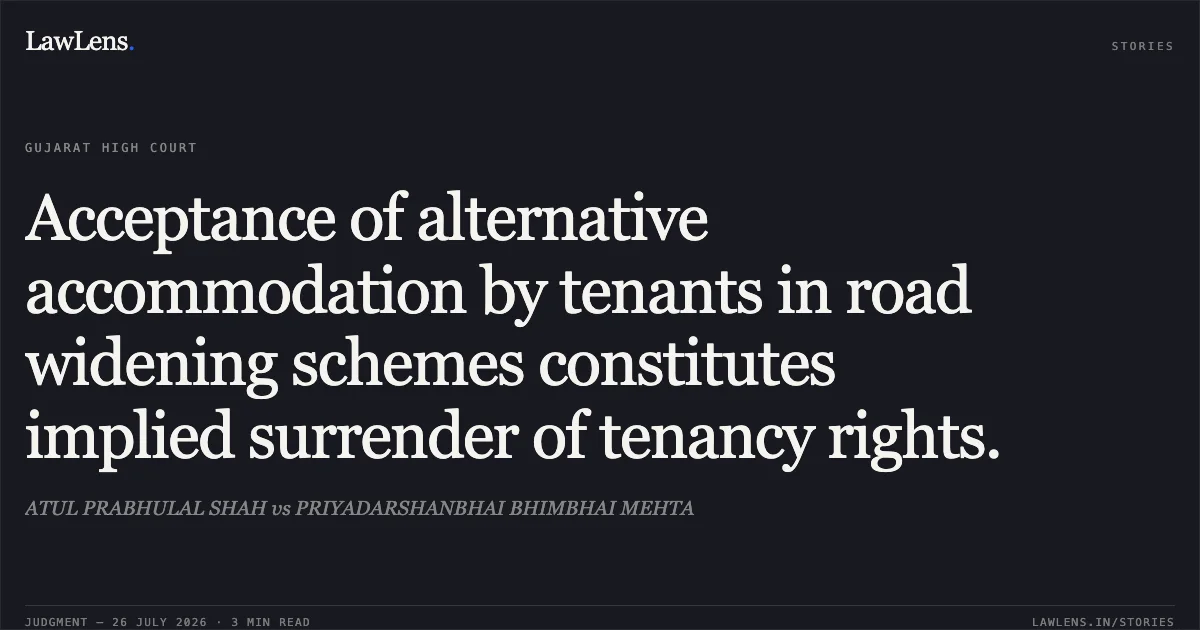
Source reference: p. 25It interpreted the doctrine of "implied surrender" of tenancy under the Transfer of Property Act, 1882, in the context of accepting alternative sites
Source reference: p. 24It further relied on the principle of Vigilantibus non dormientibus jure subventiunt (law assists the vigilant), citing Hameed Joharan v. Abdul Salam
Source reference: p. 28Regarding the negligence of counsel as a ground for relief, the court applied the precedent from Salil Dutta v. T.M. & M.C. Private Ltd. and Rajneesh Kumar v. Ved Prakash, which holds that a litigant cannot shift entire blame to their advocate to undo judicial proceedings
Source reference: p. 26-27Reasoning
The Court reasoned that the 1986 High Court order and the subsequent AMC scheme established that alternative accommodations were provided specifically in lieu of the compensation and the loss of the original tenanted premises
Source reference: p. 17-21By accepting these new sites and shifting their businesses, the tenants' rights in the original suit shops were extinguished through implied surrender
Source reference: p. 24The Court found no evidence (such as rent receipts post-1990) to prove a continuing landlord-tenant relationship
Source reference: p. 15Consequently, any re-entry into the non-demolished "sliver" of land was held to be the act of a "rank trespasser" or "encroacher" rather than a tenant
Source reference: p. 25Since no relationship governed by the Rent Act existed, Section 28 of said Act did not bar the City Civil Court’s jurisdiction
Source reference: p. 25The Court also rejected the request for a remand, noting the defendants had failed to cross-examine the plaintiff despite multiple opportunities and could not now plead "negligence of counsel" to reopen the case
Source reference: p. 27-28Holding
The High Court dismissed the appeals and confirmed the trial court’s decree
It held that the defendants lost their tenancy rights upon accepting alternative accommodation and their current status is that of rank trespassers
Source reference: p. 25The City Civil Court properly exercised jurisdiction
Source reference: p. 25The defendants were ordered to vacate the premises and pay damages as decreed. All interim stays were vacated, and the request for a further stay on the judgment was rejected
Source reference: p. 30Acts & Sections Cited
5 provisions across 4 statutes referred to in this judgment. Each provision opens on LawLens.
Bombay Rent-free Estates Act, 18512
Code of Civil Procedure, 19081
Limitation Act, 19631
Manipur Municipalities Act, 19941
Original Court PDF
ATUL PRABHULAL SHAHvsPRIYADARSHANBHAI BHIMBHAI MEHTA
Click to open original judgment
Original judgment, available to read, download and summarize on LawLens.in