Facts
The petitioner, a mail-conveyance contractor, entered into an agreement with the Chief Postmaster General, Bihar Circle, on 25 March 2013 for conveying mails by motor vehicle on the Dehri–Sasaram–Bikramganj–Kadth route for the period 1 April 2013 to 31 March 2014.
Source reference: pp. 2–3Although the agreement expired on 31 March 2014, the petitioner continued providing services, and the Department continued making payments, including payments at an enhanced diesel-linked rate until February 2016.
Source reference: pp. 2–3, 9From March 2016 onward, the petitioner continued rendering services but was not paid at a proportionately enhanced rate.
Source reference: pp. 3–4The Department contended that, after expiry of the agreement, no contractual obligation existed and that the petitioner had continued providing services voluntarily; it also challenged the writ petition as belated and lacking a continuing cause of action.
Source reference: pp. 6–8Issues
Whether the petitioner could claim compensation at an enhanced, diesel-linked rate for services rendered after expiry of the written agreement.
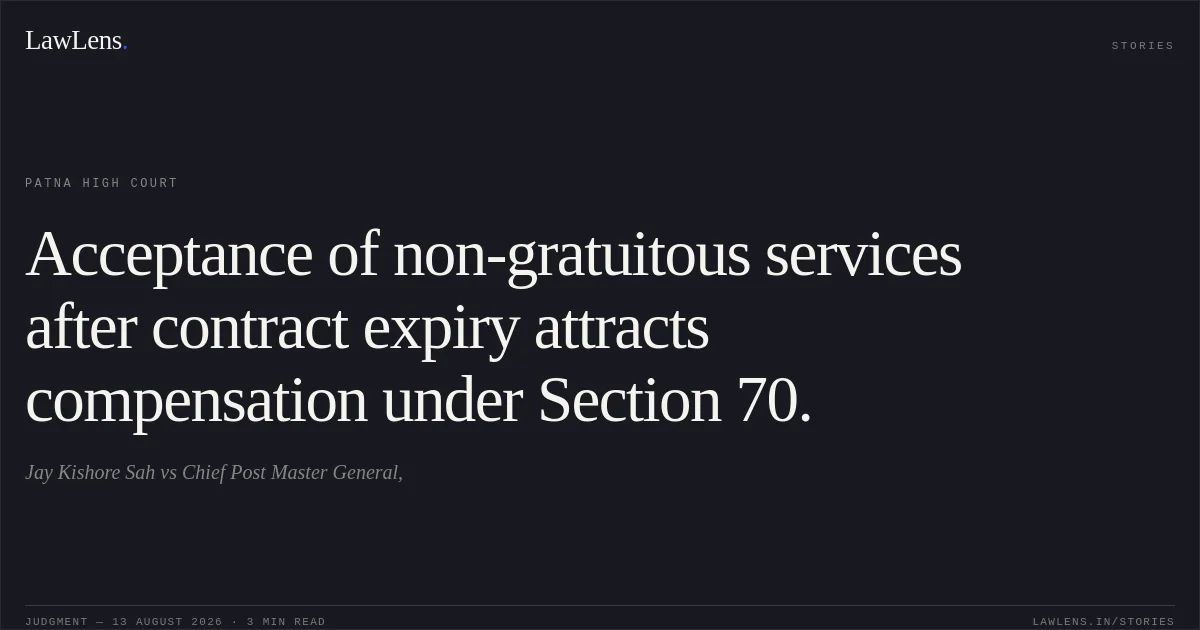
Source reference: pp. 9–11, 15–16Whether the Department’s acceptance and enjoyment of the petitioner’s post-contract services attracted the statutory obligation under Section 70 of the Indian Contract Act, 1872, notwithstanding the absence of a renewed agreement.
Source reference: pp. 10–14Whether the writ petition was liable to be dismissed on the grounds of delay, limitation, or absence of a continuing cause of action.
Source reference: pp. 7–10Law Applied
The Court applied Section 70 of the Indian Contract Act, 1872, under which a person who lawfully does something for another, without intending to act gratuitously, and whose benefit is voluntarily enjoyed by the other, is entitled to compensation.
Source reference: p. 11Relying on State of West Bengal v. B.K. Mondal & Sons, 1961 SCC OnLine SC 76, the Court held that Section 70 requires: (i) a lawful act or delivery, (ii) absence of gratuitous intent, and (iii) voluntary acceptance or enjoyment of the benefit; the resulting liability is quasi-contractual and does not arise from enforcement of the expired contract.
Source reference: pp. 11–13The Court also relied on Ramesh Kumar Jain v. Bharat Aluminium Company Limited (BALCO), 2025 SCC OnLine SC 2857, for the principle that Section 70 creates an independent statutory obligation founded on restitution, quantum meruit, and prevention of unjust enrichment.
Source reference: p. 14As the Union of India is “State” under Article 12, its conduct was also required to be fair, reasonable, and non-exploitative.
Source reference: pp. 9–10Reasoning
The Court accepted that the written agreement had expired in 2014 and therefore could not, by itself, be enforced after that date. However, the Department admittedly accepted and enjoyed the petitioner’s mail-conveyance services for several years after expiry of the agreement and made payments for those services, including enhanced payments until February 2016.
Source reference: p. 9The petitioner’s continued performance was held to be non-gratuitous, particularly because it was rendered in the expectation that the arrangement would continue or be renewed.
Source reference: pp. 10–14Applying Section 70, the Court treated the Department’s acceptance of the services as creating an independent obligation to provide reasonable compensation and prevent unjust enrichment, rather than as a continuation of the expired contract.
Source reference: pp. 10–14The Court further considered the Department’s earlier sanction of arrears for increased diesel costs in a comparable period and found the refusal to provide corresponding compensation in the present period to be arbitrary and exploitative.
Source reference: p. 9Since the alleged underpayment recurred throughout the period in which services continued, the Court characterised the cause of action as continuing and rejected the objection based on delay or limitation.
Source reference: p. 10Holding
The Court held that the petitioner was legally entitled to claim compensation calculated with reference to the enhanced and revised diesel rates for services rendered from March 2016 onward, despite the absence of a renewed written agreement.
The writ petition was accordingly allowed.
Source reference: p. 15The petitioner was directed to submit, within 15 days, a representation containing supporting documents and a calculation chart showing the diesel-price escalation.
Source reference: p. 16The respondents were directed to examine the claim, in consultation with the petitioner if necessary, and pay the differential amount for the relevant period within three months, together with interest at 6% per annum.
Source reference: p. 16Acts & Sections Cited
1 provisions across 1 statute referred to in this judgment. Each provision opens on LawLens.
Indian Contract Act, 18721
Original Court PDF
Jay Kishore SahvsChief Post Master General,
Click to open original judgment
Original judgment, available to read, download and summarize on LawLens.in