Facts
The appellant, while serving as Divisional Security Commissioner, Railway Protection Force, Palakkad, was prosecuted pursuant to FIR No. RC19(A)/2005/KER/CBI for allegedly demanding and obtaining illegal gratification from RPF personnel seeking transfers, postings, and other service benefits through subordinate intermediaries, Anantha Narayanan and Abdul Gafoor.
Source reference: paras. 1, 6–10The present appeals concerned two prosecutions: C.C. No. 2 of 2014, arising from a trap involving P.P. Nandakumar, and C.C. No. 3 of 2015, involving alleged payments by T.V. Rajan, C.K. Aravindan, and N.P. Gopi Kumar.
Source reference: paras. 15–16In C.C. No. 2 of 2014, Anantha Narayanan, originally an accused, accepted pardon under Section 306 CrPC and became an approver. He was apprehended while accepting ₹5,000 from Nandakumar during a CBI trap. The appellant was not apprehended or found in possession of the money.
Source reference: paras. 11–14, 57–60The Trial Court convicted the appellant under Sections 7 and 13(2) read with Section 13(1)(d) of the Prevention of Corruption Act, 1988, and the High Court affirmed the conviction.
Source reference: paras. 2, 4, 16In C.C. No. 3 of 2015, Abdul Gafoor, also an accused-turned-approver, was alleged to have collected money from RPF personnel on the appellant’s behalf. The High Court ultimately upheld only the conviction relating to N.P. Gopi Kumar, who alleged that ₹3,000 was handed to the appellant through Abdul Gafoor at the appellant’s residence.
Source reference: paras. 3–4, 75, 79–80Issues
Whether the prosecution proved beyond reasonable doubt that the appellant demanded illegal gratification, directly or through intermediaries, in connection with transfers, postings, or service-related benefits.
Source reference: para. 41(i)Whether the amounts paid to Anantha Narayanan and Abdul Gafoor were accepted or obtained by them on behalf of the appellant, thereby constituting acceptance or obtainment by the appellant under Sections 7 and 13 of the Prevention of Corruption Act.
Source reference: para. 41(ii)Whether the testimony of the approvers, who were originally co-accused and subsequently granted pardon, was reliable and sufficiently corroborated to sustain the convictions.
Source reference: para. 41(iii)Whether the statutory presumption under Section 20 of the Prevention of Corruption Act could be invoked in the absence of satisfactory proof of the appellant’s acceptance or obtainment of illegal gratification.
Source reference: para. 41(iv)Whether the concurrent findings of the Trial Court and the High Court warranted interference by the Supreme Court.
Source reference: para. 41(v)Whether the prosecution sanctions under Section 19 of the Prevention of Corruption Act were validly accorded.
Source reference: para. 41(vi)Law Applied
The Court applied Sections 7, 13(1)(d), 13(2), 19, and 20 of the Prevention of Corruption Act, 1988.
Source reference: no citationIt reaffirmed that proof of demand and acceptance or obtainment of illegal gratification is the essential foundation of liability, and that mere recovery or payment of money is insufficient: C.M. Girish Babu v. CBI and B. Jayaraj v. State of Andhra Pradesh.
Source reference: paras. 44–48Under P. Satyanarayana Murthy v. District Inspector of Police, demand is a sine qua non for offences under the Act.
Source reference: para. 48Relying on the Constitution Bench decision in Neeraj Dutta v. State (Government of NCT of Delhi), the Court held that demand may be proved by circumstantial evidence, but the prosecution must first establish foundational facts of acceptance or obtainment before the presumption under Section 20 can arise.
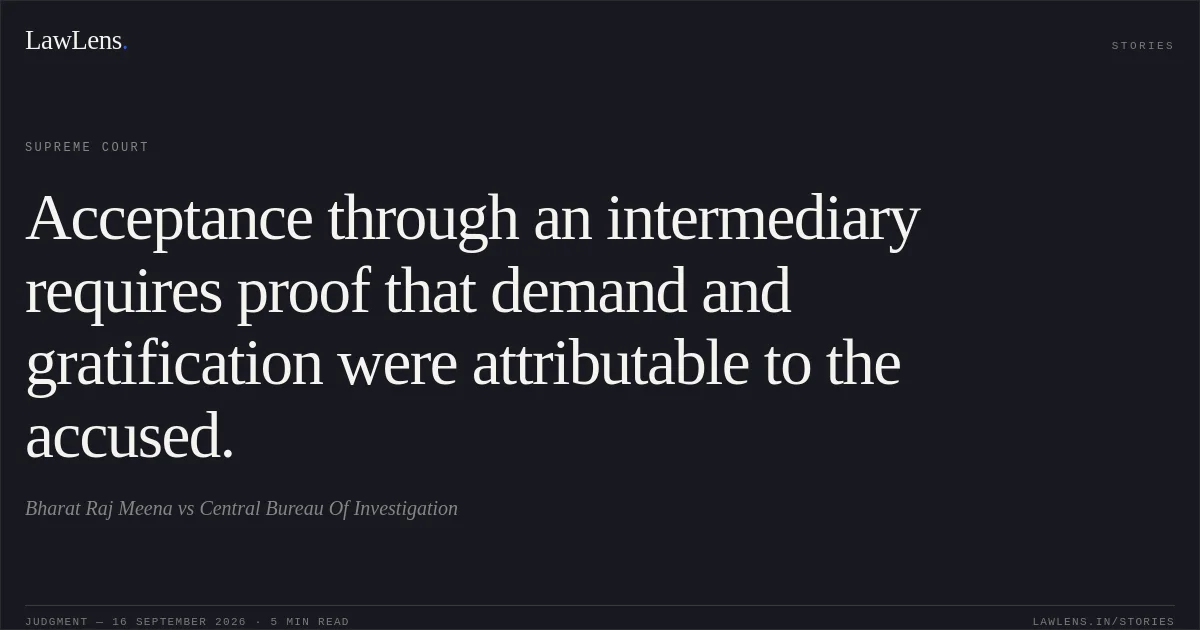
Source reference: para. 49Acceptance through an intermediary may legally constitute acceptance by the public servant, including where the gratification is obtained for another person, as recognised in State by Lokayuktha Police v. K. Rangayya; however, the prosecution must prove that the intermediary acted under the accused’s authority, direction, or for his benefit.
Source reference: paras. 50–51Although an approver is a competent witness under Section 133 of the Evidence Act, Illustration (b) to Section 114 embodies the rule of prudence that accomplice testimony should ordinarily be corroborated in material particulars connecting the accused with the offence, as stated in Sarwan Singh v. State of Punjab.
Source reference: paras. 52–55Reasoning
In the Nandakumar transaction, the evidence established, at most, that Nandakumar handed ₹5,000 to Anantha Narayanan, who was apprehended with the money. The accounts of Nandakumar and Anantha Narayanan materially diverged regarding whether the appellant directed the payment to be made through the intermediary.
Source reference: paras. 59–66The appellant was not apprehended, the money was not recovered from him, and the CBI stopped the trap upon recovery from Anantha Narayanan instead of tracing the money to the appellant’s residence.
Source reference: paras. 59–66The alleged demand was also inherently doubtful because the appellant lacked authority over Nandakumar’s posting, which had been ordered by the Senior DPO, and the relevant officials denied that the appellant had influenced the posting.
Source reference: para. 69The approver’s assertion that the money was intended for delivery at the appellant’s residence lacked independent corroboration, leaving open the reasonable possibility that Anantha Narayanan had acted independently.
Source reference: paras. 70–74Accordingly, the foundational fact of the appellant’s acceptance or obtainment was not proved and Section 20 could not be invoked.
Source reference: paras. 74, 85–86As regards Gopi Kumar, the prosecution relied principally on the testimony of Gopi Kumar and approver Abdul Gafoor. Although both referred to the appellant’s presence, the alleged words of the appellant did not expressly mention money, the Inspector who allegedly summoned Gopi Kumar was not examined, there were no call records or duty records placing the appellant at the residence, and no money was recovered.
Source reference: paras. 79–84The appellant’s diary placed him away from Palakkad on the only date appearing in the record for the transaction, and the prosecution offered no satisfactory reconciliation.
Source reference: para. 83The evidence therefore did not establish the demand and acceptance attributable to the appellant with the certainty required in a criminal case; the presumption under Section 20 consequently did not arise.
Source reference: para. 85Holding
The Supreme Court held that the prosecution failed to prove beyond reasonable doubt that the appellant demanded, accepted, or obtained illegal gratification through Anantha Narayanan or Abdul Gafoor.
Recovery of money from an intermediary, without reliable proof that the intermediary acted for or under the direction of the appellant and that the money was accepted or obtained by him, was insufficient to sustain conviction. The statutory presumption under Section 20 was therefore unavailable.
Source reference: paras. 74, 85–86Both appeals were allowed. The convictions and sentences in C.C. No. 2 of 2014 and C.C. No. 3 of 2015 were set aside, and the appellant was acquitted of all charges.
Source reference: paras. 88–89His bail bonds were discharged and any fine deposited was directed to be refunded.
Source reference: paras. 88–89Acts & Sections Cited
10 provisions across 2 statutes referred to in this judgment. Each provision opens on LawLens.
Prevention of Corruption Act, 19884
Code of Criminal Procedure, 19736
Original Court PDF
Bharat Raj MeenavsCentral Bureau Of Investigation
Click to open original judgment
Original judgment, available to read, download and summarize on LawLens.in