Facts
The Appellants are former employees (or legal heirs) of the Export Inspection Council (EIC) and Export Inspection Agencies (EIAs), statutory bodies under the Ministry of Commerce.
Source reference: para 7Between 1991 and 1994, the Appellants exited service through various modes: retrenchment, superannuation, or the Special Voluntary Retirement Scheme (SVRS).
Source reference: para 21They challenged a Single Judge’s dismissal of their writ petition, which sought pensionary benefits under the CCS (Pension) Rules, 1972.
Source reference: para 6-7The Appellants contended that despite a 1994 Cabinet decision intended to protect surplus staff and provide pensionary benefits, they were denied these rights and were instead treated under the Contributory Provident Fund (CPF) scheme or retrenched under Temporary Service Rules.
Source reference: para 13-15Issues
1. Whether the Appellants possess an enforceable right to be governed by the CCS (Pension) Rules based on the 1994 Cabinet policy that was never formally implemented.
Source reference: para 242. Whether the Appellants, having exercised options to remain under the CPF scheme or having accepted SVRS settlements, can claim parity with pensionable employees decades later.
Source reference: para 22, 263. Whether the denial of pension constitutes a "continuing wrong" sufficient to overcome a delay of over thirty years.
Source reference: para 18, 27Law Applied
The Court applied Section 17(3) of the Export (Quality Control and Inspection) Act, 1963 (as amended in 1984), which continues EIC Pension Rules only for those who did not exercise a contrary option.
Source reference: para 16, 23It relied on the principle that a Cabinet decision not brought into effect does not confer enforceable rights, distinguishing State of Arunachal Pradesh v. Nezone Law House which pertains to rules framed under Article 309 of the Constitution.
Source reference: para 24The Court further applied the doctrine of "negative equality," asserting that Article 14 cannot be invoked to perpetuate an illegality or claim parity where circumstances differ.
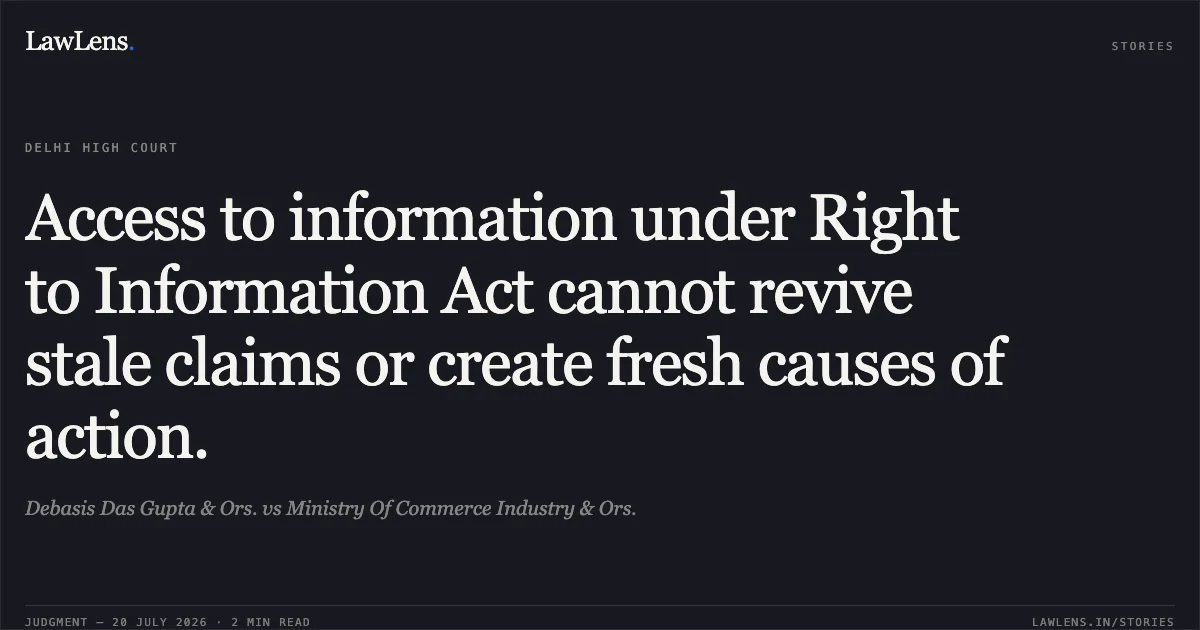
Source reference: para 28The Court held that the Right to Information Act, 2005, cannot revive stale claims or create fresh causes of action.
Source reference: para 27Reasoning
The Court found that the Appellants lacked a uniform legal standing because their service exits (retrenchment vs. SVRS) carried distinct legal consequences.
Source reference: para 21While Appellants claimed the 1994 Cabinet decision granted them pension rights, the Court noted this proposal was never formulated or submitted, thus remaining legally unenforceable.
Source reference: para 24Regarding the CPF scheme, evidence showed Appellants had signed individual option forms to remain in CPF; the presumption in Section 17(3) of the Export Act only covers those who exercised no option, which was not the case here.
Source reference: para 22-23The Court rejected the "continuing wrong" argument, noting that the grievance crystallized at the time of exit (1991–1994); taking a one-time SVRS settlement served as a full discharge of claims, and the Appellants could not "recast" that exit decades later.
Source reference: para 26-27Holding
The Court dismissed the appeal, holding that the Appellants failed to establish a legal right to a mandamus.
The Court concluded that the challenges to orders from the 1990s were barred by extraordinary delay and laches and that obtaining documents via RTI does not reset the limitation period for stale claims.
Source reference: para 25, 27The Impugned Judgment of the Single Judge was upheld, and no costs were awarded.
Source reference: para 29Acts & Sections Cited
3 provisions across 1 statute referred to in this judgment. Each provision opens on LawLens.
Export (Quality Control and Inspection) Act, 19633
Original Court PDF
Debasis Das Gupta & Ors.vsMinistry Of Commerce Industry & Ors.
Click to open original judgment
Original judgment, available to read, download and summarize on LawLens.in


