Facts
On 10 December 2015, the appellant, while attempting to board Train No. 14114 (Link Express) at Moradabad Railway Station to travel to Chandausi, allegedly fell when the train suddenly started with a jerk and suffered serious injuries, including traumatic amputation of his left forearm.
Source reference: p.2He possessed a valid Monthly Season Ticket, which was recovered at the spot; the Railway Claims Tribunal consequently held him to be a bona fide passenger.
Source reference: pp.2–3The Tribunal nevertheless dismissed his claim application on the ground that the occurrence did not constitute an “untoward incident” under the Railways Act, 1989.
Source reference: p.2The appellant challenged that decision under Section 23 of the Railway Claims Tribunal Act, 1987.
Source reference: p.2Before the High Court, the appellant relied on his testimony and submitted that the Railway had not led oral evidence in rebuttal.
Source reference: p.2The Railway relied on the Station Master’s diary and other contemporaneous records, including a discharge summary stating that the appellant fell while crossing the railway track and was hit by an engine.
Source reference: p.3Issues
Whether the injuries sustained by the appellant while allegedly boarding a moving passenger train constituted an “untoward incident” under Sections 123(c) and 124-A of the Railways Act, 1989?
Source reference: pp.3–4Whether the Railway established, through cogent evidence, circumstances sufficient to exclude its statutory strict/no-fault liability under Section 124-A?
Source reference: pp.3–5Whether the Tribunal’s dismissal of the claim application was sustainable in light of the appellant’s unrebutted testimony and the conflicting documentary records?
Source reference: pp.3–5Law Applied
The Court applied Section 23 of the Railway Claims Tribunal Act, 1987, governing appeals from Tribunal orders, and Sections 123(c) and 124-A of the Railways Act, 1989.
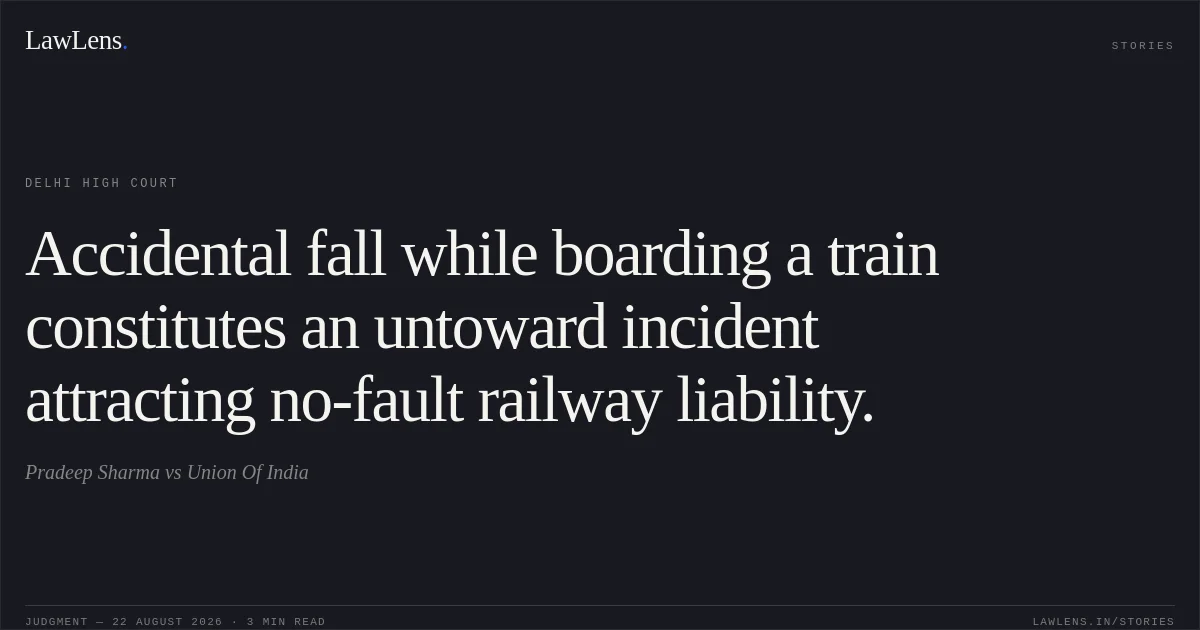
Source reference: pp.2, 4–5An accidental falling of a bona fide passenger from a train while boarding or alighting constitutes an “untoward incident,” attracting the Railway Administration’s strict/no-fault liability, subject to the statutory exceptions under Section 124-A.
Source reference: pp.2, 4–5Relying on Union of India v. Prabhakaran Vijaya Kumar, (2008) 9 SCC 527, and Jameela v. Union of India, (2010) 12 SCC 443, the Court held that alleged negligence by the passenger does not, by itself, defeat the claim.
Source reference: pp.2, 4–5The Court also relied on Rina Devi for the proposition that accidental falling while boarding or alighting is an untoward incident, and on Mohd. Ubaid v. Union of India, 2026 SCC OnLine Del 3239, which reiterated that the Railway must establish a statutory exception by cogent evidence before strict liability can be avoided.
Source reference: pp.2, 4–5Reasoning
The High Court treated the appellant’s status as a bona fide passenger as settled because the Tribunal had so found on the basis of the recovered valid season ticket, and the Railway had not challenged that finding.
Source reference: p.3The appellant consistently stated that he fell because the train suddenly moved with a jerk while he was boarding, and his testimony as AW-1 remained unrebutted since the Railway did not examine any witness in opposition.
Source reference: pp.3–4The Tribunal’s reliance on the Station Master’s entry—that the appellant was brought to the Station Master’s room at 18:50 hours, the recorded departure time of the train—was held to be inferential, as the record did not establish either the precise time of the fall or the time taken to bring him to the room.
Source reference: p.4Similarly, the discharge summary’s reference to the appellant falling while crossing the track and being hit by an engine was not adequately proved, as the person responsible for making or supplying that information was neither identified nor examined.
Source reference: p.4Applying the strict/no-fault liability principle, the Court held that the Railway had not proved any statutory exception under Section 124-A and that the evidence supported classification of the occurrence as an untoward incident.
Source reference: pp.4–5Holding
The Court held that the injuries suffered by the appellant resulted from an “untoward incident” within the meaning of Sections 123(c) and 124-A of the Railways Act, 1989.
The appeal was allowed, the Tribunal’s judgment dated 8 November 2019 was set aside, and the matter was remanded to the Tribunal to assess the compensation payable in accordance with law.
Source reference: p.5The concerned authorities were directed to disburse the compensation within two months of receiving the order, and the matter was directed to be listed before the Tribunal on 9 September 2026.
Source reference: p.5Acts & Sections Cited
2 provisions across 2 statutes referred to in this judgment. Each provision opens on LawLens.
Railway Claims Tribunal Act, 19871
Railways Act, 19891
Original Court PDF
Pradeep SharmavsUnion Of India
Click to open original judgment
Original judgment, available to read, download and summarize on LawLens.in