Facts
The appellant, Rajinder Prasad, aged approximately 48 years, claimed that he purchased a computerised railway ticket for ₹169 from Siwan to Ambala Cantt. and travelled by Jan Sadharan Train No. 04601.
Source reference: paras. 2, 9–9.1On 24 April 2013, near Jagadhari Railway Station, he was standing near the compartment door due to heavy passenger rush when his foot slipped and he fell from the train into the gap between the train and Platform No. 3.
Source reference: paras. 2, 9–9.1The Railway Claims Tribunal dismissed his claim under Section 124-A of the Railways Act, 1989.
Source reference: paras. 3–5The appellant challenged the Tribunal’s judgment under Section 23 of the Railway Claims Tribunal Act, 1987.
Source reference: para. 1Issues
Whether the appellant was a bona fide passenger notwithstanding the non-production of the railway ticket?
Source reference: paras. 9–9.2Whether the appellant’s fall from Train No. 04601 constituted an “untoward incident” under Sections 123(c)(2) and 124-A of the Railways Act, 1989?
Source reference: paras. 10–10.4Whether the injuries suffered by the appellant—amputation of both legs—were scheduled injuries warranting statutory compensation?
Source reference: para. 11What amount of compensation and interest was payable to the appellant?
Source reference: para. 11.1Law Applied
Section 124-A of the Railways Act, 1989 imposes statutory liability on the Railway administration to pay compensation for death or injury resulting from an “untoward incident,” subject to the exceptions in its proviso, including suicide, attempted suicide, self-inflicted injury, and certain other specified circumstances.
Source reference: paras. 10–10.2Section 123(c)(2) includes the accidental falling of a passenger from a train carrying passengers within the definition of an “untoward incident.”
Source reference: para. 10Mere non-production of a ticket does not, by itself, disprove bona fide passenger status where the claimant gives a consistent account of purchasing the ticket and its loss is reasonably explicable; the evidentiary burden may shift to the Railways to rebut that account, as recognised in Union of India v. Rina Devi, (2019) 3 SCC 572.
Source reference: paras. 9.1–9.2The expression “accidental falling of a passenger” is to receive a liberal and purposive interpretation consistent with the beneficial object of the legislation, as held in Union of India v. Prabhakaran Vijaya Kumar, 2008 ACJ 1895.
Source reference: para. 10.3Under Part II, Item (3) of the Schedule to the Railway Accidents and Untoward Incidents (Compensation) Rules, 1990, double amputation through the leg or thigh, or comparable loss of both lower limbs, is a scheduled injury attracting compensation.
Source reference: para. 11Reasoning
The Court held that the Tribunal had improperly treated the absence of the original ticket as conclusive proof that the appellant was ticketless.
Source reference: paras. 9.1–9.2The appellant had consistently stated, in his contemporaneous statement to the GRP, claim application, affidavit, and deposition, that he had purchased a ₹169 ticket from Siwan to Ambala Cantt. and that it was lost during the incident or subsequent medical treatment.
Source reference: paras. 9.1–9.2The Railways produced no evidence that he had been apprehended travelling without a ticket or that proceedings under Sections 55 or 137 of the Railways Act had been initiated against him.
Source reference: paras. 9.1–9.2The Court further found that the appellant’s accidental-fall account was supported by the Station Master’s memo, the medical and GRP material, and the fact that he was found injured in connection with the relevant train.
Source reference: paras. 10–10.3The Tribunal’s inference that he had attempted to de-board the train merely because Jagadhari was not a scheduled stoppage, or because he was a resident of Yamunanagar, was held to be conjectural.
Source reference: paras. 10–10.3In the absence of evidence of an intention to commit suicide or cause self-injury, the statutory exceptions under Section 124-A could not be invoked.
Source reference: paras. 10–10.3The medical record, the appellant’s statement, and his deposition established traumatic amputation of both legs, which fell within the scheduled injuries under the 1990 Rules.
Source reference: para. 11Holding
The appeal was allowed.
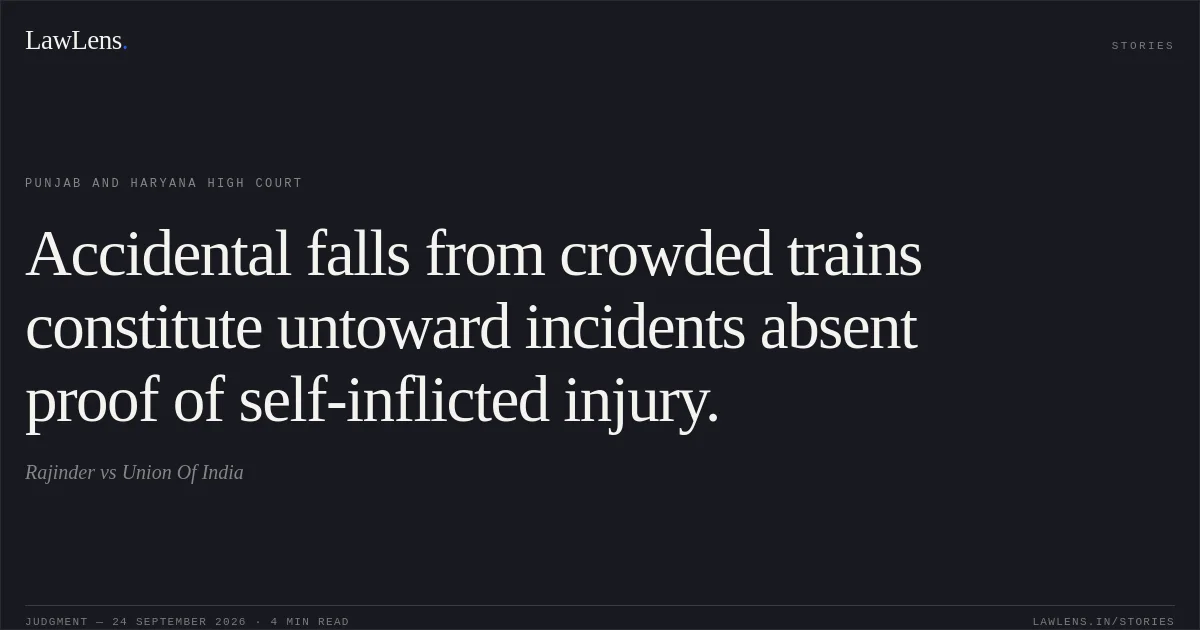
It held that the appellant was a bona fide passenger, that he had accidentally fallen from Train No. 04601 near Platform No. 3 at Jagadhari on 24 April 2013, and that the occurrence constituted an “untoward incident” under Section 123(c)(2) of the Railways Act, 1989.
Source reference: para. 10.4For the double-amputation injury, the appellant was held entitled to ₹4,20,000 with interest at 9% per annum from the date of filing of the claim petition until realization, or ₹8,00,000 under the enhanced schedule applicable as on the date of the award, whichever was higher.
Source reference: para. 11.1The Union of India was directed to deposit or pay the applicable amount with accrued interest before the Tribunal within two months of receiving a certified copy of the judgment.
Source reference: para. 11.1In default, further interest at 12% per annum would apply until payment.
Source reference: para. 11.1Acts & Sections Cited
4 provisions across 2 statutes referred to in this judgment. Each provision opens on LawLens.
Railway Claims Tribunal Act, 19871
Railways Act, 19893
Original Court PDF
RajindervsUnion Of India
Click to open original judgment
Original judgment, available to read, download and summarize on LawLens.in