Facts
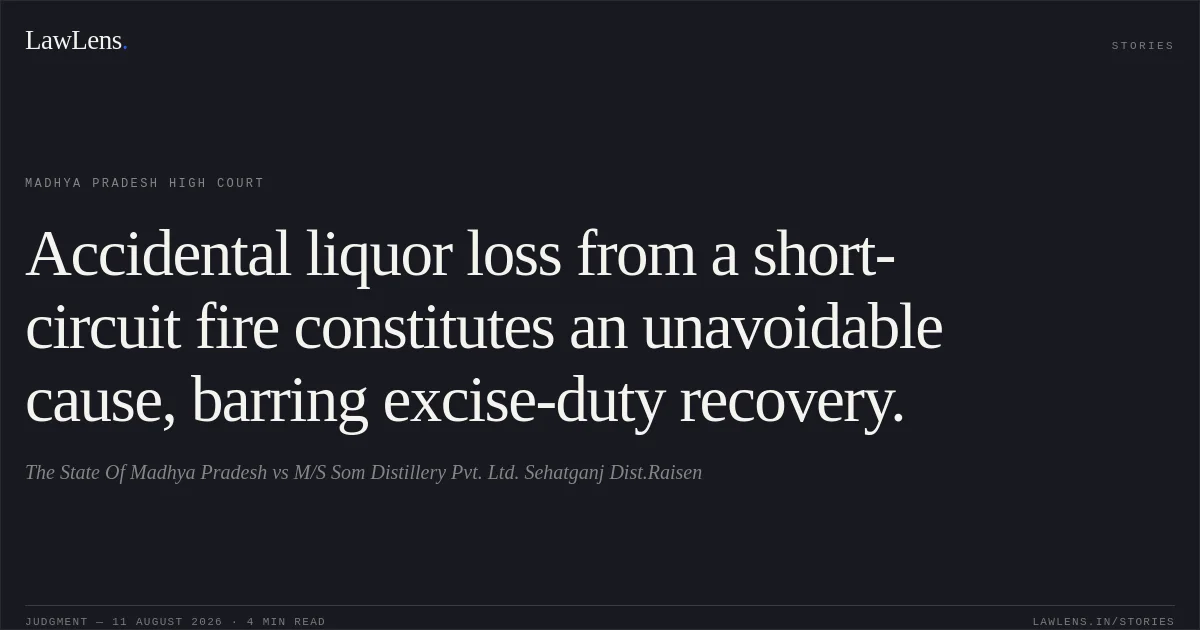
The respondent, a licensed manufacturer of foreign liquor, suffered destruction of 20,993.22 proof litres of liquor in a fire caused by an electrical short circuit at its bottling plant on 13.06.2007.
Source reference: para. 2Following CAG audit objections, the Commissioner of Excise demanded Rs. 38,41,409/- as excise duty on the destroyed liquor, holding that the M.P. Foreign Liquor Rules, 1996 did not exempt such loss from duty.
Source reference: paras. 2, 9The respondent disputed the quantity, calculation, rate of duty, and liability, asserting that the loss resulted from an unavoidable accidental fire and that no negligence or deliberate conduct was involved.
Source reference: paras. 2, 11, 16, 18By order dated 29.09.2010, the Commissioner confirmed the demand. On appeal under Section 62(2)(c) of the M.P. Excise Act, the Board of Revenue, by order dated 19.07.2012, set aside the demand after finding that the loss was caused by an accidental fire arising from a short circuit and fell within “unavoidable causes” under Rule 19(2).
Source reference: para. 2The State challenged the Board’s order under Article 226 of the Constitution.
Source reference: no citationIssues
1. Whether the destruction of foreign liquor in an accidental fire caused by a short circuit constituted loss due to an “unavoidable cause” under Rule 19(2) of the M.P. Foreign Liquor Rules, 1996, so as to relieve the respondent from the disputed liability?
Source reference: paras. 20–232. Whether the Board of Revenue’s finding that the fire was accidental and not attributable to negligence, diversion, or deliberate conduct was perverse or otherwise amenable to interference under Article 226?
Source reference: paras. 23, 28–303. Whether the substituted Rule 19, which reduced the rigour of the penalty provisions, was applicable to pending proceedings?
Source reference: paras. 12–15, 254. Whether the disputed computation, classification, rate of duty, and alleged denial of natural justice warranted interference with the Board’s order?
Source reference: paras. 16–18, 26–27Law Applied
The Court applied Article 226 of the Constitution, under which findings of fact recorded by a final statutory appellate authority are ordinarily not interfered with unless they are unsupported by evidence, perverse, or vitiated by jurisdictional error.
Source reference: paras. 28–30It considered the M.P. Excise Act and Rule 19(2) of the M.P. Foreign Liquor Rules, 1996, including the statutory treatment of losses caused by “unavoidable causes” such as fire or accident.
Source reference: paras. 4, 14, 22The Court recognized that the claimant ordinarily bears the burden of establishing entitlement to a statutory exemption or benefit, and referred to Commissioner of Customs v. Dilip Kumar & Co., (2018) 9 SCC 1 and Novopan India Ltd. v. Collector of Central Excise, 1994 Supp (3) SCC 606 on strict construction of fiscal exemptions.
Source reference: paras. 6, 24However, it held that strict interpretation does not permit the Court, in writ jurisdiction, to reassess factual findings made by the competent appellate authority.
Source reference: para. 24Relying on Pernod Ricard India Pvt. Ltd. v. State of M.P., AIR 2024 SC 3143, the Court held that the substituted Rule 19, being beneficial and reducing the penalty burden, applies to pending proceedings.
Source reference: para. 25The Court also referred to Kranti Associates Pvt. Ltd. v. Masood Ahmed Khan, (2010) 9 SCC 496, concerning the duty of quasi-judicial authorities to provide reasoned orders, and Khoday Distilleries Ltd. v. State of Karnataka, (1995) 1 SCC 574, regarding the statutory nature of the privilege to manufacture and trade in liquor.
Source reference: paras. 9, 5Reasoning
The Court held that the occurrence of the fire and its cause—an electrical short circuit—were not disputed by the Department.
Source reference: para. 22The Board of Revenue had examined the record and found no evidence of deliberate destruction, diversion, violation of mandatory safety requirements, known unattended electrical defects, or negligence attributable to the respondent.
Source reference: paras. 20–22Although the State correctly argued that every fire does not automatically constitute an unavoidable cause, the Court emphasized that the determination was fact-specific.
Source reference: paras. 21–23Since the Board, as the final fact-finding authority, had recorded a finding that the fire was accidental and unavoidable, the absence of further electrical inspection or maintenance records did not make that finding perverse.
Source reference: paras. 21–23The principles of strict construction of fiscal exemptions did not authorize the High Court to substitute its own assessment of the evidence in writ proceedings.
Source reference: para. 24The Court further accepted that the substituted Rule 19 was applicable to pending proceedings under the Supreme Court’s ruling in Pernod Ricard.
Source reference: para. 25The objections concerning the quantity, classification, rate of duty, and procedural fairness involved disputed factual matters, and the Board had already annulled the demand; consequently, no ground for interference was established.
Source reference: paras. 26–29Holding
The Court answered the principal issues in favour of the respondent.
It held that the accidental fire caused by a short circuit was properly treated as an “unavoidable cause” under Rule 19(2), and that the Board of Revenue’s factual findings were neither perverse nor legally unsustainable.
Source reference: paras. 22–24, 28–30The Court also held that the substituted Rule 19, which reduced the penalty burden, applied to the pending proceedings.
Source reference: para. 25Finding no jurisdictional error, manifest illegality, or perversity in the Board’s order dated 19.07.2012, the High Court dismissed the writ petition and declined to restore the Commissioner’s demand of Rs. 38,41,409/-.
Source reference: paras. 29–31Acts & Sections Cited
1 provisions across 1 statute referred to in this judgment. Linked provisions open on LawLens.
M.P. Excise Act, 19151
Original Court PDF
The State Of Madhya PradeshvsM/S Som Distillery Pvt. Ltd. Sehatganj Dist.Raisen
Click to open original judgment
Original judgment, available to read, download and summarize on LawLens.in