Facts
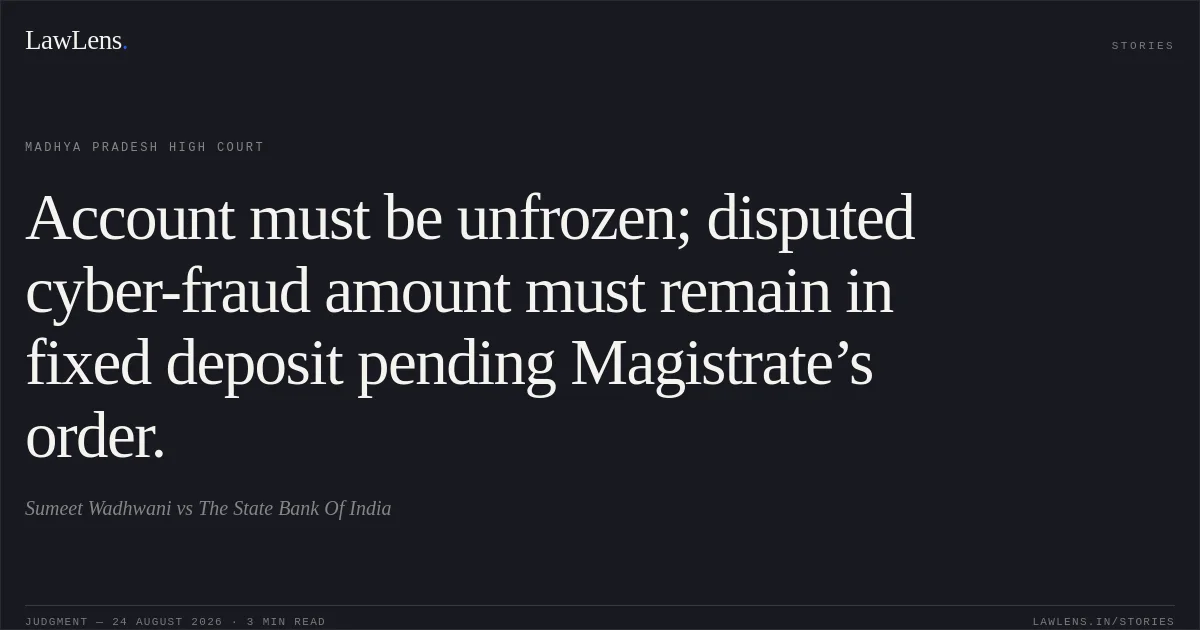
The petitioner maintained Account No. 63000169616 with the State Bank of India, Indore Bank Colony Branch.
Source reference: paras. 1–3The account had been frozen pursuant to information or instructions received from cyber-crime agencies alleging that a sum of ₹25,900 credited to the account was connected with cyber fraud.
Source reference: paras. 1–3The petitioner sought a writ directing immediate defreezing of the account.
Source reference: paras. 1–3Relying on Malcolm Murayis v. State Bank of India, W.P. No. 1100 of 2024, decided on 26 April 2024, the petitioner contended that the bank had frozen the account on the instructions of investigating agencies and that the disputed amount could instead be secured separately.
Source reference: paras. 1–3Issues
Whether the petitioner’s bank account, frozen pursuant to cyber-crime agency communications, ought to be unfrozen while securing the allegedly disputed amount separately.
Source reference: paras. 2–5Whether the disputed amount of ₹25,900 should be retained in a fixed deposit pending orders of the competent Judicial Magistrate and further action by the investigating agency under the applicable law.
Source reference: para. 5Law Applied
The Court applied the principle laid down in Malcolm Murayis v. State Bank of India, W.P. No. 1100 of 2024, decided on 26 April 2024, that where a bank account is frozen on the instructions of cyber-crime or investigating agencies, the entire account need not remain inoperative if the allegedly tainted amount can be segregated and protected in a fixed deposit.
Source reference: Malcolm Murayis, paras. 7–10In Malcolm Murayis, the Court directed that the disputed amount be kept in fixed deposits, subject to liquidation only upon orders of the competent Judicial Magistrate within the stipulated period, while requiring the investigating agency to proceed in accordance with Section 102 of the CrPC or other applicable law.
Source reference: Malcolm Murayis, paras. 7–10The present Court adapted that principle to the applicable provisions of the BNSS and directed that the disputed amount be secured in a fixed deposit for three months.
Source reference: para. 5Reasoning
The Court found the present matter materially analogous to Malcolm Murayis, where accounts had been frozen by banks acting on cyber-crime agency instructions and the Court had protected the allegedly tainted amount without continuing the freeze over the entire account.
Source reference: paras. 3–4Applying that precedent, the Court treated ₹25,900 as the amount requiring preservation and directed that it be placed in a fixed deposit.
Source reference: para. 5This adequately protected the interests of the investigation while avoiding an unnecessary restraint on the petitioner’s operation of the bank account.
Source reference: para. 5The fixed deposit could be liquidated only upon orders of the competent Judicial Magistrate within three months, thereby requiring the police agency to take timely action under the applicable statutory procedure.
Source reference: para. 5Holding
The Court held that the principle laid down in Malcolm Murayis applied mutatis mutandis to the present case.
The petition was disposed of.
Source reference: paras. 5–6The State Bank of India was directed to unfreeze the petitioner’s bank account, while keeping ₹25,900—the amount reported by the cyber-crime agencies—in a fixed deposit.
Source reference: paras. 5–6The amount could be liquidated only pursuant to an order of the competent Judicial Magistrate within three months.
Source reference: paras. 5–6If the police agency failed to proceed in accordance with law within that period, the fixed-deposit amount could also be withdrawn by the petitioner, under intimation to the police agency.
Source reference: paras. 5–6Acts & Sections Cited
1 provisions across 1 statute referred to in this judgment. Each provision opens on LawLens.
Code of Criminal Procedure, 19731
Original Court PDF
Sumeet WadhwanivsThe State Bank Of India
Click to open original judgment
Original judgment, available to read, download and summarize on LawLens.in