Facts
The petitioner filed a complaint under Section 500 of the Indian Penal Code against Respondent No. 2, alleging that Respondent No. 2 had submitted a false application to the police concerning land at Compartment No. 396, Plot No. 2, Village Bandishervan, District Narmada.
Source reference: paras. 3–5; pp. 2–3The petitioner alleged that the contents of the application were subsequently circulated on Facebook by one Vasava Champak, along with photographs, and that related defamatory reports were published in Gujarat Samachar and Sandesh at Respondent No. 2’s instance.
Source reference: paras. 3–5; pp. 2–3The Additional Chief Judicial Magistrate, Dediyapada, dismissed the complaint under Section 203 of the Code of Criminal Procedure, holding that the alleged police application had not been produced, the truth or falsity of the allegations required investigation, and the newspaper reports did not mention the petitioner’s name.
Source reference: para. 6; pp. 4–5The petitioner’s Criminal Revision Application No. 34 of 2022 was dismissed by the Sessions Court, which held that the ingredients of defamation were not prima facie established and that the alleged role of Respondent No. 2 in the publication of the reports had not been shown.
Source reference: para. 7; pp. 5–6The petitioner thereafter filed the present Special Criminal Application seeking quashing of those orders and restoration of the complaint.
Source reference: para. 8; p. 5Issues
Whether the Magistrate and revisional court erred in dismissing the petitioner’s complaint under Section 203 of the Code of Criminal Procedure for want of prima facie material supporting the allegation of defamation under Section 500 of the Indian Penal Code?
Source reference: paras. 6–8, 14; pp. 4–6, 8–9Whether the alleged police application submitted by Respondent No. 2, even if assumed to exist, constituted defamation, or was protected by Exception 8 to Section 499 of the Indian Penal Code as an accusation made in good faith to a person having lawful authority?
Source reference: paras. 11, 15; pp. 6–7, 9Whether the alleged Facebook circulation and newspaper reports could sustain the complaint against Respondent No. 2 in the absence of proof that Respondent No. 2 caused or authorised their publication?
Source reference: paras. 7, 12, 14; pp. 5–8Law Applied
Section 500 of the Indian Penal Code prescribes punishment for defamation, while Section 499 defines defamation and its exceptions.
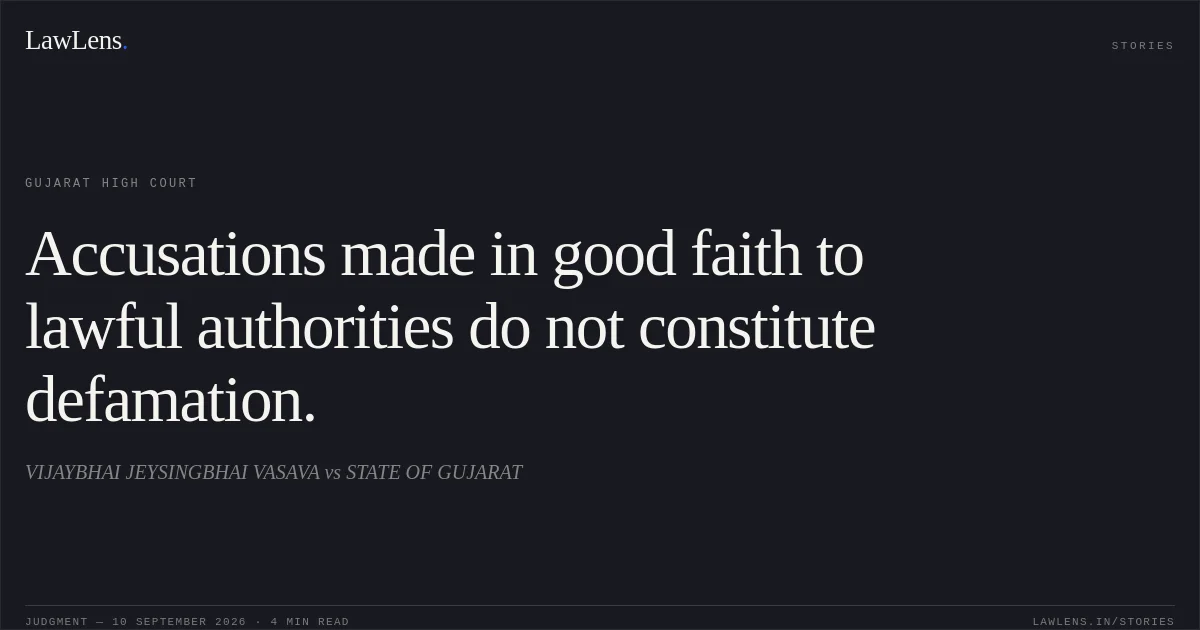
Source reference: paras. 11, 15; pp. 6–7, 9Exception 8 to Section 499 protects an accusation made in good faith to a person having lawful authority over the subject matter of the accusation; therefore, merely submitting a complaint or application to the police does not constitute defamation where the statutory exception applies.
Source reference: paras. 11, 15; pp. 6–7, 9Section 203 of the Code of Criminal Procedure permits dismissal of a complaint where, after considering the complainant’s examination and the materials on record, there is insufficient ground for proceeding.
Source reference: para. 6; p. 4In the exercise of its jurisdiction, the High Court will not interfere where the subordinate courts’ orders are based on the absence of prima facie material and disclose no legal infirmity.
Source reference: paras. 14–16; pp. 8–9Reasoning
The High Court found that the principal document on which the allegation of defamation rested—the alleged application submitted by Respondent No. 2 to the police—had not been produced either before the Magistrate or in revision.
Source reference: para. 14; p. 8Consequently, the Court had no material to assess its contents or determine whether it contained defamatory imputations.
Source reference: para. 14; p. 8The person alleged to have circulated the application on Facebook, Vasava Champak, had not been impleaded before the Magistrate, and the petitioner had not shown that Respondent No. 2 had caused or authorised the Facebook publication or newspaper reports.
Source reference: para. 14; p. 8Further, the newspaper reports did not identify the petitioner as the person responsible for grazing the land.
Source reference: paras. 6, 14; pp. 4, 8Independently, even assuming that Respondent No. 2 had submitted the police application, such a communication to an authority having lawful jurisdiction over the subject matter would fall within Exception 8 to Section 499, provided it was made in good faith.
Source reference: paras. 11, 15; pp. 6–7, 9The concurrent findings of the Magistrate and revisional court were therefore supported by the record and did not warrant interference.
Source reference: paras. 14–16; pp. 8–9Holding
The High Court held that the petitioner failed to establish prima facie material constituting defamation under Section 500 of the Indian Penal Code.
The alleged police application was not produced, the petitioner did not establish Respondent No. 2’s connection with the Facebook circulation or newspaper reports, and the alleged application would in any event potentially fall within Exception 8 to Section 499 if made in good faith.
Source reference: paras. 14–15; pp. 8–9The Special Criminal Application was dismissed, the orders of the Additional Chief Judicial Magistrate, Dediyapada, and the Sessions Court, Narmada at Rajpipla, were not interfered with, the request to restore Enquiry Case No. 2 of 2022 was rejected, and the Rule was discharged.
Source reference: paras. 15–17; p. 9Acts & Sections Cited
3 provisions across 2 statutes referred to in this judgment. Each provision opens on LawLens.
Indian Penal Code, 18602
Code of Criminal Procedure, 19731
Original Court PDF
VIJAYBHAI JEYSINGBHAI VASAVAvsSTATE OF GUJARAT
Click to open original judgment
Original judgment, available to read, download and summarize on LawLens.in