Facts
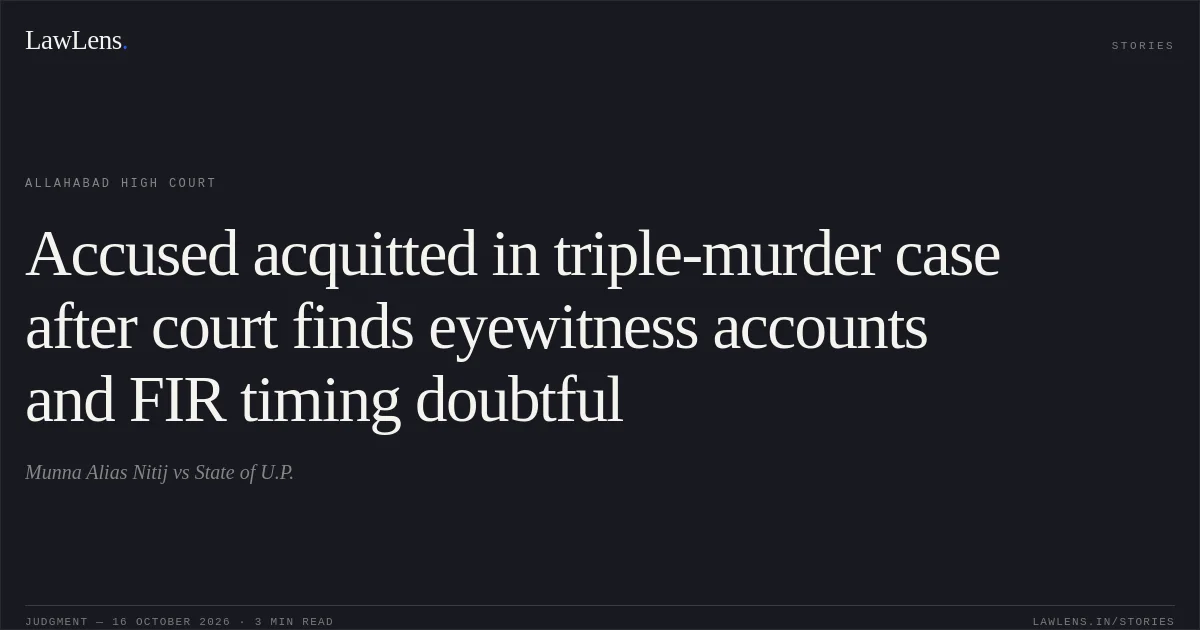
The prosecution alleged that, on 3 July 2012, a group of armed assailants stopped an Indica car carrying Ravi Kumar, Shashi Kumar, Ramesh Chandra and Ram Rishi near a brick kiln, shot at them, and set the car on fire.
Source reference: paras. 3–4, 21–24, 62–63The FIR named eight accused and referred to two unknown persons; the prosecution case at trial included additional accused and a third vehicle. The Sessions Court convicted the appellants under Sections 147, 148, 307/149, 302/149 and 435 IPC, Section 7 of the Criminal Law Amendment Act, and Sections 25/27 of the Arms Act. The appellants challenged their convictions; the State also appealed against acquittals, and the informant sought leave to appeal
Source reference: paras. 3–4, 21–24, 62–63Issues
1. Whether the prosecution eyewitnesses’ presence and credibility were established despite contradictions and alleged police tutoring.
Source reference: para. 79(1)2. Whether the eyewitness account of the shooting was irreconcilable with the post-mortem evidence.
Source reference: para. 79(2)3. Whether the FIR was ante-timed, including in light of the evidence about when the report was completed and the delay in its transmission to the Magistrate.
Source reference: para. 79(3)4. Whether the additions to the prosecution account—including a third vehicle and further accused—and the absence of a Test Identification Parade undermined the convictions.
Source reference: para. 79(4)5. Whether the physical condition of the recovered Bolero supported or contradicted the alleged collision and fire.
Source reference: para. 79(5)6. Whether the recovery memos could be relied upon given PW-2’s evidence that his signatures were obtained the following day.
Source reference: para. 79(6)Law Applied
The Court considered the offences charged under Sections 147, 148, 307/149, 302/149 and 435 IPC, Section 7 of the Criminal Law Amendment Act, and Sections 25/27 of the Arms Act.
Source reference: paras. 81–85It relied on the principle that eyewitness testimony must be assessed for consistency and credibility, citing Rai Sandeep @ Deepu v. State (NCT of Delhi), (2012) 8 SCC 21, and other authorities.
Source reference: paras. 81–85It applied Solanki Chimanbhai Ukabhai v. State of Gujarat, (1983) 2 SCC 174, and Thaman Kumar v. State of Union Territory of Chandigarh, (2003) 6 SCC 380, for the principle that medical evidence may discredit ocular testimony where it renders the alleged manner of injury impossible.
Source reference: paras. 90–92On FIR timing and dispatch, it relied on Thulia Kali v. State of Tamil Nadu, (1972) 3 SCC 393, and Meharaj Singh v. State of U.P., (1994) 5 SCC 188, among other authorities.
Source reference: paras. 95–98It also considered Kanan v. State of Kerala, (1979) 3 SCC 319, on first-time in-court identification of previously unknown accused without a prior identification parade, and Subramanya v. State of Karnataka, 2022 SCC OnLine SC 1400, on proof of recoveries under Section 27 of the Evidence Act.
Source reference: paras. 102, 108Reasoning
The Court found that the eyewitnesses gave materially conflicting accounts of the seating arrangement, the survivors’ escape routes, and the number of vehicles.
Source reference: paras. 86–89It also considered PW-2’s evidence that police told him to describe a third vehicle because fourteen accused could not have travelled in two, and the evidence of the village Pradhan and investigating officer about the absence of relatives at the scene.
Source reference: paras. 86–89The Court held that the account of Shashi being shot from behind while fleeing was inconsistent with the post-mortem findings of frontal entry wounds with blackening and tattooing.
Source reference: paras. 93–94It further treated the reported completion of the written report in the evening and its delayed transmission to the Magistrate as supporting the appellants’ claim that the FIR was ante-timed.
Source reference: paras. 99–100The additional vehicle and accused, the absence of a test identification parade for persons not previously known, the Bolero’s recorded condition, and PW-2’s evidence that signatures on recovery memos were obtained later cumulatively weakened the prosecution case.
Source reference: paras. 103–110, 112Holding
The Court held that the prosecution had not proved the appellants’ guilt beyond reasonable doubt.
It allowed the criminal appeals, set aside the convictions and sentences, acquitted the appellants, and directed their release unless required in another case.
Source reference: paras. 113–115It dismissed the State’s Government Appeals and the informant’s application for leave to appeal.
Source reference: para. 116Acts & Sections Cited
12 provisions across 3 statutes referred to in this judgment. Each provision opens on LawLens.
Code of Criminal Procedure, 19734
Indian Penal Code, 18606
Arms Act, 19592
Original Court PDF
Munna Alias NitijvsState of U.P.
Click to open original judgment
Original judgment, available to read, download and summarize on LawLens.in